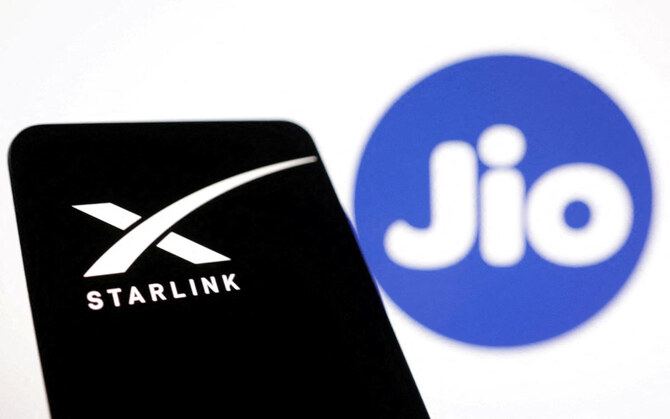
NEW DELHI: Elon Musk’s Starlink signed an agreement with India’s top telecom operator on Wednesday to bring the US satellite Internet giant’s services to the world’s most populous country, a day after announcing a similar agreement with the country’s second-largest provider.
The deals with Reliance Jio and Bharti Airtel, which together control more than 70 percent of India’s telecom market, could help bring Internet connections to millions of people who live in remote areas.
But they depend on Starlink obtaining government approval to enter India. The partnership announcements come weeks after Indian Prime Minister Narendra Modi met with Musk in Washington.
Deals will put Starlink devices in stores across India
Wednesday’s deal will allow Starlink to stock and sell its equipment in Jio’s thousands of retail outlets, giving the company direct distribution across India. Starlink will also use its partners’ network infrastructure to enhance satellite coverage across India, where a vast population still lacks Internet access.
A statement from Jio said Starlink will complement the Indian telecom giant’s broadband services “by extending high-speed Internet to the most challenging of locations in a quick and affordable manner.”
Jio will also provide installation and activation support for the Starlink devices, the statement said.
India has long been out of reach for Musk’s companies
Jio has long been at odds with Starlink over methods for awarding satellite service spectrum in India.
Jio had urged Indian government to grant spectrum for satellite services through auctions to ensure fair competition, while Musk wanted spectrum to be allocated administratively, in line with global trends. Indian government eventually decided to assign satellite spectrum.
It is unclear whether Starlink’s license application has already been approved, but local media reports suggest it is nearing initial regulatory approval.
Last November, India’s telecoms minister, Jyotiraditya Scindia, said Starlink had yet to comply with security norms, and that a license would be issued to the company only after it meets all the requirements.
Yet the biggest challenge Starlink faces in India could be pricing.
Mobile data in India is among the world’s cheapest — Ambani’s Jio once even gave it for free with mobile plans.
Tesla, Musk’s electric car maker, has also faced hurdles in India due to the country’s high import duties on vehicles, but it could be getting a boost as well. The copmany began hiring in India last month and has also signed a lease deal to open its first showroom in Mumbai, according to local news reports.
Starlink could help India bring millions online in remote areas
At least 40 percent of the country’s more than 1.4 billion people don’t have access to the Internet. Cheap satellite broadband is needed to bridge this gap, particularly in India’s vast remote and mountainous rural areas.
Starlink has at least 6,900 active satellites orbiting Earth that provide low-latency broadband, including to areas where Internet previously has been completely unavailable.


![]()

Musk’s Starlink could help remote parts of India get online under deals with telecoms players
Short Url
https://arab.news/y5wvw
Musk’s Starlink could help remote parts of India get online under deals with telecoms players
- Deals with Reliance Jio and Bharti Airtel, which together control more than 70 percent of India’s telecom market, could help bring Internet connections to millions of people who live in remote areas


Latest updates


© 2026 SAUDI RESEARCH & PUBLISHING COMPANY, All Rights Reserved And subject to Terms of Use Agreement.