Pakistani architect Yasmeen Lari turns down Israel’s Wolf Prize over ‘genocide’ in Gaza

In this picture taken on May 4, 2023, architect Yasmeen Lari, the head of Heritage Foundation of Pakistan, speaks during an interview with AFP at her garden in Karachi. (AFP)
Short Url
Updated 12 March 2025
Follow

Pakistani architect Yasmeen Lari turns down Israel’s Wolf Prize over ‘genocide’ in Gaza

  • The Wolf Prize is an international award granted in Israel to scientists, artists for achievements in ‘interest of mankind and friendly relations among people’
  • Lari, who works in the intersection of architecture and social justice, says declining the award was ‘the very least I could do’ given the situation in Gaza

KARACHI: Renowned Pakistani architect Yasmeen Lari has refused to accept the prestigious Wolf Prize 2025 in the field of architecture over the “continuing genocide” of Palestinians in Gaza, she confirmed on Tuesday.
The Wolf Prize is an international award granted in Israel since 1978 to living scientists and artists for their “achievements in the interest of mankind and friendly relations among people.”
It is awarded in six fields, including agriculture, chemistry, mathematics, medicine, physics, and an arts prize that rotates between architecture, music, painting and sculpture.
Lari, who works in the intersection of architecture and social justice, wrote to Wolf Foundation that she was grateful for the honor, but could not accept it “in view of the unfortunate continuing genocide in Gaza.”
“I declined the award because of the ongoing genocide in Gaza, a reason I explicitly stated in my response to them. Given the current situation in Gaza, accepting the award was out of the question,” she told Arab News.
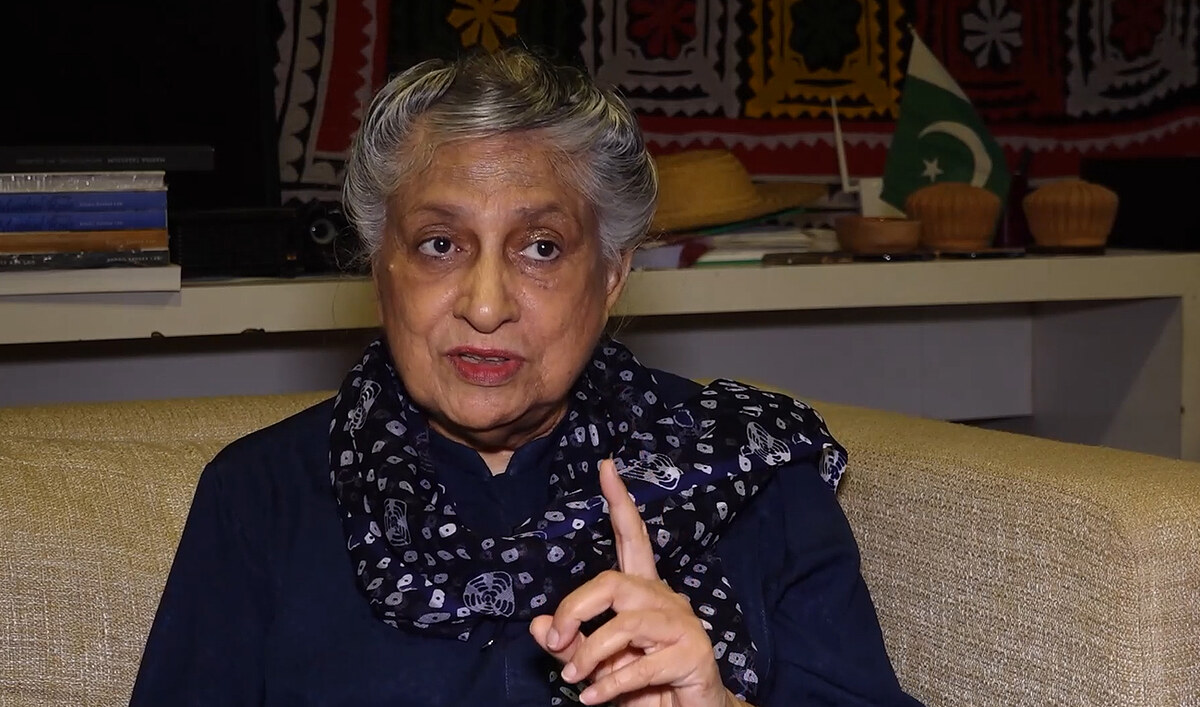


Pakistani architect Yasmeen Lari speaks during an interview with Arab News at her office in Karachi on July 20, 2024. (AN Photo/File)

The development came as Israeli fire killed eight people in the Gaza Strip in the past 24 hours, Palestinian officials said on Tuesday, even as a fragile ceasefire with Hamas has largely held. Israel last week suspended supplies of goods and electricity to the territory of more than 2 million Palestinians as it tries to pressure Hamas to accept an extension of the first phase of their ceasefire, which ended on March 1.
Israel wants Hamas to release half of the remaining hostages in return for a promise to negotiate a lasting truce. Hamas instead wants to start negotiations on the ceasefire’s more difficult second phase, which would see the release of remaining hostages from Gaza, the withdrawal of Israeli forces and a lasting peace. Hamas is believed to have 24 living hostages and the bodies of 35 others.
Israel’s war on Gaza, which began after Oct. 7, 2023 attacks by Hamas, has killed more than 48,000 Palestinians, a majority of them women and children. The 15-month Israeli military campaign has laid waste to the Gaza Strip, destroying hospitals, schools and entire residential neighborhoods.
“Declining the award was the very least I could do,” Lari told Arab News.

Lari is known for her socially conscious works on humanitarian grounds and for catering to the spatial needs of Pakistan’s most marginalized communities. She co-founded the Heritage Foundation of Pakistan with her husband, Suhail Zaheer Lari, in 1980, and has constructed over 50,000 sustainable self-built shelters and over 80,000 ecological cooking stoves using natural materials like mud, lime, and bamboo.
The philanthropic architect, who advocates that traditional construction techniques can lead to low-impact carbon-neutral buildings, was awarded the prestigious Royal Institute of British Architects Royal Gold Medal in 2023 for her humanitarian work.


EU, Pakistan sign €60 million loan agreement for clean drinking water in Karachi

Updated 17 December 2025
Follow

EU, Pakistan sign €60 million loan agreement for clean drinking water in Karachi

  • Project will finance rehabilitation, construction of water treatment facilities in Karachi city, says European Investment Bank
  • As per a report in 2023, 90 percent of water samples collected from various places in city was deemed unfit for drinking

ISLAMABAD: The European Investment Bank (EIB) and Pakistan’s government on Wednesday signed a €60 million loan agreement, the first between the two sides in a decade, to support the delivery of clean drinking water in Karachi, the EU said in a statement. 

The Karachi Water Infrastructure Framework, approved in August this year by the EIB, will finance the rehabilitation and construction of water treatment facilities in Pakistan’s most populous city of Karachi to increase safe water supply and improve water security. 

The agreement was signed between the two sides at the sidelines of the 15th Pak-EU Joint Commission in Brussels, state broadcaster Radio Pakistan reported. 

“Today, the @EIB signed its first loan agreement with Pakistan in a decade: a €60 million loan supporting the delivery of clean drinking water for #Karachi,” the EU said on social media platform X. 

Radio Pakistan said the agreement reflects Pakistan’s commitment to modernize essential urban services and promote climate-resilient infrastructure.

“The declaration demonstrates the continued momentum in Pakistan-EU cooperation and highlights shared priorities in sustainable development, public service delivery, and climate and environmental resilience,” it said. 

Karachi has a chronic clean drinking water problem. As per a Karachi Water and Sewerage Corporation (KWSC) study conducted in 2023, 90 percent of water from samples collected from various places in the city was deemed unsafe for drinking purposes, contaminated with E. coli, coliform bacteria, and other harmful pathogens. 

The problem has forced most residents of the city to get their water through drilled motor-operated wells (known as ‘bores’), even as groundwater in the coastal city tends to be salty and unfit for human consumption.

Other options for residents include either buying unfiltered water from private water tanker operators, who fill up at a network of legal and illegal water hydrants across the city, or buying it from reverse osmosis plants that they visit to fill up bottles or have delivered to their homes.

The EU provides Pakistan about €100 million annually in grants for development and cooperation. This includes efforts to achieve green inclusive growth, increase education and employment skills, promote good governance, human rights, rule of law and ensure sustainable management of natural resources.