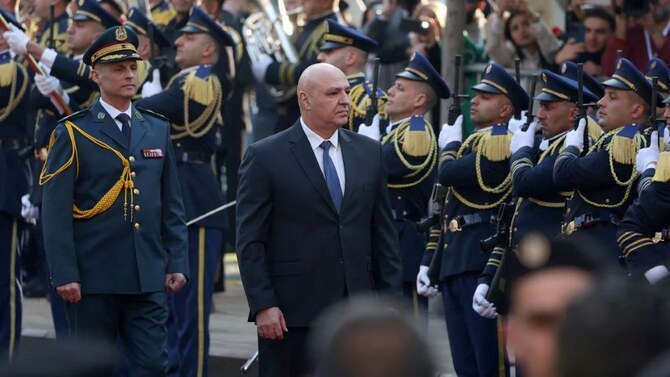

BEIRUT: Lebanese President Joseph Aoun requested the population on Monday to view Lebanon as a state for all rather than continue to view it through sectarian and partisan lenses.
Aoun cautioned his visitors during a meeting that “if we remain prisoners of our narrow perspectives, we will lose many opportunities available to us.”
He added: “We have significant Arab and international support, and everyone claims to be with us. However, Lebanon is required to implement the necessary reforms.”
Aoun’s statement followed controversial remarks by Hezbollah’s Secretary-General Sheikh Naim Qassem during an interview on the group’s Al-Manar channel.
He said: “The resistance will not cease and will not relinquish its capabilities in the face of Israeli aggression and occupation.”
He added: “The ceasefire agreement with Israel includes the phrase ‘south of the Litani River’ five times, which is the framework we must rely upon.”
He stressed that “the resistance views Israel as a threat to Lebanon and that there is no objection to the army and the state defending the country.”
He added: “The resistance has the right to continue its efforts to protect Lebanon. We do not consider the president’s remarks regarding the exclusivity of weapons to be directed at us.”
Qassem criticized Foreign Minister Youssef Rajji, who is affiliated with the Lebanese Forces team in the government.
The Lebanese Forces Party said that Hezbollah had not learned from past experiences and added that the group continued to act on the same logic despite tragedies and destruction.
The party said that Rajji had highlighted a truth understood by decision-makers: reconstruction of southern Lebanon would only occur under a state that had sole authority over war, controlled weapons, and maintained sovereignty over all Lebanese territory.
The statement also said that the international community was reluctant to rebuild what Hezbollah might destroy again.
It added: “Sheikh Qassem understands that reconstruction is an international responsibility.”
Mustafa Alloush, a former minister, told Arab News: “Hezbollah is ignoring what it knows to delay the surrender.”
Alloush added that Hezbollah had said that “it exists and will remain, and perhaps the party is counting on certain circumstances and changes.”
Alloush added: “When Hezbollah hands over its weapons, it cannot transform into a political party, as the justification for its establishment is primarily military, and it has no choice but to be stubborn to survive.
“The party is trying to continue with full encouragement from Iran, and perhaps it is counting on returning to what it used to be through the events on the Syrian coast. This is how I understand Naim Qassem’s stubbornness.
“But, in return, the new Lebanese government must not resort to settlements that would set back its launch and undermine the confidence granted to it by parliament.”
Alloush said Hezbollah’s supporters “must hold the party accountable when they see the procrastination in rebuilding the human and material losses caused by the war and that Hezbollah destroyed."
The Lady of the Mountain Gathering cautioned against Hezbollah’s “denial of its defeat and its attempt to evade responsibility by refusing to surrender its illegal weapons to the state, in violation of both the constitution and international legitimacy resolutions. They seem to believe that time is on their side.”
The meeting said that Hezbollah was once again placing its members and the entire Lebanese population in a dangerous situation.
It added: “By refusing to hand over its weapons to the state, Hezbollah is providing Israel with a pretext to threaten Lebanon’s safety. Surrendering these weapons to the state, on the other hand, is essential for the reconstruction and safety of Lebanon.”
The meeting urged Lebanon’s president, parliamentary speaker, and prime minister to “exert maximum diplomatic pressure to ensure the complete withdrawal of Israeli forces from Lebanese territories and to compel Hezbollah to implement Resolution 1701 across Lebanon. The failure of any party to do so could lead to Lebanon’s downfall.”
Meanwhile, across the Lebanese border, Israeli media reported that the UN Special Coordinator for Lebanon Jeanine Hennis-Plasschaert had been informed by Israeli Foreign Minister Gideon Moshe Sa’ar that Iran was smuggling funds to Hezbollah.
Hennis-Plasschaert is overseeing the implementation of the ceasefire agreement and UN Resolution 1701 from Tel Aviv.
More than a week ago, Lebanese airport security thwarted an attempt to smuggle $2.5 million.
The money was being transported by a passenger who claimed that an Iranian had given him the funds. The passenger remains in custody for attempting to smuggle undeclared money.
Additionally, about two months ago, Lebanon’s border security agencies pursued people who had abandoned $4 million in bags at an illegal crossing point.
A Lebanese judicial source informed Arab News that the situation likely forms part of Iran’s ongoing efforts to provide financial support to Hezbollah.