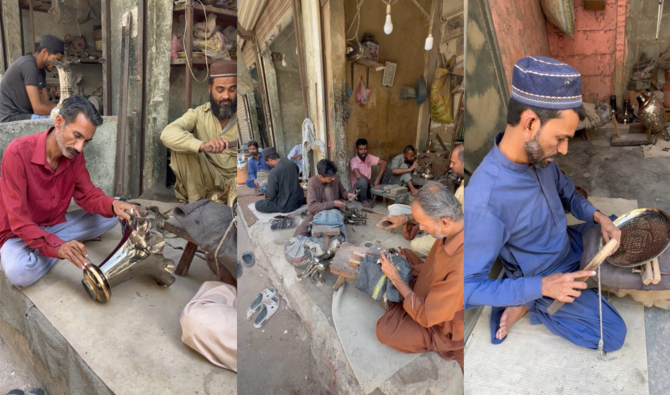

KARACHI: Brass, silver and copper animal figurines, plates and vases were on display earlier this month on the side of a narrow, sequestered alley in the southern Pakistani port city of Karachi.
The slender winding street, not visible from the main road, is known as ‘Peetal Gali,’ or Brass Market, once a go-to area for anyone looking for utensils and decoration pieces made from brass and copper.
A bustling home for decades to over 70 shops and run by artisans who had originally migrated from Moradabad in India after the partition of the Indian subcontinent in 1947, today Peetal Gali in the Gulbahar area of Karachi is dying a slow death. Only seven or eight shops remain, while the others have shut down due to dwindling demand for brass wares, inflation and frequent power outages.
“We have been working for 22–23 years, but in these 22–23 years, this craft has been completely ruined,” brass artisan Sharjeel Khan, 38, told Arab News as he carved a floral design on a vase. “There used to be a high demand for this work. Tourists from abroad, the British and Chinese used to come.”
Khan’s Khan’s family migrated from Moradabad after the 1947 partition and set up a brass shop at Peetal Gali.
“Whatever style you ask for [in brass] we can make it in that style. Even if you want figurines made, like an animal or a bird, we can craft it for you by hand,” he boasted.
But now there are no customers.
“There are neither shops nor customers, and only about 50 to 60 craftsmen remain here,” Khan lamented, saying he made less than $5 a day and would not encourage others to take up this line of work.
Wilayat Shah, a shopkeeper who has been in the brass business since 1993, also blamed unreliable power supply for the decline of the industry.
An energy network desperately in need of an upgrade can lead to frequent blackouts and electricity rationing in Pakistan. Millions of Pakistanis suffer partial blackouts almost daily, including scheduled “load shedding” power cuts aimed at conserving electricity.
“The main reason is electricity, there is no power here,” Shah told Arab News. “From morning till evening, we only get electricity for about 4.5 hours. How can work be done in such conditions?“
The lack of “fair” wages for brass craftsmen and inflation had also forced many to leave the profession.
Pakistan’s annual inflation rate slowed to 1.5 percent in February, the lowest in nearly a decade, below the finance ministry’s estimates and down from a multi-decade high of around 40 percent in May 2023.
“Some started working in factories, some became rickshaw drivers, and others started selling fruits,” Shah said of artisans leaving the profession.
Muhammad Shamim, 67, a veteran trader born in Karachi to a family of Moradabad craftsmen, remembered when exports of brassware was thriving and locals and foreigners alike flocked to Peetal Gali.
He blamed multiple factors for the decline of Peetal Gali, mainly the fall of brass exports to Europe due to the withdrawal of NATO forces from Afghanistan, and an increase in the costs of materials due to inflation.
After the 9/11 terror attacks on the United States and the subsequent invasion of Afghanistan which borders Pakistan, NATO assumed command of the International Security Assistance Force in Afghanistan in 2003, initially focused on securing Kabul, but later expanded its role and troop presence to cover the entire country, culminating in a peak of over 130,000 troops. NATO troops withdrew with US forces after the Afghan Taliban took Kabul in 2021.
“When NATO forces were here, they used to buy a lot of our products, and the business thrived,” Shamim explained. “But ever since the Afghan Taliban took over, demand has dropped significantly.”
But the trader was hopeful that the market could be revived if craftsmen were provided with the necessary infrastructure and power supply was ensured.
Khan, the brass worker, however, was less optimistic.
“If someone comes and asks us to teach this craft to their children, we refuse,” he said. “Why should such an art form not disappear when it cannot help a person sustain his household?”