

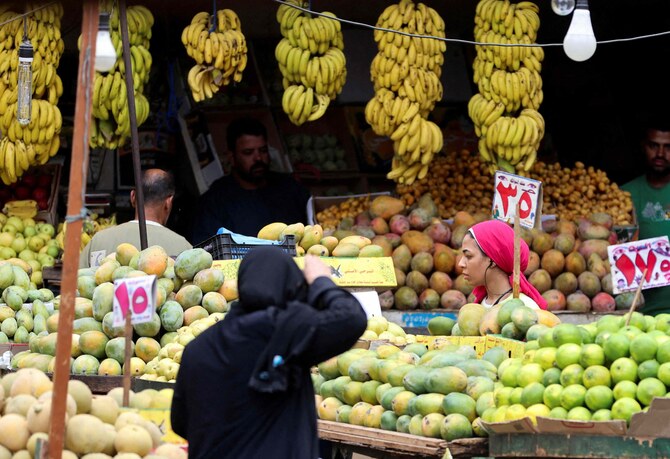
Egypt’s annual inflation drops sharply to 12.8%

This marks the fourth time in the last seven months that inflation has slowed, following a period of acceleration that began in August 2023. Reuters
Short Url
Updated 10 March 2025
Follow

Egypt’s annual inflation drops sharply to 12.8%

  • Slowdown mainly attributed to an 8.2 percent dip in vegetable prices

RIYADH: Egypt’s annual urban consumer price inflation fell sharply to 12.8 percent in February, down from 24 percent in January, according to the latest data from the country’s statistics agency.

The Central Agency for Public Mobilization and Statistics  attributed the decline to the base effect, noting that the exceptionally high price increases observed over the past two years are no longer influencing the inflation rate.

A Reuters survey of 15 analysts had predicted a median inflation rate of 14.5 percent, meaning February’s actual figure was significantly lower than anticipated.

On a month-to-month basis, consumer prices increased by 1.4 percent in February, a slight decrease from January’s 1.5 percent rise. This marks the fourth time in the last seven months that inflation has slowed, following a period of acceleration that began in August 2023.

Last year’s inflationary pressures were primarily driven by rising fuel prices, higher public transportation fares — including for trains and the metro—and a 300 percent hike in the price of subsidized bread in May, marking the first such increase in over 30 years.

The February slowdown was mainly attributed to an 8.2 percent drop in vegetable prices, while costs for water, electricity, and gas remained stable. On the other hand, grain and bread prices rose by 0.8 percent, meat and poultry saw a 3.2 percent increase, and fruit prices climbed by 3 percent.

Egypt’s economic foundations have been showing positive results. The banking sector saw a significant 26.9 percent increase in total deposits for the 2023/2024 fiscal year, compared to the previous 12-month period.

Earlier in February, CAPMAS reported that total banking deposits reached 11.99 trillion Egyptian pounds ($237 billion), reflecting a surge in banking activity across various sectors.

The country’s fiscal year runs from July 1 to June 30 of the following year.

This growth in banking deposits comes amid high inflation, which peaked at 38 percent in September 2023, prompting both individuals and businesses to deposit more money in banks as a safeguard against currency devaluation.

The central bank’s attractive interest rates, along with financial inclusion initiatives under Egypt's Vision 2030 plan, also played a significant role in encouraging deposit growth.

CAPMAS data indicated that the household sector dominated Egypt’s banking deposits, accounting for 7.03 trillion pounds—an increase of 27.5 percent from the previous year. Individual depositors represented 95.9 percent of household deposits, underscoring strong saving trends among Egyptians. Overall, the household sector controlled 58.6 percent of total banking deposits.

Meanwhile, the business sector also experienced notable growth, with deposits rising to 1.99 trillion pounds—up 37.6 percent from the previous fiscal year.



Saudi Arabia’s oil sector skills to help Kingdom evolve as a green hydrogen hub, experts say

Updated 28 February 2026
Follow

Saudi Arabia’s oil sector skills to help Kingdom evolve as a green hydrogen hub, experts say

  • Saudi Arabia, having set its net-zero target for 2060, has been heavily investing in the renewable energy sector

RIYADH: Saudi Arabia’s long-proven expertise in the oil industry could help the Kingdom emerge as a global leader in green hydrogen production as the world marches toward a sustainable future, experts told Arab News. 

Saudi Arabia, having set its net-zero target for 2060, has been heavily investing in the renewable energy sector, and with the world’s largest green hydrogen plant, located in Neom, set to become fully operational in 2027. 

The plant will rely entirely on solar and wind energy to power a 2.2 gigawatt electrolyzer, designed to produce hydrogen continuously. 

Speaking to Arab News, Paul Sullivan, an energy and environment expert at Johns Hopkins University, said that Saudi Arabia could use its vast experience in project management and execution in the traditional energy sector to become a leader in green hydrogen production. 

“Many skills could be transferred from traditional fuels, such as oil and gas, to green hydrogen. Experience and skills in project development could be transferred,” said Sullivan. 

He added: “The knowledge gained from developing traditional energy projects at Saudi Aramco and its contractors puts Saudi Arabia at an advantage as it advances its hydrogen projects. AI expertise can be used across energy types and uses. AI could help optimize current and future energy systems, regardless of their nature.” 

Samuele Bellani, managing director and partner at Boston Consulting Group, shared similar views, and said that Saudi Arabia has access to advantageous solar and wind renewable energy, which could help the Kingdom emerge as a global powerhouse in green hydrogen production. 

“This strong competitive advantage, together with Saudi Arabia’s commercial and marketing capabilities, and decades of experience in large-scale gas processing, refining, and project execution can position the country as a key producer and exporter of low carbon hydrogen in the future,” said Bellani. 

The BCG official added that the Kingdom’s expertise in managing complex, capital-intensive projects at scale in the traditional fuel sector provides an invaluable foundation for hydrogen development, where similar skills in engineering, logistics, and international energy trading are essential. 

Green hydrogen, created through electrolysis powered by renewable energy, is seen as a critical component in reducing global carbon emissions, because it produces no greenhouse gases in the production process.

In December, speaking to Al-Eqtisadiah on the sidelines of the Absher Conference, Saudi Arabia’s Minister of State for Foreign Affairs and Climate Envoy Adel Al-Jubeir said that the Kingdom is making steady progress in advancing the circular carbon economy and green hydrogen production as part of broader efforts to address climate challenges through technology and investment. 

The minister added that the Kingdom has made tangible progress in deploying new technologies that support more efficient energy use while expanding the production of alternative and renewable energy sources.

Upgrading existing systems

Sullivan said that infrastructure used in the traditional energy sector, such as pipelines, can be repurposed for the renewable industry, with some required changes to ensure safety and affordability. 

“A wide range of legal, administrative, managerial, engineering, supply chain, policy development, governance, finance, safety and risk management, and economic skills could be transferred. Plumbers, electricians, pipefitters, welders, and other skilled craftspeople can be repurposed and used directly,” said Sullivan. 

He added: “Furthermore, the oil and gas industries already produce hydrogen for their own needs. They have experience in developing ports, pipelines, and other logistical systems, as well as international trading and supply chain networks. That experience will not go to waste.” 

Bellani said that Saudi Arabia can adapt existing gas, power, and industrial infrastructure to support blue hydrogen with carbon capture and storage, and green hydrogen powered by renewables. 

The BCG official added that export infrastructure — including ports, storage tanks, and shipping — could be upgraded to handle hydrogen carriers such as ammonia. 

Carbon capture and storage is central to Saudi Arabia’s blue hydrogen strategy.

Samuele Bellani, managing director and partner at Boston Consulting Group

Industrial zones and pipelines can be repurposed or expanded to integrate hydrogen production, conversion, and export at scale provided materialization of demand and ability to secure long term offtake agreements. 

“This adaptive approach maximizes the value of existing investments while minimizing development timelines. The Kingdom’s world-class port facilities and industrial complexes provide a strong foundation that can be enhanced rather than rebuilt, offering significant cost and time advantages over competitors starting from scratch,” he added. 

According to Bellani, carbon capture and storage is central to Saudi Arabia’s blue hydrogen strategy, enabling production from natural gas while significantly reducing lifecycle carbon dioxide emissions. 

“The Kingdom’s large geological storage potential and experience with CO2 injection support the development of high-capture-rate projects at scale. This technology serves as a crucial bridge, allowing Saudi Arabia to leverage its existing natural gas resources while building toward a fully renewable hydrogen economy,” said Bellani. 

He added: “The Kingdom’s geological advantages — including extensive underground formations suitable for CO2 storage — provide a natural competitive edge in blue hydrogen production that few other nations can match.” 

The strategic Vision 2030 agenda

According to Sullivan, Saudi Arabia’s Vision 2030 economic diversification program, as well as the initiatives taken by the Kingdom’s sovereign wealth fund, is playing a crucial role in materializing the nation’s hydrogen goal. 

Sullivan said that Vision 2030 is the umbrella for strategic policies, including building new supply chains and new visions toward trade and commerce, as well as economic, financial, and employment diversification. 

The Public Investment Fund is funding such activities, including the giant Neom and Yanbu green hydrogen projects, as well as the development of green hydrogen hubs.

“PIF green bonds help reduce costs and make financing green hydrogen projects cheaper than they would otherwise be. The Saudi Green Initiative provides direction and policy developments on climate and environmental policies that could help advance green hydrogen in tandem with Vision 2030 and the PIF’s work,” said Sullivan. 

He added: “Without a proper strategic confluence of all three, many of today’s and future green hydrogen projects could face a more difficult future.”

Bellani shared a similar opinion and said that the Vision 2030 program’s strategic framework ensures that hydrogen development receives the highest levels of government support and investment priority. 

The BCG official added that Saudi Arabia can reduce its dependence on oil revenues while developing new industrial capabilities and contributing to global decarbonization efforts by building a valuable hydrogen economy. 

“Vision 2030 promotes economic diversification, industrial localization, and energy transition. All these three objectives align with low carbon hydrogen value proposition,” said Bellani. 

Target countries

According to Sullivan, Europe will be one of the priority markets for Saudi Arabia as it ramps up green hydrogen production. 

“Saudi Arabia’s green hydrogen has better economics than many other countries’, given the costs of electricity production and offtake contracts under concessional regimes, as well as its natural endowments for green energy,” said Sullivan. 

He added: “Even with shipping costs included, Saudi green hydrogen could be competitive in Europe in many circumstances.” 

Bellani echoed similar sentiments and said that the demand for Saudi Arabia’s green hydrogen will be driven by demand for both blue and green hydrogen to meet decarbonization targets and energy security needs. 

East Asian countries such as Japan and South Korea are also key markets due to their limited domestic energy resources and strong interest in hydrogen and ammonia imports. 

The BCG official further said that additional demand may emerge from other Asian and emerging economies seeking affordable, low-carbon fuels in the future. 

Potential challenges and combat measures

Speaking to Arab News, Safak Yucel, associate director of business of sustainability initiative at McDonough School of Business Georgetown University Dubai, said finding buyers could be one of the obstacles Saudi Arabia faces in its hydrogen journey. 

“The biggest challenge is driving the cost down sufficiently so that there would be a meaningful scale of buyers. This would require significant investments not only in the infrastructure but also research and development,” said Yucel. 

Bellani said that the challenges Saudi Arabia could face include ensuring global demand certainty, securing long-term offtake contracts, and remaining cost-competitive as international hydrogen markets evolve. 

The BCG official added that scaling CCS for blue hydrogen and renewable capacity, water supply, and electrolysis for green hydrogen requires significant coordination and capital.

Regulatory alignment, certification complexity, and infrastructure build-out timelines also pose execution risks. 

“These challenges highlight the complexity of transforming an entire energy system while building new international markets simultaneously. However, Saudi Arabia’s experience managing large-scale energy projects and its substantial financial resources position the Kingdom well to address these implementation hurdles systematically,” added Bellani. 

Yucel said that Saudi Arabia could explore international collaboration, to evolve as a market leader in the hydrogen energy ecosystem. 

“Many companies are interested in investing in green hydrogen and several research groups across the globe are working on further advancing the technology. Such collaborative efforts would be vital in driving costs down,” said Yucel. 

Bellani elaborated and said that there are strong opportunities for collaboration across the value chain, including joint ventures for blue and green hydrogen projects, offtake agreements, and infrastructure development. 

According to him, international energy companies, technology providers, and engineering firms can contribute expertise in CCS, electrolysis, ammonia, and logistics, while partnerships with research institutions can accelerate innovation in hydrogen technologies, cost reduction, and sustainability standards. 

“Saudi Arabia’s transition from oil giant to hydrogen superpower represents one of the most significant energy sector transformations of our time. By systematically addressing each aspect of hydrogen economy development — from leveraging existing expertise to building new international partnerships— the Kingdom is positioning itself at the forefront of the global energy transition,” said Bellani.