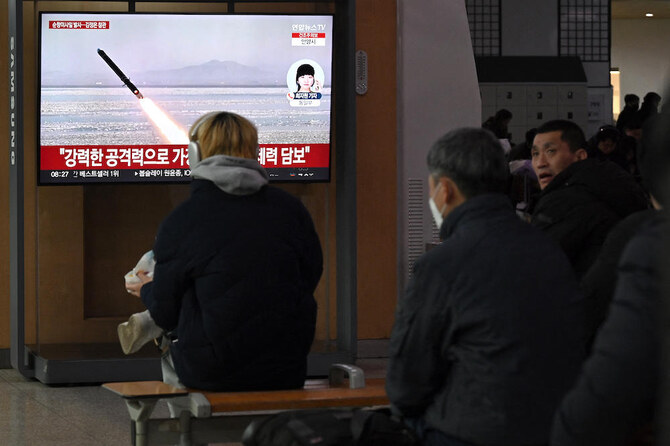
SEOUL: North Korea fired “multiple unidentified ballistic missiles” on Monday, South Korea’s military said, the same day Seoul and Washington began a major annual joint military drill known as Freedom Shield.
“Our military has detected at around 13:50 (0450 GMT) multiple unidentified ballistic missiles fired from Hwanghae province into the West Sea,” the Joint Chiefs of Staff said, referring to the body of water also known as the Yellow Sea.
“Our military will bolster surveillance and maintain a full readiness posture under close cooperation with the United States,” the JCS added.
The United States stations tens of thousands of US soldiers in South Korea, and the allies regularly stage joint drills, which they describe as defensive in nature.
But such exercises infurate Pyongyang, which regards them as rehearsals for invasion and routinely responds with weapons tests of its own.
Earlier Monday, the nuclear-armed North slammed the drills as a “provocative act,” warning of the danger of sparking war with “an accidental single shot.”
“This is a dangerous provocative act of leading the acute situation on the Korean peninsula, which may spark off a physical conflict between the two sides by means of an accidental single shot,” said Pyongyang’s foreign ministry, according to the Korean Central News Agency.
The joint US-South Korea “Freedom Shield 2025” exercise kicked off on Monday, and will involve “live, virtual, and field-based training,” according to a US statement.
The exercise will run until March 20, the statement said.
The latest exercise comes after two South Korean Air Force fighter jets accidentally dropped eight bombs on a village during a joint training exercise with US forces on March 6.
Some 31 people, including civilians and military personnel, were wounded in that incident, South Korea’s military said.
Relations between Pyongyang and Seoul have been at one of their lowest points in years, with the North launching a flurry of ballistic missiles last year in violation of UN sanctions.
The two Koreas remain technically at war since their 1950-1953 conflict ended in an armistice, not a peace treaty.
The large-scale Freedom Shield exercises are one of the allies’ biggest annual joint exercises.
In its statement on Monday, North Korea’s foreign ministry dubbed the exercises “an aggressive and confrontational war rehearsal.”
Last week, Pyongyang slammed the United States for “political and military provocations” over the visit of a US Navy aircraft carrier to the South Korean port of Busan.


![]()

North Korea fires missiles as South begins drills with US
Short Url
https://arab.news/6aw9c
North Korea fires missiles as South begins drills with US
- The United States stations tens of thousands of US soldiers in South Korea
- The allies regularly stage joint drills, which they describe as defensive in nature


Latest updates


© 2026 SAUDI RESEARCH & PUBLISHING COMPANY, All Rights Reserved And subject to Terms of Use Agreement.