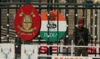
Pakistan president addresses joint session of parliament amid protest from opposition lawmakers

The screengrab taken from PTV Parliament shows Pakistan President Asif Ali Zardari addressing a joint session of parliament in Islamabad on March 10, 2025. (PTV Parliament/YouTube)
Short Url
Updated 10 March 2025
Follow

Pakistan president addresses joint session of parliament amid protest from opposition lawmakers

  • Asif Ali Zardari, who has previously served as president, will be addressing parliament for eighth time today
  • Opposition lawmakers, mostly from Pakistan Tehreek-e-Insaf party, raise slogans in favor of ex-PM Imran Khan

ISLAMABAD: President Asif Ali Zardari is addressing the joint session of Pakistan’s parliament amid loud protest chants from opposition lawmakers, mostly from the Pakistan Tehreek-e-Insaf (PTI) party on Monday. 

Pakistan’s president is constitutionally required to address both houses of parliament at the start of the first session of each parliamentary year. Zardari, who previously served as Pakistan’s president from 2018-2013, has addressed joint sessions of the parliament seven times before. 

Pakistani presidents’ addresses to parliament have been marred by noisy protests from opposition lawmakers in the past. As soon as Zardari started his speech, PTI lawmakers started banging their desks and shouting slogans in favor of their party’s founder, former prime minister Imran Khan. 

“It is my singular privilege as your civilian president to address for the eighth time the august house at the beginning of another parliamentary year,” Zardari said amid loud chants by opposition members. 

Earlier, state broadcaster Radio Pakistan said stringent security arrangements were put in place at the Parliament House. Quoting the National Assembly Secretariat, it said entry for guests was prohibited while media representatives would be allowed in “limited numbers.”

The president’s address takes place as Pakistan navigates a tricky path to economic recovery after a prolonged macroeconomic crisis. Pakistan’s government says its economic reforms over the past one year have yielded fruit, pointing to improving macroeconomic indicators such as a decline in inflation, current account surplus and increase in exports. 

The country, however, faces surging militancy in its western provinces bordering Afghanistan. Balochistan and Khyber Pakhtunkhwa (KP) have reported an increase in attacks launched by religiously motivated militants and separatist outfits since November 2022, dealing a blow to Pakistan’s efforts to root out militancy. 

The Shehbaz Sharif-led coalition government is also grappling with political instability as its tensions with Khan’s PTI persist. The former prime minister continues to remain popular from behind bars, with his party leading a large protest calling for his release from prison last year that involved clashes with law enforcers. 

Both sides attempted to break the political deadlock in the country by holding negotiations in December 2024. However, after three rounds of talks, the negotiations failed as the PTI pulled out in January, citing the government’s failure to form judicial commissions to investigate protests it led in May 2023 and November 2024.


US freezes immigrant visa processing for 75 countries, including Pakistan

Updated 15 January 2026
Follow

US freezes immigrant visa processing for 75 countries, including Pakistan

  • Immigrant visas to be suspended from Jan 21, tourist visas unaffected
  • Move targets “public charge” concerns as Trump revives hard-line immigration rules

ISLAMABA: The United States will pause immigrant visa issuances for nationals of 75 countries, including Pakistan, from January 21, the State Department said on Thursday, as President Donald Trump presses ahead with a hard-line immigration agenda centered on financial self-sufficiency.

In an update published on its website, the State Department said it was conducting a comprehensive review of immigration policies to ensure that migrants from what it described as “high-risk” countries do not rely on public welfare in the United States or become a “public charge.”

“The State Department will pause immigrant visa processing from 75 countries whose migrants take welfare from the American people at unacceptable rates. The freeze will remain active until the US can ensure that new immigrants will not extract wealth from the American people,” the department said.

The pause applies specifically to immigrant visas, which are issued to people seeking permanent residence in the United States. The department said applicants from affected countries may still submit applications and attend interviews, but no immigrant visas will be issued during the suspension.

According to the State Department, the affected countries include Pakistan, Afghanistan, Bangladesh, Iran, Iraq, Egypt, Nigeria, Russia, Somalia, Brazil, Thailand and dozens of others across Asia, Africa, the Middle East, Europe and Latin America.

The department said tourist and other non-immigrant visas are not affected, and that no previously issued immigrant visas have been revoked. Dual nationals applying with a valid passport from a country not on the list are exempt from the pause.

The State Department did not indicate how long the visa pause would remain in effect, saying it would continue until its review of screening and vetting procedures is completed.

The announcement underscores the breadth of the Trump administration’s renewed immigration crackdown. Since returning to office last year, Trump has revived and expanded enforcement of the “public charge” provision of US immigration law, which allows authorities to deny entry to applicants deemed likely to rely on public benefits.

During his previous term, Trump imposed sweeping travel restrictions on several Muslim-majority countries, a policy widely referred to as a “Muslim ban,” which was challenged in courts before a revised version was upheld by the Supreme Court and later rescinded under former president Joe Biden.

The visa freeze also comes amid an intensifying domestic enforcement push. US Immigration and Customs Enforcement (ICE) has expanded operations nationwide, drawing scrutiny over its tactics. Last week, an ICE agent shot and killed Renee Good, a US citizen, during a federal operation in Minneapolis, sparking protests and renewed debate over immigration enforcement under the Trump administration.