ISTANBUL: Women took to the streets of cities across Europe, Africa and elsewhere to mark International Women’s Day with demands for ending inequality and gender-based violence.
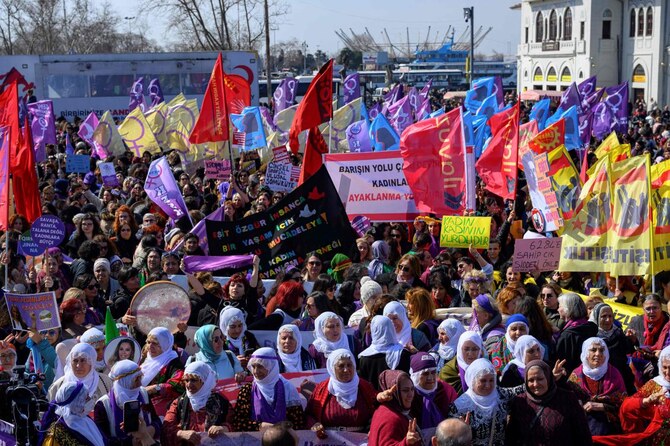
On the Asian side of Turkiye’s biggest city Istanbul, a rally in Kadikoy saw members of dozens of women’s groups listen to speeches, dance and sing in the spring sunshine.
The colorful protest was overseen by a large police presence, including officers in riot gear and a water cannon truck.
The government of President Recep Tayyip Erdogan declared 2025 the Year of the Family. Protesters pushed back against the idea of women’s role being confined to marriage and motherhood, carrying banners reading “Family will not bind us to life” and “We will not be sacrificed to the family.”
Critics have accused the government of overseeing restrictions on women’s rights and not doing enough to tackle violence against women.
Erdogan in 2021 withdrew Turkiye from a European treaty, dubbed the Istanbul Convention, that protects women from domestic violence. Turkiye’s We Will Stop Femicides Platform says 394 women were killed by men in 2024.
“There is bullying at work, pressure from husbands and fathers at home and pressure from patriarchal society. We demand that this pressure be reduced even further,” Yaz Gulgun, 52, said.
Women across Europe and Africa march against discrimination
In many other European countries, women also protested against violence, for better access to gender-specific health care, equal pay and other issues in which they don’t get the same treatment as men.
In Poland, activists opened a center across from the parliament building in Warsaw where women can go to have abortions with pills, either alone or with other women.
Opening the center on International Women’s Day across from the legislature was a symbolic challenge to authorities in the traditionally Roman Catholic nation, which has one of Europe’s most restrictive abortion laws.
From Athens to Madrid, Paris, Munich, Zurich and Belgrade and in many more cities across the continent, women marched to demand an end to treatment as second-class citizens in society, politics, family and at work.
In Madrid, protesters held up big hand-drawn pictures depicting Gisele Pélicot, the woman who was drugged by her now ex-husband in France over the course of a decade so that she could be raped by dozens of men while unconscious.
Pélicot has become a symbol for women all over Europe in the fight against sexual violence.
In the Nigerian capital of Lagos, thousands of women gathered at the Mobolaji Johnson Stadium, dancing and signing and celebrating their womanhood.
Many were dressed in purple — the traditional color of the women’s liberation movement.
In Russia, the women’s day celebrations had a more official tone, with honor guard soldiers presenting yellow tulips to girls and women during a celebration in St. Petersburg.
Germany’s president warns of backlash against progress already made
In Berlin, German President Frank-Walter Steinmeier called for stronger efforts to achieve equality and warned against tendencies to roll back progress already made.
“Globally, we are seeing populist parties trying to create the impression that equality is something like a fixed idea of progressive forces,” he said. He gave an example of ” large tech companies that have long prided themselves on their modernity and are now, at the behest of a new American administration, setting up diversity programs and raving about a new ‘masculine energy’ in companies and society.”

Protesters on International Women’s Day demand equal rights, end to discrimination, sexual violence
Short Url
https://arab.news/vc89h
Protesters on International Women’s Day demand equal rights, end to discrimination, sexual violence
- On the Asian side of Turkiye’s biggest city Istanbul, a rally in Kadikoy saw members of dozens of women’s groups listen to speeches, dance and sing
- In many other European countries, women also protested against violence, for better access to gender-specific health care, equal pay and other issues
The UN aid coordination agency cuts its funding appeal after Western support plunges
GENEVA: The UN’s humanitarian aid coordination office is downsizing its appeal for annual funding in 2026 after support this year, mostly from Western governments, plunged to the lowest level in a decade.
The United Nations Office for the Coordination of Humanitarian Affairs said Monday it was seeking $33 billion to help some 135 million people cope with fallout from wars, climate disasters, earthquakes, epidemics and food shortages. This year, it took in $15 billion, the lowest level in a decade.
The office says next year it wants more than $4.1 billion to reach 3 million people in Palestinian areas, another $2.9 billion for Sudan — home to the world’s largest displacement crisis — and $2.8 billion for a regional plan around Syria.
“In 2025, hunger surged. Food budgets were slashed — even as famines hit parts of Sudan and Gaza. Health systems broke apart,” said OCHA chief Tom Fletcher. “Disease outbreaks spiked. Millions went without essential food, health care and protection. Programs to protect women and girls were slashed, hundreds of aid organizations shut.”
The UN aid coordinator sought $47 billion for this year and aimed to help 190 million people worldwide. Because of the lower support, it and humanitarian partners reached 25 million fewer people this year than in 2024.
The donor fatigue comes as many wealthy European countries face security threats from an increasingly assertive Russia on their eastern flank and have experienced lackluster economic growth in recent years, putting new strains on government budgets and the consumers who pay taxes to sustain them.
“I know budgets are tight right now. Families everywhere are under strain,” Fletcher said. “But the world spent $2.7 trillion on defense last year – on guns and arms. And I’m asking for just over 1 percent of that.”
The UN system this year has slashed thousands of jobs, notably at its migration and refugee agencies, and Secretary-General António Guterres’ office has launched a review of UN operations — which may or may not produce firm results.
Fletcher, who answers to Guterres, has called for “radical transformation” of aid by reducing bureaucracy, boosting efficiency and giving more power to local groups. Fletcher cited “very practical, constructive conversations” almost daily with the Trump administration.
“Do I want to shame the world into responding? Absolutely,” Fletcher said. “But I also want to channel this sense of determination and anger that we have as humanitarians, that we will carry on delivering with what we get.”
The United Nations Office for the Coordination of Humanitarian Affairs said Monday it was seeking $33 billion to help some 135 million people cope with fallout from wars, climate disasters, earthquakes, epidemics and food shortages. This year, it took in $15 billion, the lowest level in a decade.
The office says next year it wants more than $4.1 billion to reach 3 million people in Palestinian areas, another $2.9 billion for Sudan — home to the world’s largest displacement crisis — and $2.8 billion for a regional plan around Syria.
“In 2025, hunger surged. Food budgets were slashed — even as famines hit parts of Sudan and Gaza. Health systems broke apart,” said OCHA chief Tom Fletcher. “Disease outbreaks spiked. Millions went without essential food, health care and protection. Programs to protect women and girls were slashed, hundreds of aid organizations shut.”
The UN aid coordinator sought $47 billion for this year and aimed to help 190 million people worldwide. Because of the lower support, it and humanitarian partners reached 25 million fewer people this year than in 2024.
The donor fatigue comes as many wealthy European countries face security threats from an increasingly assertive Russia on their eastern flank and have experienced lackluster economic growth in recent years, putting new strains on government budgets and the consumers who pay taxes to sustain them.
“I know budgets are tight right now. Families everywhere are under strain,” Fletcher said. “But the world spent $2.7 trillion on defense last year – on guns and arms. And I’m asking for just over 1 percent of that.”
The UN system this year has slashed thousands of jobs, notably at its migration and refugee agencies, and Secretary-General António Guterres’ office has launched a review of UN operations — which may or may not produce firm results.
Fletcher, who answers to Guterres, has called for “radical transformation” of aid by reducing bureaucracy, boosting efficiency and giving more power to local groups. Fletcher cited “very practical, constructive conversations” almost daily with the Trump administration.
“Do I want to shame the world into responding? Absolutely,” Fletcher said. “But I also want to channel this sense of determination and anger that we have as humanitarians, that we will carry on delivering with what we get.”
© 2025 SAUDI RESEARCH & PUBLISHING COMPANY, All Rights Reserved And subject to Terms of Use Agreement.


