

Pakistan’s deputy PM urges OIC to reject Palestinian displacement, calls it a ‘red line’

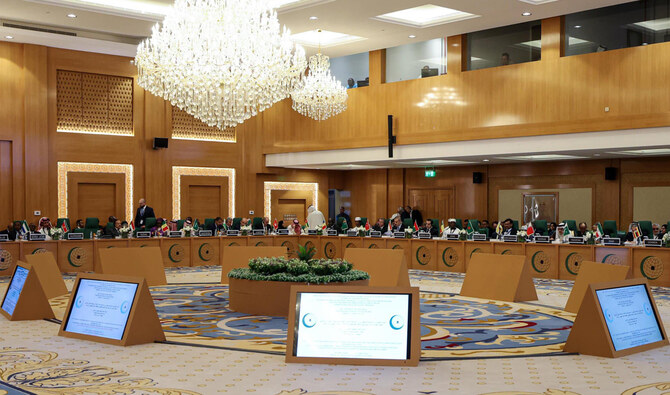
This handout photo shows a generic view of the Organization of Islamic Cooperation foreign ministers’ session on Palestine, in Jeddah, Saudi Arabia on March 8, 2025. (Photo courtesy: Handout/OIC)
Short Url
Updated 08 March 2025
Follow

Pakistan’s deputy PM urges OIC to reject Palestinian displacement, calls it a ‘red line’

  • Ishaq Dar says history will not judge Muslim nations by their words but by their actions on the Palestine issue
  • He condemns Benjamin Netanyahu’s recent suggestion that a Palestinian state be established in Saudi Arabia

ISLAMABAD: Pakistan’s Deputy Prime Minister Ishaq Dar on Saturday condemned plans to forcibly relocate Palestinians from their homeland, labeling such actions a “red line” and urging the Organization of Islamic Cooperation (OIC) to take decisive measures to hold Israel accountable for its actions in Gaza and the West Bank.
Dar, who also serves as the country’s foreign minister, is currently in Saudi Arabia, having arrived on Thursday to participate in the OIC foreign ministers’ session on Palestine held in the port city of Jeddah.
The session was convened in response to US President Donald Trump’s proposal to permanently displace over 2 million Palestinians from Gaza, with plans to transform the area into an international beach resort.
This was widely condemned by majority-Muslim nations and international rights organizations, with Arab leaders endorsing an Egyptian-led reconstruction plan for Gaza, valued at $53 billion, which aims to prevent Palestinian displacement.
“The Muslim Ummah must make it unequivocally clear: any attempt to forcibly relocate the Palestinian people, whether from Gaza or the West Bank, is ethnic cleansing and a war crime under international law,” Dar asserted during his address at the OIC special session.
“The OIC must categorically reject any proposal that seeks to eject the Palestinians from their own homeland,” he added. “No external force has the right to dictate their future to the Palestinians. They must determine their own future, through an exercise of self-determination.”
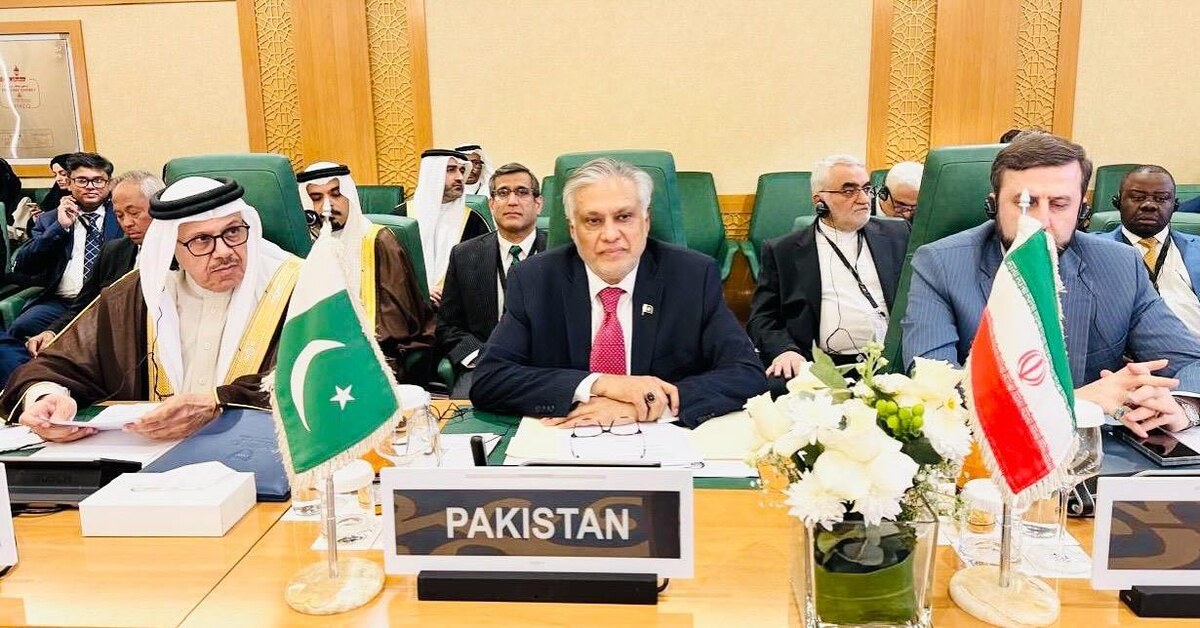


This handout photo shows Pakistan Foreign Minister and Deputy Prime Minister Ishaq Dar (center) participating in the Organization of Islamic Cooperation foreign ministers’ session on Palestine, in Jeddah, Saudi Arabia on March 8, 2025. (Photo courtesy: Handout/MOFA)

The Pakistani deputy prime minister emphasized that the notion of Palestinian displacement “must be recognized as a red line,” urging the OIC to collectively oppose and obstruct any such move.
“This is a defining moment for the Muslim Ummah,” he continued. “History will not judge us by our words but by our actions... The OIC must rise to this challenge with unity, resolve and purpose. Another Nakba cannot and must not be allowed to happen.”
Dar condemned Israel for obstructing humanitarian aid to Gaza and warned that sustainable peace cannot be achieved as long as Israeli military operations, settler violence and illegal land annexations persist.
He called for the revival of a credible and irreversible political process toward a two-state solution, leading to the establishment of an independent and sovereign Palestine.
“The OIC must mobilize its collective influence to press for the recognition of the state of Palestine as a full member of the United Nations,” he urged.
Dar also criticized Israeli Prime Minister Benjamin Netanyahu’s recent suggestion that a Palestinian state be established in Saudi Arabia.
“This is an insult to the entire Muslim Ummah,” he said. “Pakistan expresses its full solidarity with the Kingdom of Saudi Arabia and commends its steadfast support for the Palestinian cause.”


Pakistan says eyeing billions in investments through crypto projects in coming years

Updated 9 sec ago
Follow

Pakistan says eyeing billions in investments through crypto projects in coming years

  • Pakistan Virtual Assets Regulatory Authority Chairman attends Abu Dhabi Bitcoin Conference 2025
  • Says Pakistan considers Bitcoin, digital assets “a fundamental pillar of the future financial system“

ISLAMABAD: Pakistan Virtual Assets Regulatory Authority Chairman Bilal bin Saqib said this week that Islamabad is eyeing billions in investment through digital assets initiatives and cryptocurrency projects in the coming years, state media reported. 

Analysts have said Pakistan’s attempts to tap into the country’s growing crypto market, crack down on money laundering and terror financing, and promote responsible innovation could bring an estimated $25 billion in virtual assets into the tax net.

Pakistan has attempted to bring virtual asset service providers (VASPs) under a formal licensing regime in recent months. PVARA this month also granted no objection certificates (NOCs) to global crypto exchanges Binance and HTX.

Speaking during an interview at the Abu Dhabi Bitcoin Conference 2025, Saqib said Pakistan is reforming the unregulated crypto market to transform it into a “transparent and investor-friendly system in line with global standards,” state broadcaster Radio Pakistan reported on Saturday. 

“He said that interim licenses, mining, tokenization and fintech pilot projects have been launched for major exchanges in Pakistan and billions of dollars are expected to be invested in these projects in the next few years,” Radio Pakistan said in its report. 

The PVARA chairman said Pakistan has become the “center of attention” globally due to the significant progress it has achieved in crypto regulation.

Saqib said Islamabad considers Bitcoin and digital assets not only an investment but “a fundamental pillar of the future financial system.”

“He said that Pakistan’s goal is to make youth not consumers but digital creators and architects of the new economy,” Radio Pakistan said. 

Pakistan’s move to formalize digital asset regulation comes amid broader economic reforms under an International Monetary Fund program, with authorities under pressure to strengthen financial controls, improve transparency and manage risks linked to emerging technologies. 

While officials have framed the crypto framework as regulation-first rather than promotion-led, analysts say its implementation, particularly enforcement and coordination with the central bank, will be closely watched by international lenders and investors.