

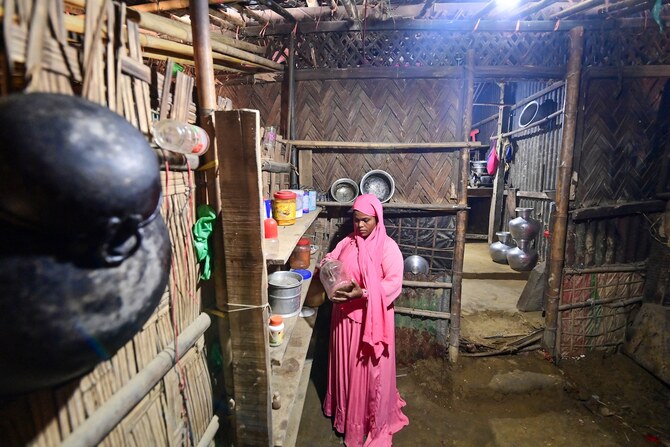
Rohingya mothers in despair as UN slashes food rations to 20 cents a day

This photo taken on Nov. 26, 2023 shows a Rohingya woman at her house in the Nayapara refugee camp at Teknaf, in Bangladesh's southeastern district of Cox's Bazar. (AFP)
Short Url
Updated 08 March 2025
Follow

Rohingya mothers in despair as UN slashes food rations to 20 cents a day

  • World Food Program will cut food rations from $12.50 to $6 per month in April after failing to secure funding
  • Daily ration per person will become equivalent to the cost of two eggs

Dhaka: Rohingya mothers in refugee camps in Bangladesh say they fear for the fate of their already malnourished children as their food rations are set to be halved from next month.

The UN World Food Program announced earlier this week that “severe funding shortfalls” would mean that the monthly food allowance for refugees would be cut from $12.50 to $6 per person.

The new daily ration will equal 24 Bangladeshi taka — the price of two eggs in the market. A single thin flatbread costs around 8 taka, while one liter of milk costs at least 80.

Refugees estimate that, at current costs, the most food that WFP vouchers will allow them to buy each month is 10 kilograms of rice, 1.5 kg of lentils and 500 grams of salt.

Uzala Bibi, a mother of two living in a camp in Cox’s Bazar in southeastern Bangladesh — the world’s biggest refugee settlement — told Arab News she was in “deep fear” over the situation her family will face from next month.

“I will be unable to feed my children,” she said. “How will my children survive on only rice and lentils?”

The WFP’s announcement left Bangladeshi authorities dumbfounded, with the government’s Refugee Relief and Repatriation Commission observing that malnutrition in the camps already ranges from “severe acute” to “moderate acute” levels.

“The situation will further deteriorate with the budget cut, weakening the immunity of the Rohingya population and leading to a rise in infectious and waterborne diseases ... The Rohingya will not be able to survive,” said Dr. Abu Toha Md. Rizuanul Haque Bhuiyan, the commission’s health coordinator.

“It is absurd and beyond imagination how anyone can prepare a diet plan with just 24 taka per day. We are at a loss for what to do, and our office is deeply concerned about the situation.”

More than 1.3 million Rohingya are cramped inside 33 camps in Cox’s Bazar, where they have limited access to job opportunities and education.

A mostly Muslim ethnic minority, the Rohingya have lived for centuries in Myanmar’s western Rakhine state, but were stripped of their citizenship in the 1980s. Since then, many have fled to Bangladesh, with about 700,000 arriving in 2017, after a military crackdown that the UN has been referring to as a “textbook case” of ethnic cleansing by Myanmar.

International aid for the Rohingya community has been dropping over the years — particularly since the COVID-19 pandemic. But the current funding gap is unprecedented.

A previous temporary round of ration cuts to Rohingya in 2023, which reduced monthly food rations from $12 to $8, led to a sharp increase in hunger and malnutrition, Bhuiyan said.

“With half of the food budget now cut, our health-sector budget is also being squeezed ...
I can’t imagine how we will cope with this situation, or what strategies should be taken to address it.”

Hason Begum, a refugee mother of five, said she had no idea how she will manage to feed her family.

“To me, it’s completely unimaginable that a person could survive on just 24 taka per day when a single egg costs 12 taka. I am forced to serve plain rice three times a day,” she said.

“My children are already suffering from malnutrition, and the situation will become unbearable next month,” she added. “How can a mother endure the pain of watching her children starve? Sometimes, I feel it would be better to embrace death.”


Modi ally proposes social media ban for India’s teens as global debate grows

Updated 3 sec ago
Follow

Modi ally proposes social media ban for India’s teens as global debate grows

  • India is the world’s second-biggest smartphone market with 750 million devices and a billion Internet users
  • South Asian nation is a key growth market for social media apps and does not set a minimum age for access
NEW DELHI: An ally of Indian Prime Minister Narendra Modi has proposed a bill to ban social media for children, as the world’s biggest market for Meta and YouTube joins a global debate on the impact of social media on young people’s health and safety.
“Not only are our children becoming addicted to social media, but India is also one of the world’s largest producers of data for foreign platforms,” lawmaker L.S.K. Devarayalu said on Friday.
“Based on this data, these companies are creating advanced AI systems, effectively turning Indian users into unpaid data providers, while the ‌strategic and economic ‌benefits are reaped elsewhere,” he said.
Australia last ‌month ⁠became the ‌first country to ban social media for children under 16, blocking access in a move welcomed by many parents and child advocates but criticized by major technology companies and free-speech advocates. France’s National Assembly this week backed legislation to ban children under 15 from social media, while Britain, Denmark and Greece are studying the issue.
Facebook operator Meta, YouTube-parent Alphabet and X did ⁠not respond on Saturday to emails seeking comment on the Indian legislation. Meta has ‌said it backs laws for parental oversight but ‍that “governments considering bans should be careful ‍not to push teens toward less safe, unregulated sites.”
India’s IT ministry ‍did not respond to a request for comment.
India, the world’s second-biggest smartphone market with 750 million devices and a billion Internet users, is a key growth market for social media apps and does not set a minimum age for access.
Devarayalu’s 15-page Social Media (Age Restrictions and Online Safety) Bill, which is not public but was seen by Reuters, says ⁠no one under 16 “shall be permitted to create, maintain, or hold” a social media account and those found to have one should have them disabled.
“We are asking that the entire onus of ensuring users’ age be placed on the social media platforms,” Devarayalu said.
The government’s chief economic adviser attracted attention on Thursday by saying India should draft policies on age-based access limits to tackle “digital addiction.”
Devarayalu’s legislation is a private member’s bill — not proposed to parliament by a federal minister — but such bills often trigger debates in parliament and influence lawmaking.
He is from the ‌Telugu Desam Party, which governs the southern state Andhra Pradesh and is vital to Modi’s coalition government.