Syrian Arab Republic welcomes re-activation of its frozen OIC membership after 13 years

1 / 2
Syria's Interim Foreign Minister Asaad al-Shibani attends an Extraordinary Session of the OIC Council of Foreign Ministers in Jeddah on March 7, 2025. (AFP)
2 / 2
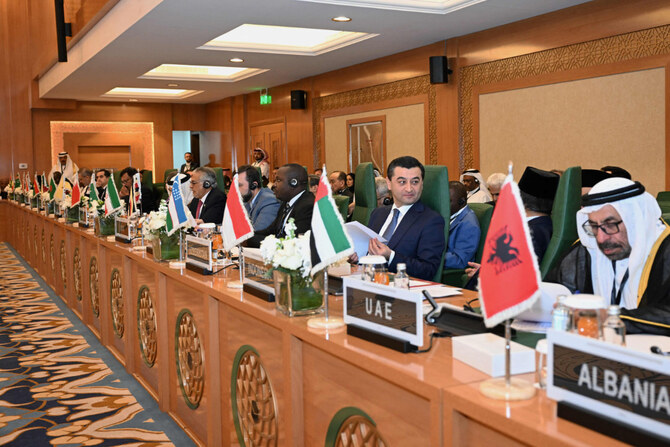
Diplomats attend an Extraordinary Session of the OIC Council of Foreign Ministers in Jeddah on March 7, 2025. (AFP)
Short Url
Updated 08 March 2025
Follow

Syrian Arab Republic welcomes re-activation of its frozen OIC membership after 13 years

  • Syria's membership was frozen in August 2012 amid the civil war under the Bashar Assad regime
  • In December, Syrian opposition forces led by the Hayat Tahrir Al-Sham toppled Assad

CAIRO: The Syrian Arab Republic welcomed on early Saturday the re-activation of its membership in the Organization of Islamic Cooperation (OIC) after it was frozen for 13 years, the foreign ministry said. 

“This decision represents an important step toward Syria’s return to the regional and international communities as a free and just state,” a ministry said in a statement.

Syria's membership frozen since 2012, was re-activated during a meeting of the 57-member group at the organization's headquarters in Jeddah, Saudi Arabia, on Friday, a Turkish diplomatic source said.

The source said the initiative put forth by Turkish Foreign Minister Hakan Fidan to re-activate Syria’s membership was accepted.


Turkiye’s Foreign Minister Hakan Fidan attends an Extraordinary Session of the OIC Council of Foreign Ministers in Jeddah on March 7, 2025. (AFP)

A statement posted on the OIC website highlighted Syria's membership as one of the topics in the discussion of the "extraordinary ministerial" meeting at the organization's headquarters in Jeddah, Saudi Arabia, but did not mention how the meeting turned out.

In his opening statenment, OIC Secretary-General Hissein Brahim Taha said the initiative to include an item on Syria on the agenda of the session comes at an appropriate time. 

In December, Syrian opposition forces led by the Hayat Tahrir Al-Sham (HTS) toppled Bashar Assad after an 11-year civil war, ending his five-decade rule. 

Syria’s new government has since sought to rebuild ties with Arab nations, Western powers, and others.

Syrian Foreign Minister Asaad Hassan Al-Shibani was called into the meeting to take Syria’s seat after the vote, the source said. A video shared by Turkiye’s Foreign Ministry showed members applauding as the minister entered the room.

NATO member Turkiye has backed opposition forces looking to oust Assad for years. It is a close ally and supporter of the new government in Damascus, vowing to help rebuild the country and help them train their armed forces.

Last month, Syria’s new President Ahmed Al-Sharaa received an invitation from Egyptian counterpart Abdel Fattah El-Sisi to participate in an Arab League summit in Cairo, a major step in rebuilding ties with the Arab world after Assad’s downfall. 


Hezbollah chief says supports state diplomacy to stop Israeli aggression

Updated 6 sec ago
Follow

Hezbollah chief says supports state diplomacy to stop Israeli aggression

  • The state has chosen “diplomacy to end the aggression and implement” a November 2024 ceasefire deal “and we support it continuing in this direction,” Qassem said
  • “They want to eliminate our existence,” Qassem said, but “we will defend ourselves”

BEIRUT: Hezbollah chief Naim Qassem on Friday said his group supported the Lebanese state’s pursuit of diplomacy to end Israeli attacks, while also criticizing the inclusion of a civilian representative in recent talks with Israel.
The state has chosen “diplomacy to end the aggression and implement” a November 2024 ceasefire deal “and we support it continuing in this direction,” Qassem said in a televised address.
Lebanese and Israeli civilian representatives held their first direct talks in decades on Wednesday under the auspices of the year-old ceasefire monitoring mechanism, a move Lebanon’s president said was to avoid prospects of another war in Lebanon.
Qassem criticized the move and urged authorities to reconsider.
“We consider this measure an additional misstep on top of the sin” of the government’s decision in August to task the army with disarming Hezbollah, he said.
“Have you made a gratuitous concession? This concession will not change the enemy’s position, nor its aggression or occupation,” Qassem said, accusing Israel and the United States of wanting Lebanese authorities to be negotiating “under fire.”
“They want to eliminate our existence,” Qassem said, but “we will defend ourselves, our people, our country. We are prepared to sacrifice everything, and we will not surrender.”
He accused Israel of violating the year-old ceasefire that sought to end more than a year of hostilities between Israel and his Iran-backed group, which emerged heavily weakened with its arsenal pummelled and senior commanders killed including former chief Hassan Nasrallah.
Qassem said his group was cooperating with the Lebanese authorities, and that America and Israel should have “no say in how we manage our domestic affairs,” calling their imposition of conditions on Lebanon as “unacceptable.”
Lebanese Prime Minister Nawaf Salam has said the new talks were strictly limited to fully implementing last year’s truce and did not amount to broader peace discussions.