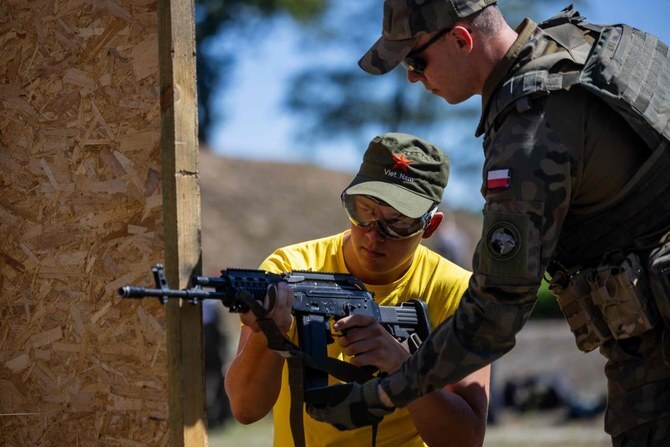
Polish leader Tusk plans large-scale military training for all adult males to boost reserves

Polish Prime Minister Donald Tusk said Friday that his government is working on a plan to prepare large-scale military training for every adult male in response to the changing security situation in Europe. (AFP/File)
Short Url
Updated 07 March 2025
Follow

Polish leader Tusk plans large-scale military training for all adult males to boost reserves

  • The military training would create a reserve force that is “adequate to possible threats,” Tusk said
  • “Today we are talking about the need for a half-million army in Poland”

WARSAW: Polish Prime Minister Donald Tusk said Friday that his government is working on a plan to prepare large-scale military training for every adult male in response to the changing security situation in Europe.
The military training would create a reserve force that is “adequate to possible threats,” Tusk said in a major speech on security to Poland’s lower house of parliament, or Sejm.
He said that there’s a need for an army of 500,000 soldiers, which would include reservists.
Last year, the Polish government said that the military was made up of around 200,000 soldiers and was to grow to 220,000 this year with the objective of increasing it to about 300,000.
But security fears have grown far more dramatic in recent weeks, as Russia continues to pound Ukraine with missiles and drones, and as the Trump administration has withdrawn military and intelligence support for Ukraine while putting its commitments to NATO in question.
“Today we are talking about the need for a half-million army in Poland,” Tusk said.
After his speech, Tusk explained to reporters that he wasn’t considering a return of universal military service, but rather a reserve system based on the model in Switzerland. In that country, every man is obliged to serve in the military or an alternative civilian service, while women can volunteer if they choose.
Poland, with a population of 38 million people, is located along NATO’s eastern flank and is deeply concerned by the war in Ukraine. There are fears that if Ukraine is defeated, Russia will turn its imperial ambitions next to countries like Poland, which Moscow controlled during the 19th century and during the Cold War.
Jaroslaw Kaczyński, the head of Poland’s largest opposition party, the conservative Law and Justice, said that a mental shift in society would also be needed in addition to the military training of men.
“We will have a return to the chivalric ethos and to the fact that men should also be soldiers, that is, be able to expose themselves, even to death,” Kaczyński said.
Concern has grown in Poland and across most of Europe as US President Donald Trump has signaled a dramatically shifting stance in Washington to one that includes support for Russia’s position — even though on Friday he issued a stern warning to Russia after it attacked Ukrainian energy facilities with dozens of missiles and drones.
“If Ukraine loses the war or if it accepts the terms of peace, armistice, or capitulation in such a way that weakens its sovereignty and makes it easier for (Russian President Vladimir) Putin to gain control over Ukraine, then, without a doubt — and we can all agree on that — Poland will find itself in a much more difficult geopolitical situation,” Tusk said.
President Andrzej Duda said Friday that he was submitting an amendment to the Polish Constitution for consideration which would oblige the country to spend at least 4 percent of its gross domestic product each year on defense.
Poland is already NATO’s top spender on defense as a percentage of its overall economy, spending above 4 percent of its GDP this year. But Duda said that he wanted to take advantage of the consensus on the political scene in Poland today on the matter to enshrine it in the highest law.
Trump has suggested that the US might abandon its commitments to the alliance if member countries don’t meet defense spending targets.


Venezuela’s acting president calls for oil industry reforms to attract more foreign investment

Updated 4 sec ago
Follow

Venezuela’s acting president calls for oil industry reforms to attract more foreign investment

  • In her speech, Rodríguez said money earned from foreign oil sales would go into two funds: one dedicated to social services for workers and the public health care system, and another to economic development and infrastructure projects

CARACAS, Venezuela: Venezuela’s acting President Delcy Rodriguez used her first state of the union address on Thursday to promote oil industry reforms that would attract foreign investment, an objective aggressively pushed by the Trump administration since it toppled the country’s longtime leader less than two weeks ago.
Rodríguez, who has been under pressure from the US to fall in line with its vision for the oil-rich nation, said sales of Venezuelan oil would go to bolster crisis-stricken health services, economic development and other infrastructure projects.
While she sharply criticized the Trump administration and said there was a “stain on our relations,” the former vice president also outlined a distinct vision for the future between the two historic adversaries, straying from her predecessors, who have long railed against American intervention in Venezuela.
“Let us not be afraid of diplomacy” with the US, said Rodriguez, who must now navigate competing pressures from the Trump administration and a government loyal to former President Nicolás Maduro.
The speech, which was broadcast on a delay in Venezuela, came one day after Rodríguez said her government would continue releasing prisoners detained under Maduro in what she described as “a new political moment” since his ouster.
Trump on Thursday met at the White House with Venezuelan opposition leader María Corina Machado, whose political party is widely considered to have won 2024 elections rejected by Maduro. But in endorsing Rodríguez, who served as Maduro’s vice president since 2018, Trump has sidelined Machado.
In her speech, Rodríguez said money earned from foreign oil sales would go into two funds: one dedicated to social services for workers and the public health care system, and another to economic development and infrastructure projects.
Hospitals and other health care facilities across the country have long suffered. Patients are asked to provide practically all supplies needed for their care, from syringes to surgical screws. Economic turmoil, among other factors, has pushed millions of Venezuelans to migrate from the South American nation in recent years.
In moving forward, the acting president must walk a tightrope, balancing pressures from both Washington and top Venezuelan officials who hold sway over Venezuela’s security forces and strongly oppose the US Her recent public speeches reflect those tensions — vacillating from conciliatory calls for cooperation with the US, to defiant rants echoing the anti-imperialist rhetoric of her toppled predecessor.
American authorities have long railed against a government they describe as a “dictatorship,” while Venezuela’s government has built a powerful populist ethos sharply opposed to US meddling in its affairs.
For the foreseeable future, Rodríguez’s government has been effectively relieved of having to hold elections. That’s because when Venezuela’s high court granted Rodríguez presidential powers on an acting basis, it cited a provision of the constitution that allows the vice president to take over for a renewable period of 90 days.
Trump enlisted Rodríguez to help secure US control over Venezuela’s oil sales despite sanctioning her for human rights violations during his first term. To ensure she does his bidding, Trump threatened Rodríguez earlier this month with a “situation probably worse than Maduro.”
Maduro, who is being held in a Brooklyn jail, has pleaded not guilty to drug-trafficking charges.
Before Rodríguez’s speech on Thursday, a group of government supporters was allowed into the presidential palace, where they chanted for Maduro, who the government insists remains the country’s president. “Maduro, resist, the people are rising,” they shouted.