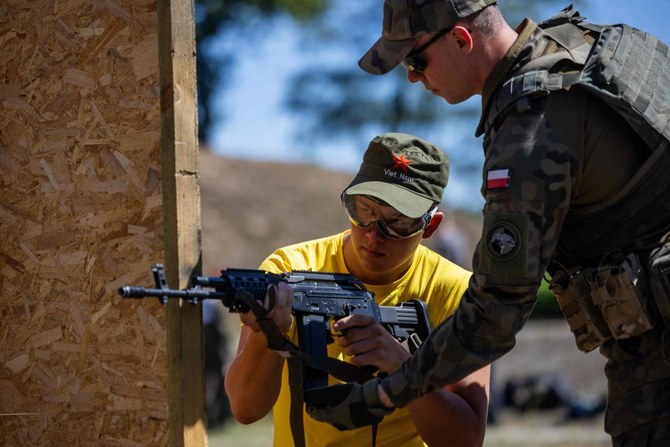
WARSAW: Poland needs to prepare its soldiers for all-out conflict, its armed forces chief of staff said on Wednesday, as the country boosts the number of troops on its border with Russia and Belarus.
Poland’s relations with Russia and its ally Belarus have deteriorated sharply since Moscow sent tens of thousands of troops into neighboring Ukraine on Feb. 24, 2022, starting a war that is still being fought.
“Today, we need to prepare our forces for full-scale conflict, not an asymmetric-type conflict,” army chief of staff General Wieslaw Kukula told a press conference.
“This forces us to find a good balance between the border mission and maintaining the intensity of training in the army,” he said.
Speaking at the same event, deputy defense minister Pawel Bejda said that as of August, the number of troops guarding Poland’s eastern border would be increased to 8,000 from the current 6,000, with an additional rearguard of 9,000 able to step up within 48 hours notice.
In May, Poland announced details of “East Shield,” a 10 billion zloty ($2.5 billion) program to beef up defenses along its border with Belarus and Russia, which it plans to complete the plans by 2028.
The border with Belarus has been a flashpoint since migrants started flocking there in 2021 after Belarus opened travel agencies in the Middle East offering a new unofficial route into Europe — a move the European Union said was designed to create a crisis.
Warsaw has ramped up defense spending to more that 4 percent of its economic output this year in response to Russia’s invasion of Ukraine.
Kukula also said the current high interest from candidates to join the army posed a dilemma over whether to take in more recruits than budgeted for at the expense of military equipment procurement, especially as he said interest was expected to start declining sharply from 2027.
The size of the armed forces stood at about 190,000 personnel at the end of last year, including ground, air, naval, special forces and territorial defense forces. Poland plans to increase this to 300,000 troops within a few years.

Poland must prepare army for full-scale conflict, army chief says
https://arab.news/5qgz6
Poland must prepare army for full-scale conflict, army chief says
- Poland’s relations with Russia and its ally Belarus have deteriorated sharply since Moscow sent tens of thousands of troops into neighboring Ukraine
- “Today, we need to prepare our forces for full-scale conflict, not an asymmetric-type conflict,” army chief of staff General Wieslaw Kukula said
Nowhere to pray as logs choke flood-hit Indonesian mosque
- Before the disaster, the mosque bustled with worshippers — locals and students alike — attending daily and Friday prayers
- Indonesia consistently ranks among the countries with the highest annual deforestation rates
ACEH TAMIANG, Indonesia: Almost two weeks on from devastating floods, Muslim worshippers in Indonesia’s Sumatra who gathered at their local mosque on Friday for prayers were blocked from entering by a huge pile of thousands of uprooted trees.
The deadly torrential rains had inundated vast tracts of rainforest nearby, leaving residents of the Darul Mukhlisin mosque and Islamic boarding school to search elsewhere for places of worship that had been less damaged.
“We have no idea where all this wood came from,” said Angga, 37, from the nearby village of Tanjung Karang.
Before the disaster, the mosque bustled with worshippers — locals and students alike — attending daily and Friday prayers.
“Now it’s impossible to use. The mosque used to stand near a river,” said Angga. “But the river is gone — it’s turned into dead land.”
Village residents told AFP the structure likely absorbed much of the impact of trees and logs carried by the torrents, preventing even greater destruction downstream.
When AFP visited the site, the mosque was still encircled by a massive heap of timber — a mix of uprooted trees and felled logs, likely from nearby forests.
By Friday, the death toll from one of northern Sumatra’s worst recent disasters — including in Aceh, where a tsunami wreaked havoc in 2004 — had reached 995 people, with 226 still missing and almost 890,000 displaced, according to the National Disaster Mitigation Agency.
- Uncontrolled logging -
Authorities have blamed the scale of devastation partly on uncontrolled logging.
Environmentalists say widespread forest loss has worsened floods and landslides, stripping the land of tree cover that normally stabilizes soil and absorbs rainfall.
Indonesia consistently ranks among the countries with the highest annual deforestation rates.
President Prabowo Subianto, visiting Aceh Tamiang district on Friday, assured victims the government was working to restore normalcy.
“We know conditions are difficult, but we will overcome them together,” he said, urging residents to “stay alert and be careful.”
“I apologize for any shortcomings (but) we are working hard,” he said.
Addressing environmental concerns, Prabowo called for better forest protection.
“Trees must not be cut down indiscriminately,” he said.
“I ask local governments to stay vigilant, to monitor and safeguard our nature as best as possible.”
But frustrations were growing, with flood victims complaining about the pace of relief efforts.
Costs to rebuild after the disaster could run up to 51.82 trillion rupiah ($3.1 billion) and the Indonesian government has so far shrugged off suggestions that it call for international assistance.
Back in nearby Babo Village, Khairi Ramadhan, 37, said he planned to seek out another mosque for prayers.
“I’ll find one that wasn’t hit by the flood,” he said. “Maybe some have already been cleaned. I don’t want to dwell on sorrow anymore.”