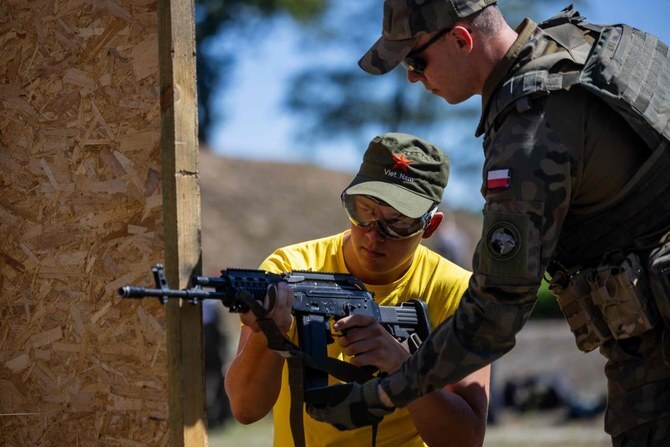
WARSAW: Polish Prime Minister Donald Tusk said Friday that his government is working on a plan to prepare large-scale military training for every adult male in response to the changing security situation in Europe.
The military training would create a reserve force that is “adequate to possible threats,” Tusk said in a major speech on security to Poland’s lower house of parliament, or Sejm.
He said that there’s a need for an army of 500,000 soldiers, which would include reservists.
Last year, the Polish government said that the military was made up of around 200,000 soldiers and was to grow to 220,000 this year with the objective of increasing it to about 300,000.
But security fears have grown far more dramatic in recent weeks, as Russia continues to pound Ukraine with missiles and drones, and as the Trump administration has withdrawn military and intelligence support for Ukraine while putting its commitments to NATO in question.
“Today we are talking about the need for a half-million army in Poland,” Tusk said.
After his speech, Tusk explained to reporters that he wasn’t considering a return of universal military service, but rather a reserve system based on the model in Switzerland. In that country, every man is obliged to serve in the military or an alternative civilian service, while women can volunteer if they choose.
Poland, with a population of 38 million people, is located along NATO’s eastern flank and is deeply concerned by the war in Ukraine. There are fears that if Ukraine is defeated, Russia will turn its imperial ambitions next to countries like Poland, which Moscow controlled during the 19th century and during the Cold War.
Jaroslaw Kaczyński, the head of Poland’s largest opposition party, the conservative Law and Justice, said that a mental shift in society would also be needed in addition to the military training of men.
“We will have a return to the chivalric ethos and to the fact that men should also be soldiers, that is, be able to expose themselves, even to death,” Kaczyński said.
Concern has grown in Poland and across most of Europe as US President Donald Trump has signaled a dramatically shifting stance in Washington to one that includes support for Russia’s position — even though on Friday he issued a stern warning to Russia after it attacked Ukrainian energy facilities with dozens of missiles and drones.
“If Ukraine loses the war or if it accepts the terms of peace, armistice, or capitulation in such a way that weakens its sovereignty and makes it easier for (Russian President Vladimir) Putin to gain control over Ukraine, then, without a doubt — and we can all agree on that — Poland will find itself in a much more difficult geopolitical situation,” Tusk said.
President Andrzej Duda said Friday that he was submitting an amendment to the Polish Constitution for consideration which would oblige the country to spend at least 4 percent of its gross domestic product each year on defense.
Poland is already NATO’s top spender on defense as a percentage of its overall economy, spending above 4 percent of its GDP this year. But Duda said that he wanted to take advantage of the consensus on the political scene in Poland today on the matter to enshrine it in the highest law.
Trump has suggested that the US might abandon its commitments to the alliance if member countries don’t meet defense spending targets.


![]()

Polish leader Tusk plans large-scale military training for all adult males to boost reserves
Short Url
https://arab.news/nq63r
Polish leader Tusk plans large-scale military training for all adult males to boost reserves
- The military training would create a reserve force that is “adequate to possible threats,” Tusk said
- “Today we are talking about the need for a half-million army in Poland”


Latest updates


© 2026 SAUDI RESEARCH & PUBLISHING COMPANY, All Rights Reserved And subject to Terms of Use Agreement.