



WASHINGTON: US President Donald Trump said on Thursday that he would soon decide whether to revoke temporary legal status for some 240,000 Ukrainians who fled the conflict with Russia, following a Reuters report that his administration planned to take that step.
Such a move would be a stunning reversal of the welcome Ukrainians received under President Joe Biden’s administration and potentially put them on a fast-track to deportation.
“We’re not looking to hurt anybody, we’re certainly not looking to hurt them, and I’m looking at that,” Trump told reporters in the Oval Office when asked about revoking the Ukrainians’ status and deporting them. “There were some people that think that’s appropriate, and some people don’t, and I’ll be making the decision pretty soon.”
The planned rollback of protections for Ukrainians would be part of a broader Trump administration effort to strip legal status from more than 1.8 million migrants allowed to enter the US under temporary humanitarian parole programs launched under the Biden administration, a senior Trump official and three sources familiar with the matter told Reuters. A move to revoke the Ukrainians’ status could come as soon as April, all four said. They said the plans to revoke their status got underway before Trump publicly feuded with Ukrainian President Volodymyr Zelensky last week.
White House press secretary Karoline Leavitt pushed back on the Reuters report in a post on X, saying “no decision has been made at this time.” US Department of Homeland Security spokesperson Tricia McLaughlin said on Wednesday that the department had no new announcements. Ukrainian government agencies did not respond to requests for comment.
A Trump executive order issued on January 20 called for DHS to “terminate all categorical parole programs.” The administration plans to revoke parole for about 530,000 Cubans, Haitians, Nicaraguans and Venezuelans as soon as this month, the Trump official and one of the sources familiar with the matter said, requesting anonymity to discuss internal deliberations. The plan to revoke parole for those nationalities was first reported by CBS News. Migrants stripped of their parole status could face fast-track deportation proceedings, according to an internal ICE email seen by Reuters.
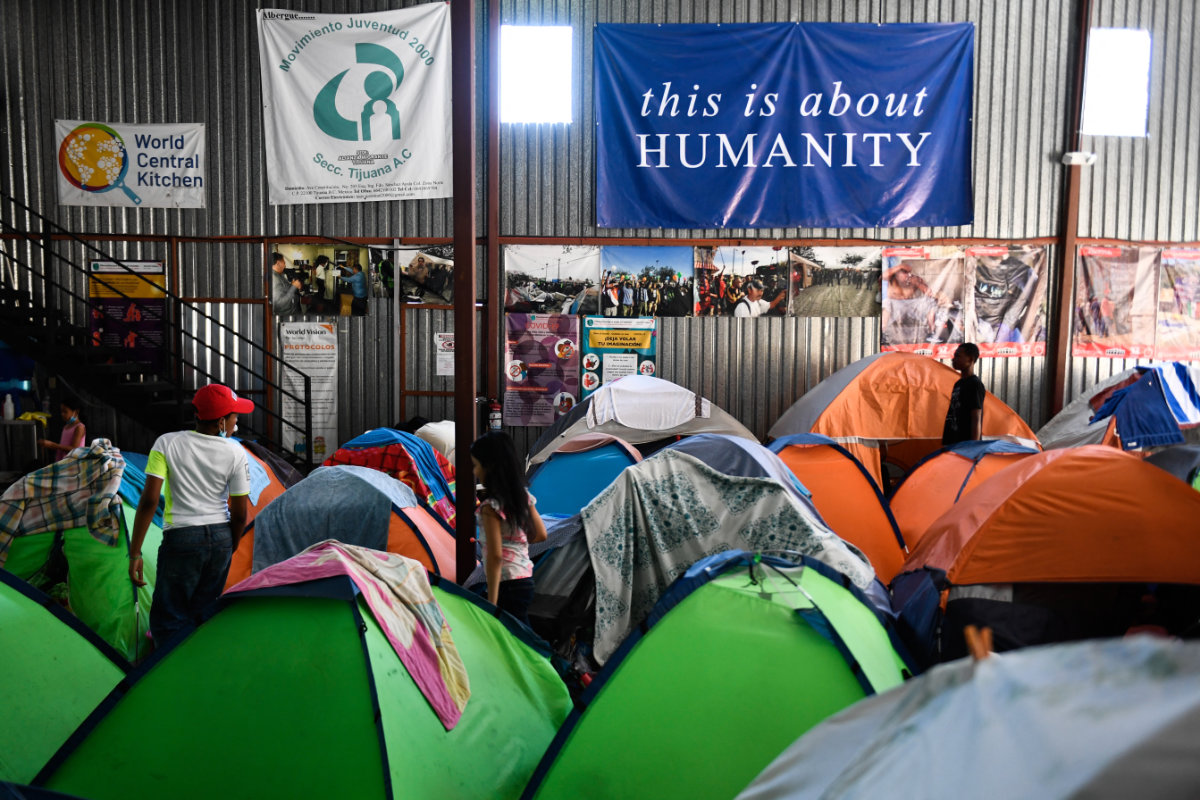
This photo taken on April 9, 2022, shows refugee migrants in the US from Central and South American countries living in tents in Tijuana, Baja California state, Mexico as they attempt to seek asylum in the US. (AFP)
Immigrants who cross the border illegally can be put into the fast-track deportation process known as expedited removal, for two years after they enter. But for those who entered through legal ports of entry without being officially “admitted” to the US — as with those on parole — there is no time limit on their rapid removal, the email said.
The Biden programs were part of a broader effort to create temporary legal pathways to deter illegal immigration and provide humanitarian relief.
In addition to the 240,000 Ukrainians fleeing the Russian invasion, and the 530,000 Cubans, Haitians, Nicaraguans and Venezuelans, these programs covered more than 70,000 Afghans escaping the Taliban takeover of Afghanistan.
An additional 1 million migrants scheduled a time to cross at a legal border crossing via an app known as CBP One. Thousands more had access to smaller programs, including family reunification parole for certain people in Latin America and the Caribbean.
Trump as a candidate pledged to end the Biden programs, saying they went beyond the bounds of US law.
The Trump administration last month paused processing immigration-related applications for people who entered the US under certain Biden parole programs — placing Ukrainian Liana Avetisian, her husband and her 14-year-old daughter, in limbo. Avetisian, who worked in real estate in Ukraine, now assembles windows while her husband works construction. The family fled Kyiv in May 2023, eventually buying a house in the small city of DeWitt, Iowa. Their parole and work permits expire in May. They say they spent about $4,000 in filing fees to renew their parole and to try to apply for another program known as Temporary Protected Status.
Avetisian has started getting headaches as she worries about their situation, she said.
“We don’t know what to do,” she said.
Ukrainian community leaders are informing people of their rights, in case they are approached by immigration officers, and what their options are for staying in the country long-term, said Andrij Dobriansky, the director of communications for the Ukrainian Congress Committee of America.
“Many of these people do not have homes to return to,” he said. “We’re talking about people whose entire towns have been leveled altogether. Where would we be sending them back to? Nothing.”
Waning welcome
US allies from Afghanistan who entered under Biden have also been swept up in Trump’s crackdown.
Rafi, a former Afghan intelligence officer who asked to be identified only by his first name to protect family members still in Afghanistan, entered the US legally in January 2024 using the CBP One mobile app at the US-Mexico border. He was given a temporary humanitarian parole status that allowed him to live and work in the United States for two years.

Rafi, a former Afghan intelligence officer (right), walks with a member of the Afghan special forces at an undisclosed location in Afghanistan, in this handout photo taken in March 2021. (Reuters)
On February 13, just over a year into that status, he was detained at a check-in appointment at an ICE office in Chantilly, Virginia. His status was revoked.
In Afghanistan, Rafi was trained by American officers and provided intelligence on “High Value Targets”, according to an October 2022 recommendation letter.
“As a result of his active efforts against the enemy, he is currently in extreme danger, and in need of assistance in departing the country,” the former CIA officer who trained him wrote. The officer described Rafi as “truly one of the most dedicated and hardworking individuals I had the honor to serve with in Afghanistan.” Reuters reviewed the letter but was not able to reach the officer. In the United States, Rafi applied for asylum and was scheduled for a hearing before an immigration judge in April.
At his February ICE check in — one of the conditions for his temporary status — he was asked to remove his belt and shoelaces, he said. He knew immediately what was happening, he said, and still, he asked: “Are you arresting me? I have broken no law.”
Rafi said he felt betrayed.
“When someone stands shoulder to shoulder with American troops and puts his life in danger…” he said in a phone call from detention, his voice shaking.
“I wasn’t expecting this behavior from them. I wasn’t expecting it.”
On February 24, his lawyer wrote to ICE asking them to release her client, noting his lack of a criminal record, that he was not a flight risk and had an active asylum case related to his work supporting the US military in Afghanistan.
James Mullan, the assistant field office director at ICE’s Washington field office responded that ICE was declining to release him.
“The priorities that you mentioned in your email ended on January 20, 2025,” Mullan wrote, referring to the date of Trump’s inauguration.


