TORONTO: Prime Minister Justin Trudeau said Thursday he welcomed indications that the US would delay substantial tariffs on Canadian products for a month, but said Canada’s plan to impose retaliatory tariffs would remain in place for now.
US President Donald Trump said Thursday that he has postponed 25 percent tariffs on most goods from Mexico for a month, amid widespread fears of the impact of a broader trade war. US Commerce Secretary Howard Lutnick had said earlier Thursday that tariffs on both Canada and Mexico would “likely” be delayed. Yet so far no decision has been announced regarding Canada.
This is the second one-month postponement Trump has announced since first unveiling the import taxes in early February.
Trudeau earlier said he expects Canada and the US to be in a trade war for the foreseeable future after having what he called a colorful but constructive call with Trump on Tuesday.
Trudeau said the two sides are “actively engaged in ongoing conversations in trying to make sure these tariffs don’t overly harm” certain sectors and workers. He also reiterated that “we will not be backing down from our response tariffs until such a time as the unjustified American tariffs are Canadian goods are lifted.”
Trump launched a new trade war Tuesday by imposing tariffs against Washington’s three biggest trading partners, drawing immediate retaliation from Mexico, Canada and China and sending financial markets into a tailspin. Trump put 25 percent taxes, or tariffs, on Mexican and Canadian imports, though he limited the levy to 10 percent on Canadian energy.
On Thursday, US Commerce Secretary Howard Lutnick said in a television interview that Trump will likely suspend the 25 percent tariffs on Canada and Mexico for most products and services for a month, broadening an exemption that was granted on Wednesday only to autos.
In an interview on CNBC, Lutnick said the one-month delay in the import taxes “will likely cover” all goods and services under the United States-Mexico-Canada Agreement, or USMCA, the trade agreement Trump negotiated in his last term that replaced NAFTA.
Lutnick estimated that more than half of what the US imports from those two countries would be eligible for the exemption.
For companies with products that comply with the trade agreement, “you will get a reprieve now,” he said.
Trudeau said Lutnick’s comments align with conversations Canadian officials have had with the Trump administration. “But I am going to wait for an official agreement to talk about Canadian response or look at the details of it but it is a promising sign.” Trudeau said. “But I will highlight that it means that the tariffs remain in place and therefore our response will remain in place.”
A day after the new tariffs took effect, Trump had said he would grant a one-month exemption for US automakers. The announcement came after Trump spoke Wednesday with leaders of Ford, General Motors and Stellantis, the parent company of Chrysler and Jeep. His press secretary said Trump told the chief executives to move auto production to the US to avoid tariffs.
Canada’s initial $30 billion Canadian ($21 billion) worth of retaliatory tariffs have been applied on items like American orange juice, peanut butter, coffee, appliances, footwear, cosmetics, motorcycles and certain pulp and paper products.
Ottawa plans a further $125 billion ($87 billion) tariffs in three weeks on American products like electric vehicles, fruits and vegetables, diary, beef, pork, electronics, steel and trucks.
Ontario Premier Doug Ford, the leader of Canada’s most populous province, said Thursday that starting Monday, the province will charge 25 percent more for electricity shipped to 1.5 million Americans in response to Trump’s tariffs. Ontario provides electricity to Minnesota, New York and Michigan.
Ford said he does not want to do it, but will not back down until Trump rescinds all tariffs.
“President Trump has created a mess,” Ford posted on X. “Here’s the solution: drop the threat tariffs completely and let’s get to the table to land a deal that creates jobs and grows our economies on both sides of the border. Until then, we won’t relent.”
Canada is the top export destination for 36 US states. Nearly $3.6 billion Canadian ($2.7 billion) worth of goods and services cross the border each day.
Despite Trump’s claim that the USdoesn’t need Canada, nearly a quarter of the oil America consumes per day comes from Canada. About 60 percent of US crude oil imports are from Canada, and 85 percent of US electricity imports as well.
Canada is also the largest foreign supplier of steel, aluminum and uranium to the US and has 34 critical minerals and metals that the Pentagon is eager for and investing for national security.
Canada’s provinces, meanwhile, are lifting inter provincial trade barriers in an effort to lessen Canada’s dependence on the US.


Trudeau expects a trade war between Canada and the US for the ‘foreseeable future’

https://arab.news/r5tv8
Trudeau expects a trade war between Canada and the US for the ‘foreseeable future’

- US Commerce Secretary Howard Lutnick had said earlier Thursday that tariffs on both Canada and Mexico would “likely” be delayed
- Trudeau said the two sides are “actively engaged in ongoing conversations in trying to make sure these tariffs don’t overly harm” certain sectors and workers


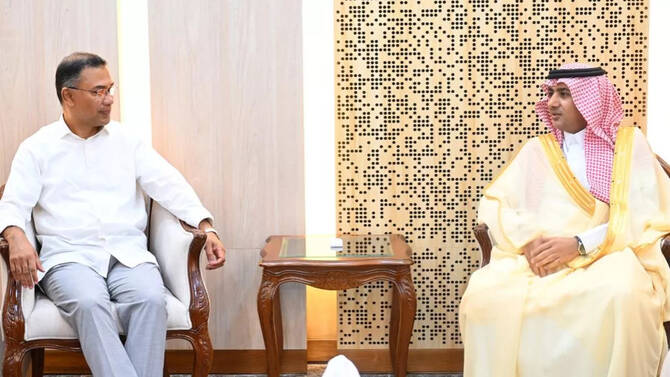
Saudi ambassador becomes first foreign envoy to meet Bangladesh’s new PM
- Tarique Rahman took oath as PM last week after landslide election win
- Ambassador Abdullah bin Abiyah also meets Bangladesh’s new FM
Dhaka: Saudi Arabia’s ambassador to Dhaka became on Sunday the first foreign envoy to meet Bangladesh’s new Prime Minister Tarique Rahman since he assumed the country’s top office.
Rahman’s Bangladesh Nationalist Party made a landslide win in the Feb. 12 election, securing an absolute majority with 209 seats in the 300-seat parliament.
The son of former Prime Minister Khaleda Zia and former President and BNP founder Ziaur Rahman, he was sworn in as the prime minister last week.
The Saudi government congratulated Rahman on the day he took the oath of office, and the Kingdom’s Ambassador Abdullah bin Abiyah was received by the premier in the Bangladesh Secretariat, where he also met Bangladesh’s new foreign minister.
“Among the ambassadors stationed in Dhaka, this is the first ambassadorial visit with Prime Minister Tarique Rahman since he assumed office,” Saleh Shibli, the prime minister’s press secretary, told Arab News.
“The ambassador conveyed greetings and best wishes to Bangladesh’s prime minister from the king and crown prince of Saudi Arabia … They discussed bilateral matters and ways to strengthen the ties among Muslim countries.”
Rahman’s administration succeeded an interim government that oversaw preparations for the next election following the 2024 student-led uprising, which toppled former leader Sheikh Hasina and ended her Awami League party’s 15-year rule.
New Cabinet members were sworn in during the same ceremony as the prime minister last week.
Foreign Minister Khalilur Rahman is a former UN official who served as Bangladesh’s national security adviser during the interim government’s term.
He received Saudi Arabia’s ambassador after the envoy’s meeting with the prime minister.
“The foreign minister expressed appreciation for the Saudi leadership’s role in promoting peace and stability in the Middle East and across the Muslim Ummah. He also conveyed gratitude for hosting a large number of Bangladeshi workers in the Kingdom and underscored the significant potential for expanding cooperation across trade, investment, energy, and other priority sectors, leveraging the geostrategic positions of both countries,” the ministry said in a statement.
“The Saudi ambassador expressed his support to the present government and his intention to work with the government to enhance the current bilateral relationship to a comprehensive relationship.”
Around 3.5 million Bangladeshis live and work in Saudi Arabia. They have been joining the Saudi labor market since 1976, when work migration to the Kingdom was established during the rule of the new prime minister’s father.
Bangladeshis are the largest expat group in the Kingdom and the largest Bangladeshi community outside Bangladesh and send home more than $5 billion in remittances every year.


