

Restoration of Qalaa Mosque in Madinah enhances Saudi Arabia’s Islamic heritage

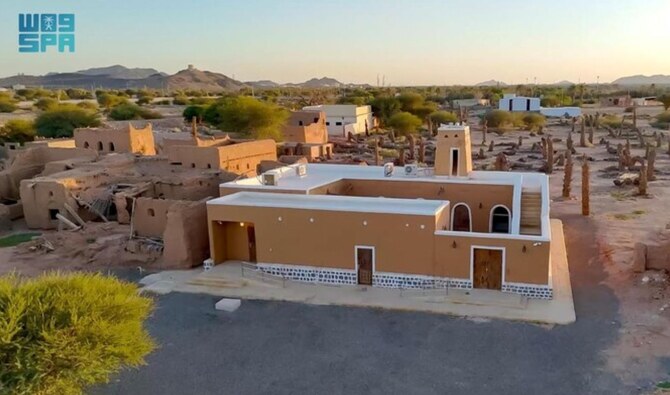
An undated file photo of Qalaa Mosque in the town of Al-Hinakiyah, northeast of Madinah, Saudi Arabia. (Photo courtesy: SPA)
Short Url
Updated 06 March 2025
Follow

Restoration of Qalaa Mosque in Madinah enhances Saudi Arabia’s Islamic heritage

  • Restoration taking place under Prince Mohammed bin Salman Project for Development of Historic Mosques 
  • The Initiative aims to enhance the Islamic heritage of the Kingdom as the land where the Qur’an was revealed

RIYADH: The historic Qalaa Mosque in the town of Al-Hinakiyah, northeast of Madinah, is among the places of worship undergoing restoration as part of a national project.

The second phase of the Prince Mohammed bin Salman Project for the Development of Historic Mosques focuses on preserving the building, which is over a century old, in Madinah’s historical architectural style, the Saudi Press Agency reported recently.

The initiative aims to enhance the Islamic heritage of the Kingdom as the land where the Qur’an was revealed, and the location of the Two Holy Mosques. 

The project will expand the mosque’s area from 181 sq. meters to 263 sq. meters to accommodate 171 worshippers. The mosque was previously unused, the SPA added.

The renovation will include the use of natural materials including clay and local wood, to ensure the mosque returns to its original form. 

It will preserve the unique building techniques that are adapted to the local environment and hot desert climate.

The crown prince’s project aims to balance traditional and modern construction standards to ensure the sustainability of historic mosques, the SPA reported.

Saudi Arabia companies and engineers specializing in heritage restoration are leading the work.

Phase two of the crown prince’s project follows the successful completion of phase one in 2018, which restored 30 mosques in 10 regions across the Kingdom.


Foreign ministers chair Saudi-Omani coordination council meeting in Muscat

Updated 57 min 38 sec ago
Follow

Foreign ministers chair Saudi-Omani coordination council meeting in Muscat

MUSCAT: Saudi Foreign Minister Prince Faisal bin Farhan met with Oman’s Foreign Minister Sayyid Badr bin Hamad Al-Busaidi on Monday.

They reviewed bilateral relations between their nations and ways to enhance and develop them across various fields. Additionally, they discussed regional and international developments.

The ministers co-chaired the third meeting of the Saudi-Omani Coordination Council in the Omani capital, Muscat, with the participation of the heads of the Council’s subsidiary committees and the two heads of the Council’s General Secretariat teams.

The meeting comes as an affirmation of the keenness of Saudi and Omani leaders to strengthen ties and advance them toward greater prosperity for both nations.

In his remarks during the meeting, Prince Faisal affirmed that gathering builds on the previous council meeting, held last year in AlUla, and on its positive and fruitful outcomes within the framework of the approved recommendations and initiatives. 

He stressed the importance of continuing the work of the council’s subsidiary committees to complete the necessary procedures to implement the remaining initiatives, and of the General Secretariat’s role in follow-up and in addressing any challenges that may hinder implementation.

He also underscored the importance of developing and enhancing trade relations, stimulating investment, and strengthening cooperation between the public and private sectors.

He also praised the ongoing work to establish and launch the Coordination Council’s electronic platform, which aims to connect all committee work and initiatives to facilitate follow-up on the Council’s progress. 

Al-Busaidi affirmed in his remarks the qualitative progress in relations between the two countries and the notable development witnessed across numerous sectors toward achieving economic integration and enhancing intra-trade and joint investments. 

The Omani foreign minister also highlighted deeper cooperation in the security and judicial fields, as well as the cultural and tourism sectors, noting the advanced and continuous political cooperation, consultation, and coordination on regional and international issues.