Jordanian border forces clash with smugglers, killing four

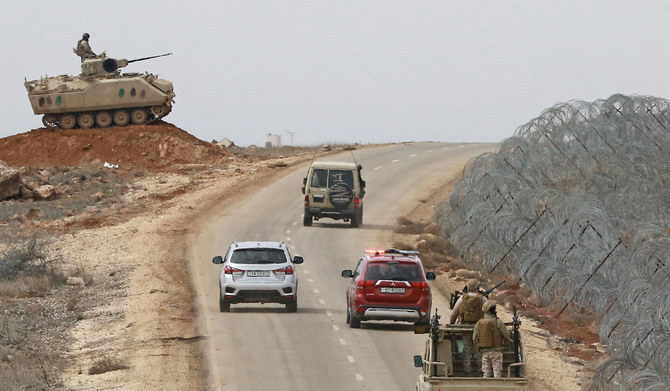
This file photo taken during a tour organised by the Jordanian Army shows soldiers patrolling the border with Syria to prevent trafficking on February 17, 2022. (AFP)
Short Url
Updated 06 March 2025
Follow

Jordanian border forces clash with smugglers, killing four

  • Large quantities of narcotics and weapons were seized and transferred to the relevant authorities, the armed forces said

DUBAI: Jordanian border forces clashed on Thursday with armed smuggling groups attempting to cross the northern border from Syria into Jordan, the Jordan Armed forces said in a statement.
The clashes resulted in the death of four smugglers, while the remaining individuals retreated into Syrian territory.
According to the statement, the smugglers had attempted to exploit poor weather conditions and dense fog to cross the border, but Jordanian forces “applied engagement rules to prevent their infiltration.”
Large quantities of narcotics and weapons were seized and transferred to the relevant authorities, the armed forces said.
The amount of the seized drugs was not disclosed.
In January, Jordan and Syria agreed to form a joint security committee to secure their border, combat arms and drug smuggling and work to prevent the resurgence of Daesh militants.
Western anti-narcotics officials say the addictive, amphetamine-type stimulant known as captagon has for years been mass-produced in Syria and that Jordan is a transit route to the oil-producing Gulf states.
Jordan’s army has conducted several pre-emptive airstrikes in Syria since 2023 that Jordanian officials say targeted militias accused of links to the drug trade, as well as the militias’ facilities.


As US weighs its options with Tehran, the region awaits with anticipation

Updated 6 sec ago
Follow

As US weighs its options with Tehran, the region awaits with anticipation

  • Saudi sources deny any attempts to influence position in Washington, DC

RIYADH: The US is continuing to weigh its options toward Iran as the aircraft carrier USS Abraham Lincoln heads toward the Middle East, amid heightened tensions and widespread protests across the Islamic Republic.

The deployment, reported since late Friday, comes as Washington reiterates that all options remain on the table in its approach to Tehran, which it considers a major regional foe, with Iran’s handling of the protests as a key factor in their ongoing deliberations.

Saudi officials have rejected claims that Riyadh is attempting to influence decision-making in Washington.

A senior Saudi official at the Kingdom’s embassy in the US said that reports suggesting Saudi Arabia had advised the US against striking Iran “are not true.”

Earlier this week, Saudi Minister of State for Foreign Affairs Adel Al-Jubeir was asked about the unrest in Iran and the prospect of a US response during a major business conference in Riyadh.

While stopping short of offering a direct view on potential military action, Al-Jubeir said that “everybody is watching the situation very closely,” expressing hope that tensions could be resolved in a way that would “minimize any kind of damage.”

Saudi commentator Ali Shihabi also denied that Riyadh was lobbying either for or against a strike on Iran. Writing on X, he said: “Saudi Arabia did not get involved in this discussion one way or the other.”

In a separate commentary published in the Saudi daily Asharq Al-Awsat, columnist Abdulrahman Al-Rashed hinted that Iran itself now holds the key to avoiding further escalation.

“Ending the nuclear program and stopping external activity could spare Iran foreign intervention that enables internal change by exploiting widespread domestic unrest,” he argued.

Al-Rashed described the current moment as unprecedented for the Islamic Republic.

“The Iranian regime is facing an existential crisis for the first time since the founder of the Islamic Republic returned to Tehran,” he said.

“There is only one actor capable of preventing its descent, and possibly its collapse, and it is neither Washington, nor Israel, nor the Gulf states. The only party capable of saving the Iranian regime from its fate is the regime itself.”

“This time, the threats against it have converged, and together they are capable of bringing it down. Danger surrounds it both internally and externally,” he concluded.