

Saudi wealth fund’s NSG, SuperMap to advance Kingdom’s geospatial sector

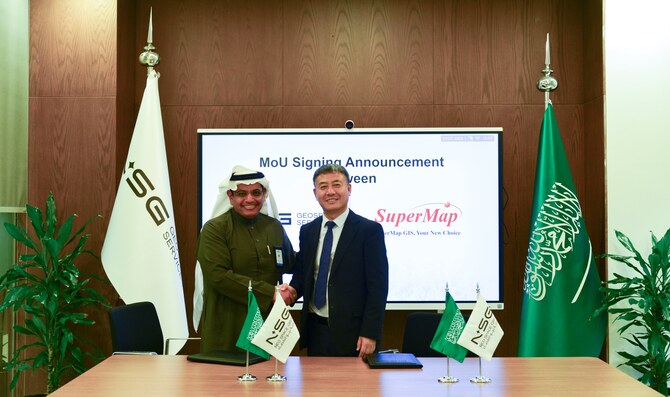
The partnership was formalized in Riyadh on Feb. 25, during a signing ceremony attended by NSG CEO Abdulaziz bin Suleiman Al-Faraj and Wang Haitao, vice president of SuperMap and president of its international division. Photo/Supplied
Short Url
Updated 05 March 2025
Follow

Saudi wealth fund’s NSG, SuperMap to advance Kingdom’s geospatial sector

JEDDAH: Saudi Arabia’s geospatial sector is poised for growth as Neo Space Group partners with SuperMap Software to enhance technological capabilities and support the Kingdom’s Vision 2030 goals.

NSG, a satellite and space firm under Saudi Arabia’s sovereign wealth fund, has teamed up with the Beijing-based SuperMap to improve geographic information system services.

This collaboration will bolster the development of the Kingdom’s geospatial sector, aligning with Saudi Arabia’s strategic objectives for expanding its commercial space operations and advancing innovative satellite solutions both locally and globally.

Founded in mid-2024, NSG is focused on diversifying investments in local and international assets, as well as pursuing promising venture capital opportunities. This initiative aims to foster the advancement and localization of specialized expertise in the sector.

The partnership was formalized in Riyadh on Feb. 25, during a signing ceremony attended by NSG CEO Abdulaziz bin Suleiman Al-Faraj and Wang Haitao, vice president of SuperMap and president of its international division.

Al-Faraj emphasized the importance of the agreement, stating that the collaboration with SuperMap would significantly contribute to the growth of Saudi Arabia’s geospatial industry and its technological capabilities.

“We look forward to delivering innovative GIS solutions that will benefit not only Saudi Arabia but the broader Middle East region,” he said.

Haitao also expressed excitement about the collaboration, noting SuperMap’s commitment to supporting Saudi Arabia’s digital transformation. “We are excited to work with NSG to explore future directions in geospatial technology and contribute to the Kingdom’s technological advancement,” he commented.

SuperMap, one of the world’s largest GIS platform providers, recently opened a local office in Saudi Arabia to strengthen its regional presence. This move reflects the company’s long-term commitment to fostering innovation and driving partnerships throughout the Middle East.

Together, NSG and SuperMap aim to revolutionize geospatial technology in Saudi Arabia and the wider region, delivering transformative solutions across various sectors, including urban planning, environmental management, and infrastructure development.


Emerging markets should depend less on external funding, says Nigeria finance minister

Updated 10 February 2026
Follow

Emerging markets should depend less on external funding, says Nigeria finance minister

RIYADH: Developing economies must rely less on external financing as high global interest rates and geopolitical tensions continue to strain public finances, Nigeria’s finance minister told Al-Eqtisadiah.

Asked how Nigeria is responding to rising global interest rates and conflicts between major powers such as the US and China, Wale Edun said that current conditions require developing countries to rethink traditional financing models.

“I think what it means for countries like Nigeria, other African countries, and even other developing countries is that we have to rely less on others and more on our own resources, on our own devices,” he said on the sidelines of the AlUla Conference for Emerging Market Economies.

He added: “We have to trade more with each other, we have to cooperate and invest in each other.” 

Edun emphasized the importance of mobilizing domestic resources, particularly savings, to support investment and long-term economic development.

According to Edun, rising debt servicing costs are placing an increasing burden on developing economies, limiting their ability to fund growth and social programs.

“In an environment where developing countries as a whole — what we are paying in debt service, what we are paying in terms of interest costs and repayments of our debt — is more than we are receiving in what we call overseas development assistance, and it is more than even investments by wealthy countries in our economies,” he said.

Edun added that countries in the Global South are increasingly recognizing the need for deeper regional integration.

His comments reflect growing concern among developing nations that elevated borrowing costs and global instability are reshaping development finance, accelerating a shift toward domestic resource mobilization and stronger economic ties among emerging markets.