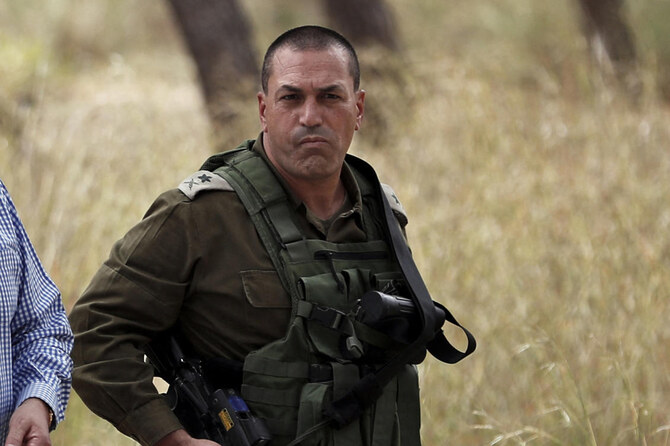
JERUSALEM: Israel’s newly appointed military chief Eyal Zamir said Wednesday that his country’s mission to defeat Hamas was not yet accomplished, with his inauguration coming at a precarious moment for the fragile truce in Gaza.
Speaking before Zamir at a ceremony at military headquarters in Tel Aviv, Prime Minister Benjamin Netanyahu said Israel was “determined” to achieve victory in the multi-front war that began with Hamas’s October 7, 2023 attack.
The remarks come after Arab leaders endorsed on Tuesday a plan to rebuild the Gaza Strip under the future administration of the Palestinian Authority, presenting an alternative to US President Donald Trump’s widely condemned proposal to take over the territory and displace its people.
But the prospect of the PA governing Gaza remains far from certain, with Israel having ruled out any future role for the body in the territory ruled by Hamas since 2007.
“Hamas has indeed suffered a severe blow, but it has not yet been defeated. The mission is not yet accomplished,” Zamir said, amid a deadlock in negotiations on next steps in the ceasefire with Hamas in Gaza.
Zamir is replacing Herzi Halevi, who announced his resignation as armed forces chief in January over the military’s shortcomings on October 7.
The military has since released the findings of an internal investigation that acknowledged its “complete failure” to prevent the deadliest attack on Israel since its creation.
The Hamas assault resulted in the deaths of 1,218 people, most of them civilians, while Israel’s military retaliation in Gaza has killed at least 48,405 people, also mostly civilians, data from both sides show.
The war in Gaza has left the territory largely in ruins and created a dire humanitarian crisis.
An Arab League summit on Tuesday announced the adoption of a “comprehensive” plan for Gaza’s reconstruction, to be financed by a trust fund, and urged the international community to offer its support.
An initial draft of the plan seen by AFP outlined a five-year roadmap with a price tag of $53 billion — roughly the amount the United Nations estimated for Gaza’s reconstruction — but the figure was not included in the summit’s final statement.
“All these efforts are proceeding in parallel with the launch of a political track” toward Palestinian statehood, it reads, an ambition that Israeli leaders have opposed.
The summit also called on Palestinian representation to be unified under the PLO, an umbrella group that is the dominant political force within the Palestinian Authority — a move that could sideline Islamist Hamas, which is not a member.
The Arab plan was a direct response to the one floated by Trump, who triggered global outrage by suggesting the United States “take over” Gaza and turn it into the “Riviera of the Middle East,” while forcing its Palestinian inhabitants to relocate to Egypt or Jordan.
Hugh Lovatt, a senior policy fellow with the Middle East and North Africa Programme at the European Council on Foreign Relations, said the new plan was “not as shaky as what the Americans are proposing.”
“It’s far more realistic than what the Trump administration is proposing in terms of being able to be operationalized,” he added.
Egyptian Foreign Minister Badr Abdelatty said the plan would seek backing from Muslim nations at an emergency summit of Organization for Islamic Cooperation (OIC) foreign ministers scheduled for Friday in Jeddah.
The ceasefire deal’s first phase ended last month, after six weeks of relative calm that included exchanges of Israeli hostages taken on October 7 for Palestinian prisoners held in Israeli jails.
While Israel has said it wants to extend the first phase until mid-April, Hamas has insisted on a transition to the deal’s second phase, which should lead to a permanent end to the war.
Of the 251 hostages taken on October 7, 58 remain in Gaza, including 34 the Israeli military has confirmed are dead
Netanyahu has faced sustained pressure throughout the war from the hostages’ families and supporters to strike a deal to bring them home.
“It’s very hard for me that the country still hasn’t completed the process of bringing back the hostages,” said Yael Lotem, who came out on Wednesday to watch the funeral procession of slain hostage Ohad Yahalomi.
“It was possible to bring them all back alive, and that didn’t happen.”


Israel’s new army chief says mission against Hamas ‘not accomplished’
https://arab.news/wxxpg
Israel’s new army chief says mission against Hamas ‘not accomplished’

- “Hamas has indeed suffered a severe blow, but it has not yet been defeated. The mission is not yet accomplished,” Zamir said
- Zamir is replacing Herzi Halevi, who announced his resignation as armed forces chief in January over the military’s shortcomings on October 7


Washington presses Syria to shift from Chinese telecom systems
- Syria is exploring the possibility of procuring Chinese technology
- It was unclear whether the United States pledged financial or logistical support to Syria to do so
DAMASCUS: The United States has warned Syria against relying on Chinese technology in its telecommunications sector, arguing it conflicts with US interests and threatens US national security, according to three sources familiar with the matter.
The message was conveyed during an unreported meeting between a US State Department team and Syrian Communications Minister Abdulsalam Haykal in San Francisco on Tuesday. Washington has been coordinating closely with Damascus since 2024, when Syria’s now President Ahmed Al-Sharaa ousted longtime leader Bashar Assad, who had a strategic partnership with China.
Syria is exploring the possibility of procuring Chinese technology to support its telecommunications towers and the infrastructure of local Internet service providers, according to a Syrian businessman involved in the procurement talks.
“The US side asked for clarity on the ministry’s plans regarding Chinese telecom equipment,” said another source briefed on the talks.
But Syrian officials said infrastructure development projects were time-critical and that Damascus was seeking greater vendor diversity, the source added.
SYRIAN OFFICIALS CITE US EXPORT CONTROLS AS TELECOMS BARRIER
Syria is open to partnering with US firms but the matter was urgent and export controls and “over-compliance” remained an issue, according to person familiar with the meeting in San Francisco.
A US diplomat familiar with the discussions told Reuters that the US State Department “clearly urged Syrians to use American technology or technology from allied countries in the telecoms sector.”
It was unclear whether the United States pledged financial or logistical support to Syria to do so.
Responding to Reuters questions, a US State Department spokesperson said: “We urge countries to prioritize national security and privacy over lower-priced equipment and services in all critical infrastructure procurement. If it seems too good to be true, it probably is.”
The spokesperson added that Chinese intelligence and security services “can legally compel Chinese citizens and companies to share sensitive data or grant unauthorized access to their customers’ systems” and promises by Chinese companies to protect customers’ privacy were “entirely inconsistent with China’s own laws and well-established practices.”
China has repeatedly rejected allegations of it using technology for spying purposes.
The Syrian Ministry of telecommunications told Reuters any decisions related to equipment and infrastructure are made “in accordance with national technical and security standards, ensuring data protection and service continuity.”
The ministry said it is also prioritizing the diversification of partnerships and technology sources to serve the national interest.
Syria’s telecom infrastructure has relied heavily on Chinese technology due to US sanctions imposed on successive Assad governments over the civil war that grew from a crackdown on anti-government protests in 2011.
Huawei technology accounts for more than 50 percent of the infrastructure of Syriatel and MTN, the country’s only telecom operators, according to a senior source at one of the companies and documents reviewed by Reuters. Huawei did not immediately respond to a request for comment.
Syria is seeking to develop its private telecommunications sector, devastated by 14 years of war, by attracting foreign investment.
In early February, Saudi Arabia’s largest telecom operator, STC, announced it would invest $800 million to “strengthen telecommunications infrastructure and connect Syria regionally and internationally through a fiber-optic network extending over 4,500 kilometers.”
The ministry of telecommunications says that US restrictions “hinder the availability of many American technologies and services in the Syrian market,” emphasizing that it welcomes expanding cooperation with US companies when these restrictions are lifted.
Syria has inadequate telecommunications infrastructure, with network coverage weak outside city centers and connection speeds in many areas barely exceeding a few kilobits per second.


