KYIV: Ukrainian President Volodymyr Zelensky said Tuesday the Oval Office blowup with US President Donald Trump last week was “regrettable,” adding that he stands ready to work under Trump’s “strong leadership” to get a lasting peace.
Zelensky’s remarks — an apparent attempt to placate Trump — came in a social media post on X, hours after the White House announced a pause in military aid to Ukraine that is critical to fighting Russia’s invasion,
He also said Ukraine is ready to sign a lucrative deal on rare-earth minerals and security with Washington.
In an apparent reference to Trump’s criticism following the contentious White House meeting on Friday that Zelensky does not want a peace deal, the Ukrainian leader said: “None of us want an endless war.”
“Ukraine is ready to come to the negotiating table as soon as possible to bring lasting peace closer. Nobody wants peace more than the Ukrainians. My team and I stand ready to work under President Trump’s strong leadership to get a peace that lasts,” he said.
The meeting “did not go the way it was supposed to be,” Zelensky said. “It is regrettable that it happened this way. It is time to make things right. We would like future cooperation and communication to be constructive.”
The US decision to pause military aid catapulted his country into alarm and apprehension. Zelensky’s statement came before Trump was expected to address the US Congress later Tuesday.
“Regarding the agreement on minerals and security, Ukraine is ready to sign it in any time and in any convenient format,” Zelensky said. “We see this agreement as a step toward greater security and solid security guarantees, and I truly hope it will work effectively.”
British Prime Minister Keir Starmer spoke to the Ukrainian leader Tuesday and “welcomed President Zelensky’s steadfast commitment to securing peace.”
Zelensky’s post came as officials in Kyiv said they were grateful for vital US help in the war and want to keep working with Washington. Ukraine’s prime minister, though, said the country still wants security guarantees to be part of any peace deal and won’t recognize Russian occupation of any Ukrainian land. Those are potential stumbling blocks for Washington and Moscow, respectively.
Ukraine and its allies are concerned Trump is pushing for a quick ceasefire that will favor Russia, which Kyiv says cannot be trusted to honor truces.
A White House official said the US was “pausing and reviewing” its aid to “ensure that it is contributing to a solution.” The order will remain in effect until Trump determines that Ukraine has demonstrated a commitment to peace negotiations, said the official, who spoke on condition of anonymity to discuss the assistance.
The pause in US aid isn’t expected to have an immediate impact on the battlefield. Ukrainian forces have slowed Russian advances along the roughly 1,000-kilometer (600-mile) front line, especially in the fiercely contested Donetsk region some 700 kilometers (400 miles) east of Kyiv. The Russian onslaught has been costly in troops and armor but hasn’t brought a strategically significant breakthrough for the Kremlin.
Ukraine needs help to fight Russia
Ukraine, which depends heavily on foreign help to hold back Russia’s full-scale invasion that began on Feb. 24, 2022, has feared that aid could be stopped since Trump took office.
US-made Patriot air defense missile systems, for example, are a pivotal part of protecting Ukraine. Just as vital is US intelligence assistance, which has allowed Ukraine to track Russian troop movements and select targets.
“I feel betrayed, but this feeling is not really deep for some reason. I was expecting something like that from Trump’s side,” said a Ukrainian soldier fighting in Russia’s Kursk region, where Ukraine launched a daring military incursion in August 2024 to improve its hand in negotiations. The soldier spoke by phone to The Associated Press on condition of anonymity because he was not authorized to talk to the media.
On the front line, where Ukraine is struggling to fend off the much larger and better-equipped Russian army, another soldier said the US decision would allow further battlefield gains for Moscow.
“War is very pragmatic,” he told AP, speaking on condition of anonymity in compliance with military regulations. “If we have weapons, enough ammunition, infantry, armored vehicles and aviation — great. If not, then we’re done,” he said.
He recalled a seven-month delay in US aid that ended in April 2024 but opened a door for the Russian capture of the strategically important city of Avdiivka.
Olena Fedorova, 46, of the southern port city of Odesa, said she hoped Trump’s decision would be temporary because “we really need help.”
US support is vital because Europe cannot fully provide what Ukraine needs in air defense systems, said lawmaker Yehor Chernov. “As a result, this will lead to an increase in the number of casualties among civilians,” he said.
The US suspension of military aid is already being felt at a hub in eastern Poland that has been used to ferry Western weapons into neighboring Ukraine, Polish Prime Minister Donald Tusk said.
The US-Ukraine relationship has taken a downturn since Trump took office and his team launched bilateral talks with Russia.
Trump had vowed during his campaign to settle the war in 24 hours, but later changed that time frame and voiced hope that peace could be negotiated in six months.
Ukrainian Prime Minister Denys Shmyhal said US help is “vital” and has saved “perhaps tens of thousands” of civilian and military lives. But he emphasized that any peace agreement must be “on Ukraine’s terms, as the victim country.”
Ukraine wants “concrete security guarantees” from Washington, European countries and Group of Seven leading industrialized nations, he said. Giving up territory to Russia, which occupies nearly 20 percent of Ukraine, “is not possible” under the UN Charter, he said.
European allies stress support for Kyiv
Kremlin spokesman Dmitry Peskov said Washington’s decision could act as a spur to a peace agreement.
“The US has been the chief supplier in this war so far,” Peskov said. “If the US suspends these supplies, it will make the best contribution to peace.”
Poland’s Foreign Ministry said the US had not consulted with or informed NATO countries before announcing the pause.
Russia will likely try to use the halt in supplies to extend its territorial gains and strengthen its position in prospective peace talks.
Russia’s state RIA Novosti news agency quoted Andrei Kartapolov, a retired general who chairs the defense committee in the lower house of parliament, as saying Ukraine would exhaust its current ammunition reserves within months. “We need to keep up the pressure and continue to target their bases and depots with long-range precision weapons to destroy the stockpiles,” he said.
Ukraine’s European allies, meanwhile, reaffirmed their commitment to Kyiv.
The chief of the European Union’s executive proposed an 800 billion euro ($841 billion) plan to bolster defenses of EU nations and provide Ukraine with military muscle.
The British government, which has been leading European efforts to keep Trump from pushing to end the war on terms that could favor Moscow, said it remains “absolutely committed to securing a lasting peace in Ukraine.”
Malcolm Chalmers, deputy director-general of the Royal United Services Institute, a London-based defense think tank, said Washington’s move could encourage Russia to ask for more Ukrainian concessions, including demilitarization and neutrality.


![]()

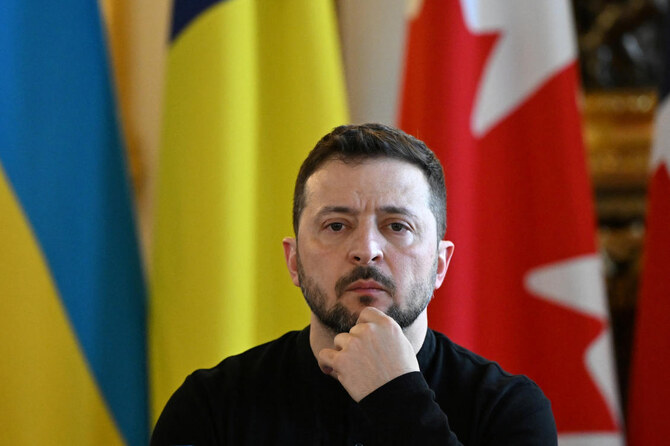
Zelensky calls Oval Office spat with Trump ‘regrettable,’ says he’s ready to work for peace
Short Url
https://arab.news/vp5pw
Zelensky calls Oval Office spat with Trump ‘regrettable,’ says he’s ready to work for peace
- Zelensky’s remarks — an apparent attempt to placate Trump — came in a social media post on X
- Comments came hours after the White House announced a pause in military aid to Ukraine that is critical to fighting Russia’s invasion


Latest updates


© 2026 SAUDI RESEARCH & PUBLISHING COMPANY, All Rights Reserved And subject to Terms of Use Agreement.