Tokyo: Firefighters were Tuesday battling Japan’s worst wildfire in half a century, which has left one dead and forced the evacuation of nearly 4,000 local residents.
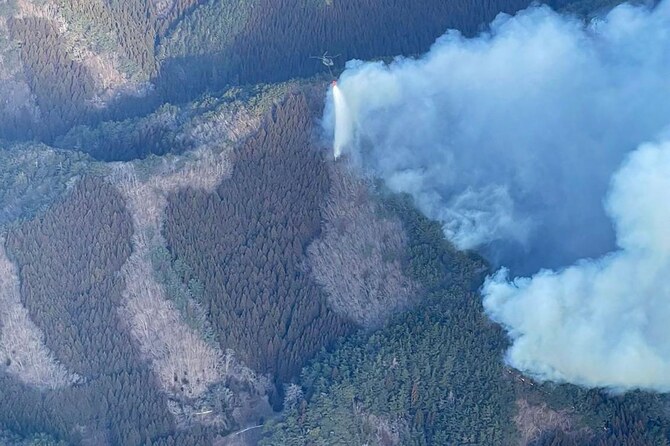
White smoke billowed from a forested area around the northern city of Ofunato, aerial TV footage showed, five days after the blaze began after record low rainfall.
The fire also follows Japan’s hottest summer on record last year, as climate change pushes up temperatures worldwide.
As of Tuesday morning, the wildfire had engulfed around 2,600 hectares (6,400 acres), the fire and disaster management agency said — over seven times the area of New York’s Central Park.
That makes it Japan’s largest wildfire since 1975 when 2,700 hectares burnt in Kushiro on northern Hokkaido island.
It is estimated to have damaged at least 80 buildings by Sunday, although details were still being assessed, the agency said.
Military and fire department helicopters are trying to douse the Ofunato fire, but it is still spreading, a city official told reporters.
“There is little concern that the fire will reach the (more densely populated) city area,” the official said, adding that authorities were “doing our best” to put it out.
Around 2,000 firefighters — most deployed from other parts of the country, including Tokyo — are working from the air and ground in the area in Iwate region, which was hard-hit by a deadly tsunami in 2011.
An evacuation advisory has been issued to around 4,600 people, of whom 3,939 have left their homes to seek shelter, according to the municipality.
The number of wildfires in Japan has declined since its 1970s peak, but the country saw about 1,300 in 2023, concentrated in February to April when the air dries and winds pick up.
Ofunato had just 2.5 millimeters (0.1 inches) of rainfall in February — breaking the previous record low for the month of 4.4 millimeters in 1967 and below the usual average of 41 millimeters.
Since Friday, “there has been no rain — or very little, if any” in Ofunato, a local weather agency official told AFP.
But “on Wednesday it may rain or snow,” he said.
Some types of extreme weather have a well established link with climate change, such as heatwaves or heavy rainfall.
Other phenomena like droughts, snowstorms, tropical storms and forest fires can result from a combination of complex factors.
Some companies have been affected by the wildfire, such as Taiheiyo Cement, which told AFP its Ofunato plant has suspended operations for several days because part of its premises is in the evacuation advisory zone.
Ofunato-based confectionery company Saitoseika warned that “if our headquarters or plants become a no-go zone, we may need to halt production,” describing the situation as “tense.”
Japanese baseball prodigy Roki Sasaki — who recently joined the Los Angeles Dodgers — has offered a 10 million yen ($67,000) donation and 500 sets of bedding, Ofunato city’s official account posted on X.
Sasaki was a high school student there, after losing his father and grandparents in the huge 2011 tsunami.


Japan’s worst wildfire in half a century spreads
https://arab.news/rnxev
Japan’s worst wildfire in half a century spreads

- It is estimated to have damaged at least 80 buildings by Sunday
- The number of wildfires in Japan has declined since its 1970s peak


WHO appeals for $1 bn for world’s worst health crises in 2026
- The UN health agency estimated 239 million people would need urgent humanitarian assistance this year and the money would keep essential health services going
GENEVA: The World Health Organization on Tuesday appealed for $1 billion to tackle health crises this year across the world’s 36 most severe emergencies, including in Gaza, Sudan, Haiti and the Democratic Republic of Congo.
The UN health agency estimated 239 million people would need urgent humanitarian assistance this year and the money would keep essential health services going.
WHO health emergencies chief Chikwe Ihekweazu told reporters in Geneva: “A quarter of a billion people are living through humanitarian crises that strip away the most basic protections: safety, shelter and access to health care.
“In these settings, health needs are surging, whether due to injuries, disease outbreaks, malnutrition or untreated chronic diseases,” he warned.
“Yet access to care is shrinking.”
The agency’s emergency request was significantly lower than in recent years, given the global funding crunch for aid operations.
Washington, traditionally the UN health agency’s biggest donor, has slashed foreign aid spending under President Donald Trump, who on his first day back in office in January 2025 handed the WHO his country’s one-year withdrawal notice.
Last year, WHO had appealed for $1.5 billion but Ihekweazu said that only $900 million was ultimately made available.
Unfortunately, he said, the agency had been “recognizing ... that the appetite for resource mobilization is much smaller than it was in previous years.”
“That’s one of the reasons that we’ve calibrated our ask a little bit more toward what is available realistically, understanding the situation around the world, the constraints that many countries have,” he said.
The WHO said in 2026 it was “hyper-prioritising the highest-impact services and scaling back lower?impact activities to maximize lives saved.”
Last year, global funding cuts forced 6,700 health facilities across 22 humanitarian settings to either close or reduce services, “cutting 53 million people off from health care.” Ihekweazu said.
“Families living on the edge face impossible decisions, such as whether to buy food or medicine,” he added, stressing that “people should never have to make these choices.”
“This is why today we are appealing to the better sense of countries, and of people, and asking them to invest in a healthier, safer world.”


