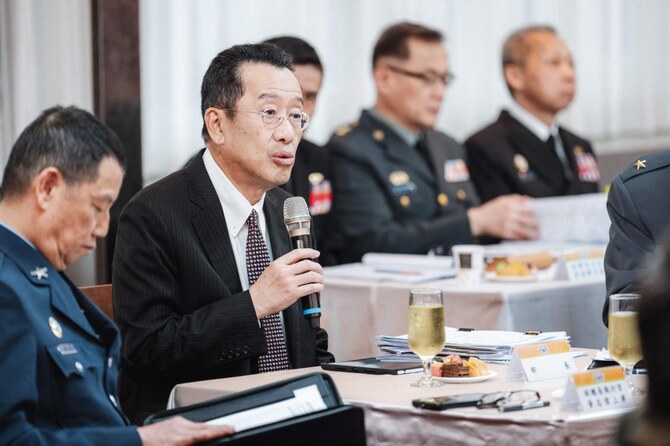
TAIPEI: The United States cannot abandon the Indo-Pacific because the region is part of its “core national interests,” Taiwan’s Defense Minister Wellington Koo said amid concerns about US security commitments to Taiwan.
The White House clash between Ukrainian President Volodymyr Zelensky and US President Donald Trump, which plunged ties between Kyiv and its top military backer to a new low, has renewed concerns in Taiwan about Washington’s security commitment at a time when China is ramping up its military pressure to assert its sovereignty claims over the democratic island.
“We indeed noticed the fast-changing and tricky international situation and deeply understand that we can’t just talk about values but not national interests,” Koo told reporters at a briefing on Monday when asked whether the US is still a reliable security partner for Taiwan.
“So we must ask: keeping the peace and stability in the Indo-Pacific region including the status quo in the Taiwan Strait and the South China Sea, is that a core US national interest?” Koo asked.
“I think it is impossible for the United States to retreat from the Indo-Pacific because it is its core national interest.”
Koo said “using deterrence and strength to achieve peace” has been the long-standing consensus between Taipei and Washington, and that stability in the region is important for the United States, both economically and geopolitically.
The United States is Taiwan’s most important international backer and arms supplier despite the lack of formal diplomatic ties between Washington and Taipei.
Taiwan, which strongly rejects China’s sovereignty claim, enjoyed support from the first Trump administration. But Trump unnerved Taiwan on the campaign trail by calling for it to pay more for US security guarantees.

‘Impossible’ for US to give up Indo-Pacific, Taiwan defense minister says
Short Url
https://arab.news/9a4h2
‘Impossible’ for US to give up Indo-Pacific, Taiwan defense minister says
- ‘I think it is impossible for the United States to retreat from the Indo-Pacific because it is its core national interest’
- The US is Taiwan’s most important international backer and arms supplier despite the lack of formal diplomatic ties
South Korea calls for resuming dialogue with North
- President Lee Jae Myung has sought to mend ties with the nuclear-armed North since taking office in June
- North Korean leader Kim Jong Un last week dashed hopes of a diplomatic thaw with Seoul
SEOUL: South Korean President Lee Jae Myung called on Sunday for dialogue with North Korea to resume, after Pyongyang last week shunned the prospect of diplomacy with its neighbor.
Since taking office in June, a dovish Lee has sought to mend ties with the nuclear-armed North, which reaffirmed its anti-Seoul approach during a party meeting last week.
“As my administration has repeatedly made clear, we respect the North’s system and will neither engage in any type of hostile acts, nor pursue any form of unification by absorption,” Lee said in a speech marking the anniversary of a historical campaign against Japan’s colonial rule.
“We will also continue our efforts to resume dialogue with the North,” he said.
North Korean leader Kim Jong Un last week dashed hopes of a diplomatic thaw with Seoul, describing its overtures as “clumsy, deceptive farce and a poor work.”
Speaking at the party congress in Pyongyang, Kim said North Korea has “absolutely no business dealing with South Korea, its most hostile entity, and will permanently exclude South Korea from the category of compatriots.”
But he also said the North could “get along well” with the United States if Washington acknowledges its nuclear status.
Speculation has mounted over whether US President Donald Trump will seek a meeting with Kim during planned travels to China.
Last year, Trump said he was “100 percent” open to a meeting.
Previous Trump-Kim summits during the US president’s first term fell apart after the pair failed to agree over sanctions relief — and what nuclear concessions North Korea might make in return.
Since taking office in June, a dovish Lee has sought to mend ties with the nuclear-armed North, which reaffirmed its anti-Seoul approach during a party meeting last week.
“As my administration has repeatedly made clear, we respect the North’s system and will neither engage in any type of hostile acts, nor pursue any form of unification by absorption,” Lee said in a speech marking the anniversary of a historical campaign against Japan’s colonial rule.
“We will also continue our efforts to resume dialogue with the North,” he said.
North Korean leader Kim Jong Un last week dashed hopes of a diplomatic thaw with Seoul, describing its overtures as “clumsy, deceptive farce and a poor work.”
Speaking at the party congress in Pyongyang, Kim said North Korea has “absolutely no business dealing with South Korea, its most hostile entity, and will permanently exclude South Korea from the category of compatriots.”
But he also said the North could “get along well” with the United States if Washington acknowledges its nuclear status.
Speculation has mounted over whether US President Donald Trump will seek a meeting with Kim during planned travels to China.
Last year, Trump said he was “100 percent” open to a meeting.
Previous Trump-Kim summits during the US president’s first term fell apart after the pair failed to agree over sanctions relief — and what nuclear concessions North Korea might make in return.
© 2026 SAUDI RESEARCH & PUBLISHING COMPANY, All Rights Reserved And subject to Terms of Use Agreement.


