

Oz, Bond and Quincy Jones: Oscars a musical ode to film icons

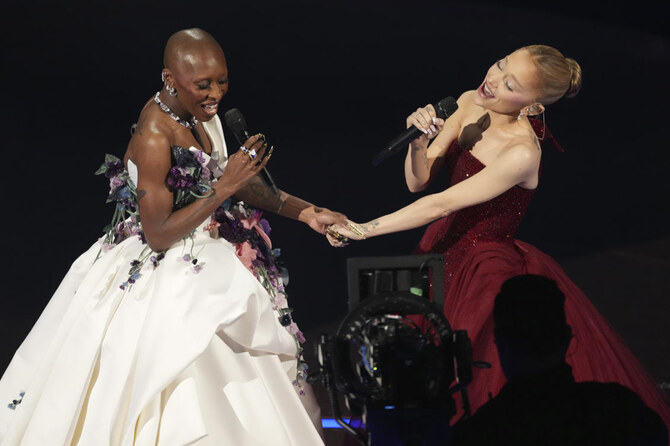
The Oscars gala traditionally features performances of all the tracks nominated for best original song — this year, the ceremony on Sunday bucked norms, but musical numbers still punctuated the show. (AP)
Short Url
Updated 03 March 2025
Follow

Oz, Bond and Quincy Jones: Oscars a musical ode to film icons

  • The Oscars gala traditionally features performances of all the tracks nominated for best original song — this year, the ceremony on Sunday bucked norms, but musical numbers still punctuated the show

HOLLYWOOD: The Oscars gala traditionally features performances of all the tracks nominated for best original song — this year, the ceremony on Sunday bucked norms, but musical numbers still punctuated the show.
Ariana Grande and Cynthia Erivo opened the star-studded gala with a tribute to Los Angeles — which recently suffered devastating wildfires — that also celebrated their Oscar-nominated roles in the blockbuster film “Wicked.”
In a glimmering red dress and shoes nodding to Dorothy’s magic slippers, Grande belted a touching version of the classic ballad “Over the Rainbow” from 1939’s “The Wizard of Oz” starring Judy Garland.
Erivo then joined to deliver a soaring rendition of “Home” from “The Wiz” — both “The Wizard of Oz” and 1978’s “The Wiz” are tales about the fantastical land of Oz that “Wicked” also riffs on.
Grande and Erivo ultimately brought the audience to its feet with the film’s hit song “Defying Gravity,” which brought some attendees, including co-star Michelle Yeoh, to tears — especially thanks to Erivo’s chills-inducing climax.
Later in the show came a James Bond medley, a celebration of the film franchise that just controversially came under the creative control of Amazon MGM Studios.
The Oscar stage turned Bond set featured a dance number led by “The Substance” star Margaret Qualley — who is a trained dancer.
Lisa — a member of the K-pop group Blackpink — descended from the ceiling to sing Wings’ “Live and Let Die” from that 1973 film.
And Doja Cat literally dripped in diamonds to sing Shirley Bassey’s “Diamonds Are Forever,” before an orchestra joined Raye to close the performance with a cover of Adele’s “Skyfall.”

Mick Jagger popped by to present the prize for best original song, which went to “El Mal,” the track off “Emilia Perez” written by Clement Ducol, Camille and the film’s director Jacques Audiard.
“We wrote ‘El Mal’ as a song to denounce corruption,” Camille said onstage. “We hope it speaks to the role music and art can play, and continue to play, as a force of the good and progress in the world.”
Before presenting the award, Jagger joked that “the producers really wanted Bob Dylan to do this — Bob didn’t want to do it because he said the best songs this year were obviously in “A Complete Unknown” — the film about Dylan.
“Bob said, ‘You should find somebody younger,’” the Rolling Stone frontman quipped.
Oprah Winfrey and Whoopi Goldberg presented a tribute to the late Quincy Jones, the composing titan who orchestrated the sounds of the music and film worlds for more than 50 years.
“Quincy was love lived out loud in human form, and he poured that love out into others and into his work,” Winfrey said.
Latifah then brought disco to the Academy Awards with a performance of “Ease on Down the Road” — yet another nod to the world of Oz — from the musical film adaptation of “The Wiz,” which Jones worked on.
Host Conan O’Brien added in his own song and dance after his opening monologue, poking fun at the show’s reputation for trudging along at a glacial pace.
“I Won’t Waste Time!” he sang.
The show ultimately clocked in at nearly four hours.


Egypt reveals restored colossal statues of pharaoh in Luxor

Updated 14 December 2025
Follow

Egypt reveals restored colossal statues of pharaoh in Luxor

  • Amenhotep III, one of the most prominent pharaohs, ruled during the 500 years of the New Kingdom, which was the most prosperous time for ancient Egypt

LUXOR: Egypt on Sunday revealed the revamp of two colossal statues of a prominent pharaoh in the southern city of Luxor, the latest in the government’s archeological events that aim at drawing more tourists to the country.
The giant alabaster statues, known as the Colossi of Memnon, were reassembled in a renovation project that lasted about two decades. They represent Amenhotep III, who ruled ancient Egypt about 3,400 years ago.
“Today we are celebrating, actually, the finishing and the erecting of these two colossal statues,” Mohamed Ismail, secretary-general of the Supreme Council of Antiquities, said ahead of the ceremony.
Ismail said the colossi are of great significance to Luxor, a city known for its ancient temples and other antiquities. They’re also an attempt to “revive how this funerary temple of King Amenhotep III looked like a long time ago,” Ismail said.
Amenhotep III, one of the most prominent pharaohs, ruled during the 500 years of the New Kingdom, which was the most prosperous time for ancient Egypt. The pharaoh, whose mummy is showcased at a Cairo museum, ruled between 1390–1353 BC, a peaceful period known for its prosperity and great construction, including his mortuary temple, where the Colossi of Memnon are located, and another temple, Soleb, in Nubia.
The colossi were toppled by a strong earthquake in about 1200 BC that also destroyed Amenhotep III’s funerary temple, said Ismail.
They were fragmented and partly quarried away, with their pedestals dispersed. Some of their blocks were reused in the Karnak temple, but archeologists brought them back to rebuild the colossi, according to the Antiquities Ministry.
In late 1990s, an Egyptian German mission, chaired by German Egyptologist Hourig Sourouzian, began working in the temple area, including the assembly and renovation of the colossi.
“This project has in mind … to save the last remains of a once-prestigious temple,” she said.
The statues show Amenhotep III seated with hands resting on his thighs, with their faces looking eastward toward the Nile and the rising sun. They wear the nemes headdress surmounted by the double crowns and the pleated royal kilt, which symbolizes the pharaoh’s rule.
Two other small statues on the pharaoh’s feet depict his wife, Tiye.
The colossi — 14.5 meters and 13.6 meters respectively — preside over the entrance of the king’s temple on the western bank of the Nile. The 35-hectare complex is believed to be the largest and richest temple in Egypt and is usually compared to the temple of Karnak, also in Luxor.
The colossi were hewn in Egyptian alabaster from the quarries of Hatnub, in Middle Egypt. They were fixed on large pedestals with inscriptions showing the name of the temple, as well as the quarry.
Unlike other monumental sculptures of ancient Egypt, the colossi were partly compiled with pieces sculpted separately, which were fixed into each statue’s main monolithic alabaster core, the ministry said.
Sunday’s unveiling in Luxor came just six weeks after the inauguration of the long-delayed Grand Egyptian Museum, the centerpiece of the government’s bid to boost the country’s tourism industry. The mega project is located near the famed Giza Pyramids and the Sphinx.
In recent years, the sector has started to recover after the coronavirus pandemic and amid Russia’s war on Ukraine — both countries are major sources of tourists visiting Egypt.
“This site is going to be a point of interest for years to come,” said Tourism and Antiquities Minister Sherif Fathy, who attended the unveiling ceremony. “There are always new things happening in Luxor.”
A record number of about 15.7 million tourists visited Egypt in 2024, contributing about 8 percent of the country’s GDP, according to official figures.
Fathy, the minister, has said about 18 million tourists are expected to visit the country this year, with authorities hoping for 30 million visitors annually by 2032.