


RIYADH: Prince Turki Al-Faisal, Saudi Arabia’s former intelligence chief and ambassador to the US and UK, has long been vocal about the plight of the Palestinian people and the destruction caused by Israel’s military campaigns.
Now, in the wake of the latest war in Gaza, he has called for a fundamental shift in how reconstruction efforts are financed — by forcing Israel to contribute to rebuilding the very infrastructure it has repeatedly destroyed.
Appearing on the Arab News current affairs program “Frankly Speaking,” Prince Turki laid out his case for why Israel should bear financial responsibility for the damage it has inflicted on Gaza and the West Bank — rather than the Gulf states footing the bill.
“I have been saying this for some time now, that there should be a fund, a worldwide fund for the reconstruction, not just in Gaza, but also in the West Bank. And Israel should be forced to chip in to that fund,” he told “Frankly Speaking” host Katie Jensen.
“We can’t have Israel, every time we reconstruct Gaza or the West Bank, coming and demolishing what has been reconstructed. That is unacceptable.
“And I think from now on, it is an issue of finality rather than temporary or procedural actions that are taken to build and then wait for the next round of destruction that comes from Israel. There has to be a finality for this situation by an end to the conflict.”
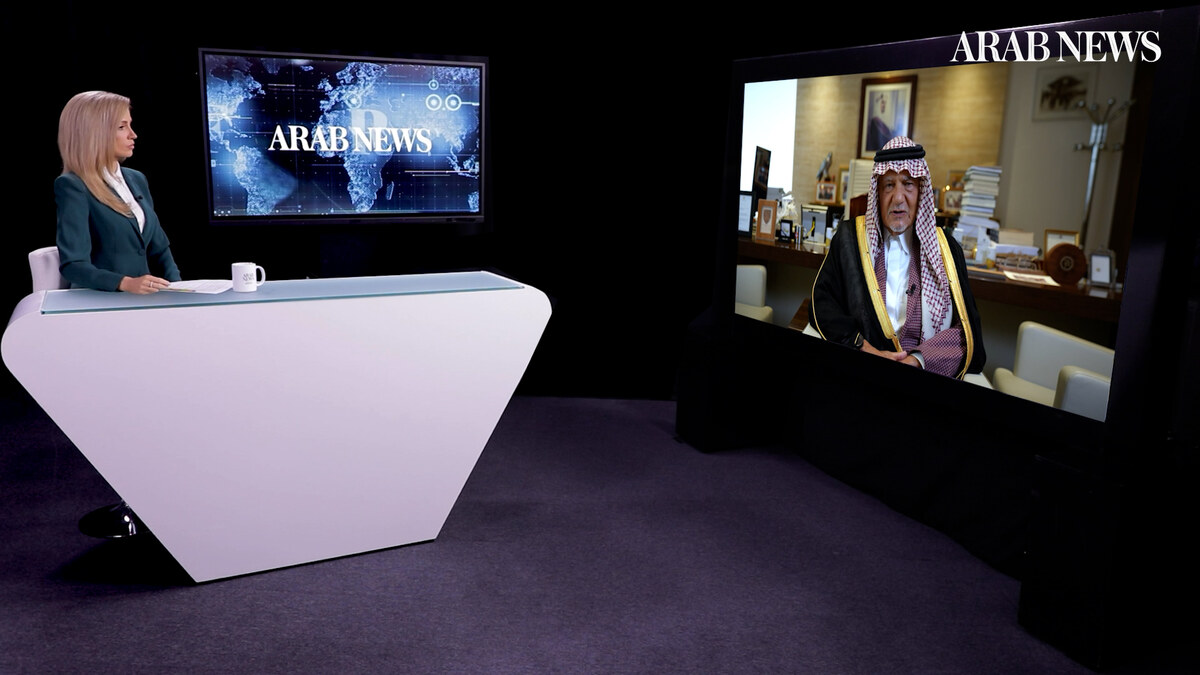
Prince Turki Al-Faisal spoke on the crisis in Gaza, Ukraine, Lebanon and other hotspots on ‘Frankly Speaking.’ (AN Photo)
Israel mounted its military operation in Gaza in retaliation for the Oct. 7, 2023, Hamas-led attack on southern Israel, which saw some 1,200 people killed, most of them civilians, and around 250 taken hostage, many of them foreign nationals.
At least 50,000 Palestinians were killed in the ensuing conflict and some 1.9 million displaced from their homes before a ceasefire deal was finally agreed on Jan. 19. Much of the enclave now lies in ruins and humanitarian needs are immense.
Prince Turki said a permanent ceasefire was the only way to guarantee that reconstruction efforts were not repeatedly undone by future Israeli military operations.
“The next phase of the ceasefire, as we have seen, will see a permanent ceasefire come into effect not just in Gaza but all of Palestine,” he said.
“That is the only way that we can guarantee that whatever is reconstructed can remain as a viable Palestinian state that can become independent and self-governing with all of the rights of its people.”
While much of the world’s focus has been on Gaza, Prince Turki warned that Israeli policies in the West Bank, where refugee camps have been raided by troops and settler violence has increased, should not be overlooked.
“The struggle for Palestine has not ended with the ceasefire in Gaza,” he said. “We see the Benjamin Netanyahu government doing similar things to what they did in Gaza in the West Bank, although at a slower pace than they did in Gaza.”
“They’re uprooting people in the West Bank, emptying some of the refugee camps there, and forcibly driving residents of the camps out with no destination. That is unacceptable as well. That is a form of ethnic cleansing. And yet Israel gets away with it, and nobody — especially not the US — condemns it.”
US President Donald Trump recently caused an international stir by sharing an AI-generated video on his Truth Social account depicting Gaza as a luxury holiday resort. In the surreal video, Palestinian children are seen emerging from rubble into a glitzy cityscape with cash raining from the sky. Elsewhere, Trump is seen sipping drinks with Netanyahu on a beachfront.
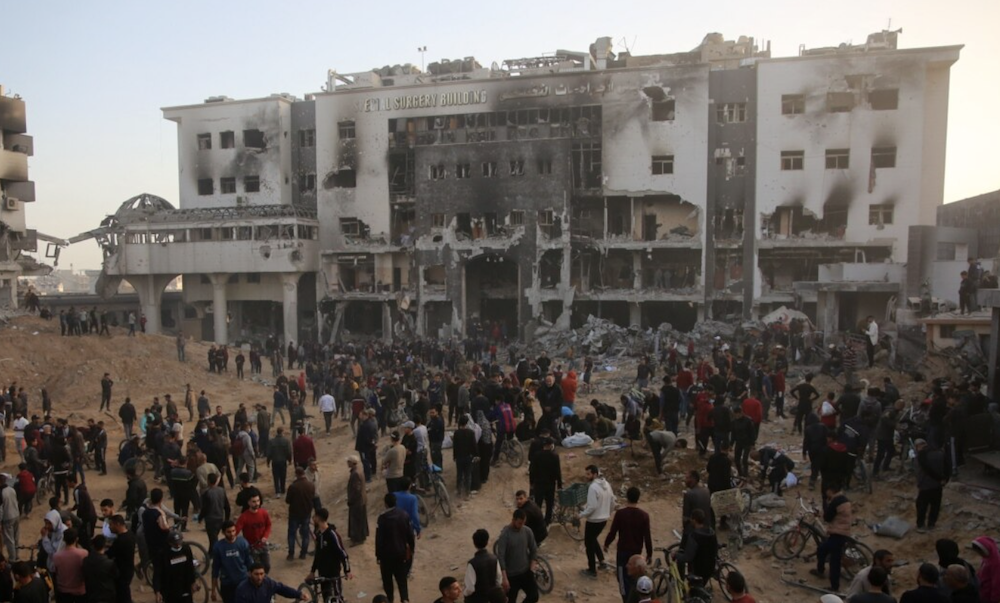
Palestinians inspect the damage outside Gaza’s Al-Shifa hospital after the Israeli military withdrew from the complex housing the hospital amid battles between Israel and Hamas. (AFP/File Photo)
The video was a reference to comments Trump made in recent weeks about the possibility of removing the Palestinian people en masse to Egypt and Jordan and rebuilding Gaza as a “Riviera of the Middle East.”
When asked what Trump was hoping to achieve by sharing the video, Prince Turki said: “I don’t know. No shock can be enough of a reaction to what he’s up to. Some people have said that he does that in order to instigate or to inspire reaction in one form or another.
“Well, he doesn’t need to do that, because definitely the brutality of the Israeli treatment of the Palestinians does inspire reactions not just from the Arab world but from the world community.”
Despite the controversy, Prince Turki noted that the international community’s response to the war in Gaza had been unprecedented. “I must say that throughout this brutal attack on the Palestinians by the Netanyahu government, the world reaction has been quite good,” he said.
“You saw the demonstrations that took place and are still taking place in various places around the world in opposition to this brutality and in support of the freedom and independence of a Palestinian state. That is a very healthy sign.”
With the Arab League holding an extraordinary summit on March 4 in Cairo to discuss alternative proposals for Gaza’s postwar future, among other pressing issues facing the region, Prince Turki was cautious about predicting the outcome of the talks.
“I really have no idea whatsoever,” he said. “Of course, I was not party to the talks and I have not seen any public statement about them. What I read in speculation, you know, in media outlets, whether in Israel or America or the Arab world, I would wait until the meeting takes place and we see what is said by the officials themselves.”
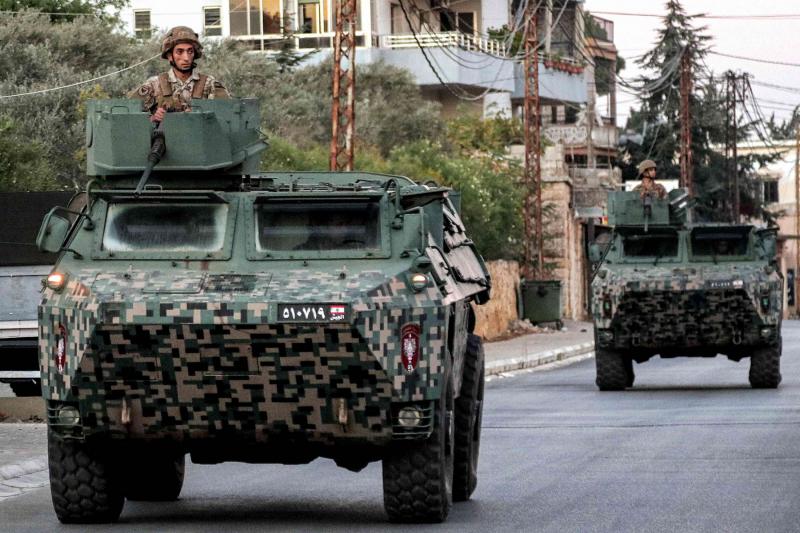
Lebanese Army vehicles patrol the area of Marjayoun in southern Lebanon near the border with Israel on October 25, 2024. Israel expanded operations in Lebanon nearly a year after Hezbollah began exchanging fire in support of its ally, Hamas, following the Palestinian group's deadly attack on Israel on October 7, 2023. (AFP/File Photo)
Asked whether Hamas could have a role to play in governing postwar Gaza, perhaps as part of the Palestinian Authority, and whether the West would tolerate such an arrangement, Prince Turki said there were those within the Palestinian militant group who rightly prioritize the needs of the Gazan people who could well be included.
“When you say Hamas, there are individuals who are definitely neutral, if you like, and more in terms of not bound by party or by commitment to either Hamas or Fatah or any of the other Palestinian groupings there,” he said.
“Those are the people, I think, who should be in charge of Gaza and meeting the needs of the people of Gaza.”
Turning to Lebanon, Prince Turki expressed optimism about the country’s new government, headed by President Joseph Aoun and Prime Minister Nawaf Salam. Aoun arrives in Saudi Arabia on Monday on his first official trip abroad since being elected president on January 9.
The new government was created after more than two years of political paralysis, which had prevented Lebanon’s recovery from its devastating financial crisis that began in 2019 and the 15-month conflict between Israel and Hezbollah that began in October 2023.
“The Kingdom has wholeheartedly supported the actions of the Lebanese parliament in electing the president,” Prince Turki said. “And now the president has designated a prime minister and I think they have announced a (cabinet) that hopefully will take its place as the ruling government of Lebanon.”
He added: “I think the Lebanese people are tired of having to be the sacrificial lamb, if you like, for either sectarian or other political factions, whether they be Hezbollah or some other Lebanese parties in the course of the development in the future.
“So, it is the Lebanese people, I think, who will be the safeguards of this new direction. And I hope that the support that is coming to Lebanon, not just from Saudi Arabia, but from the world community, will help that government to become more effective in meeting the needs of the Lebanese people.”
Although the Iran-backed Hezbollah militia remains a substantial force in Lebanon, its mauling by Israel has left it severely diminished, allowing the Lebanese state to reassert itself. Prince Turki said Saudi investors are now eager to return to Lebanon.
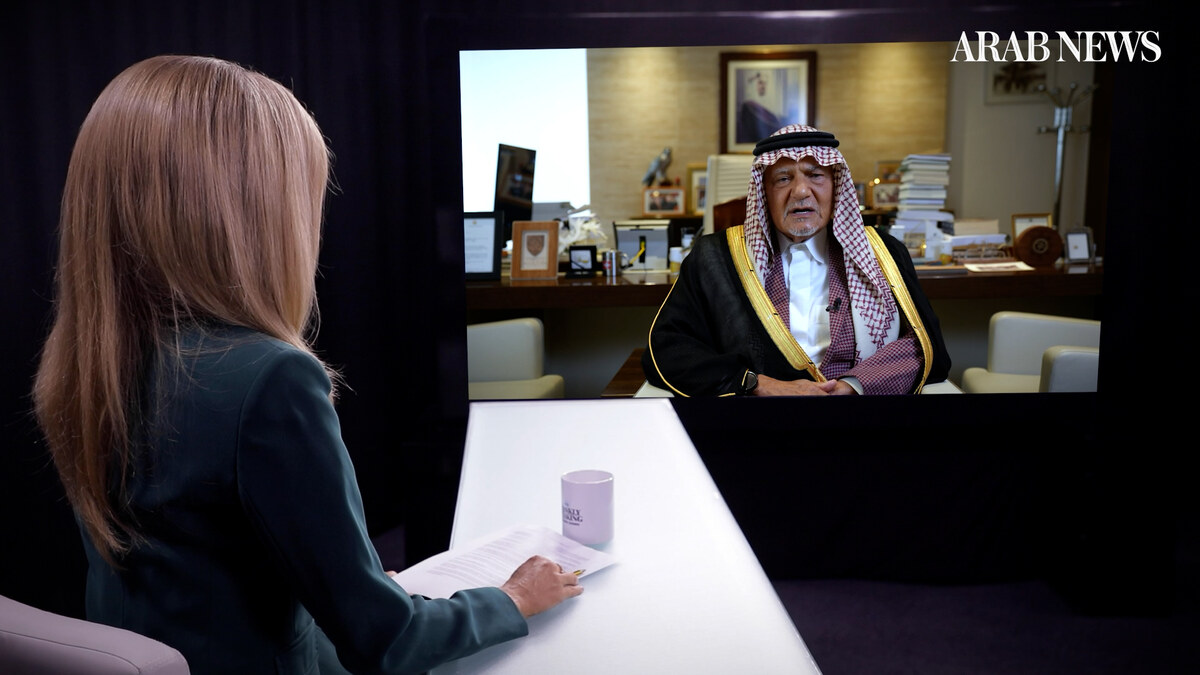
Speaking to host Katie Jensen, Prince Turki laid out his case for why Israel should bear financial responsibility for the damage it has inflicted on Gaza and the West Bank. (AN Photo)
“I hear from Saudis here that they’re willing and anxious to be able, if you like, to go back to Lebanon,” he said. “Those who have not invested yet, I think, are also thinking of the opportunities there.
“The Lebanese people are a very talented people, and Lebanon has always been a commercial hub for the Arab world. I remember my late father, King Faisal, used to say in those days, of course, that Lebanon is the lungs of the Arab world. I hope it returns to that.”
The Kingdom recently hosted high-level talks between the US and Russia to discuss a potential peace deal in Ukraine and other topics. In doing so, they reinforced Saudi Arabia’s position as a key player in global diplomacy.
“They seem to have set a course forward on a mutual return of diplomatic representation and also mutual cooperation, not only politically but also in terms of commercial and other enterprises that can bring benefit to their two peoples,” Prince Turki said of Moscow and Washington.
“It’s good to see that the potential for nuclear war between America and Russia has decreased incredibly. Is a reassuring sign that we do not face a nuclear holocaust, for which there might have been a reason had this meeting not taken place.”
Prince Turki, who is a co-founder and trustee of the Saudi-headquartered King Faisal Foundation, an international philanthropic organization, emphasized that the Kingdom’s diplomatic efforts extended beyond Ukraine.
Alluding to Riyadh’s facilitation of peace parleys between Eritrea and Ethiopia; Djibouti and Ethiopia; and between the Houthi militia and the UN-recognized government of Yemen, he said: “Saudis are proud that they are the place where people are coming to find solutions.”


