Iraq’s displaced Kurds hope to return home after Turkiye’s Kurdish militants declare a ceasefire

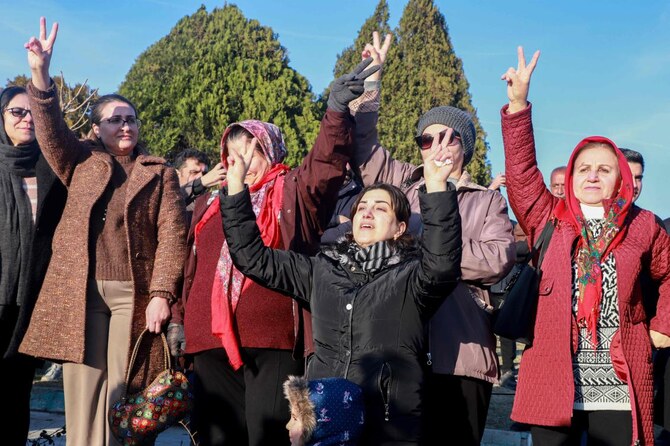
Iraqi Kurds flash the V for victory as people gather at Freedom Park to listen to an audio message by the founder of the Kurdistan Worker’s Party (PKK) Abdullah Ocalan in Sulaimaniyah, in Iraq’s autonomous Kurdistan reigion on February 27, 2025.(AFP)
Short Url
Updated 02 March 2025
Follow

Iraq’s displaced Kurds hope to return home after Turkiye’s Kurdish militants declare a ceasefire

  • Hopes were raised after the Kurdistan Workers’ Party, or PKK, on Saturday declared a ceasefire in the 40-year insurgency against the Turkish government

GUHARZE: Iraqi Kurdish villagers, displaced by fighting between Turkish forces and Kurdish militants that has played out for years in northern Iraq, are finally allowing themselves to hope they will soon be able to go home.
Their hopes were raised after the Kurdistan Workers’ Party, or PKK, on Saturday declared a ceasefire in the 40-year insurgency against the Turkish government, answering a call to disarm from earlier in the week by the group’s leader, Abdullah Ocalan, imprisoned in Turkiye since 1999.
The truce — if implemented — could not only be a turning point in neighboring Turkiye but could also bring much needed stability to the volatile region spanning the border between the two countries.
In northern Iraq, Turkish forces have repeatedly launched blistering offensives over the past years, pummeling PKK fighters who have been hiding out in sanctuaries in Iraq’s northern semi-autonomous Kurdish region, and have set up bases in the area. Scores of villages have been completely emptied of their residents.
A home left decades ago
Adil Tahir Qadir fled his village of Barchi, on Mount Matin in 1988, when Iraqi dictator Saddam Hussein launched a brutal campaign against the area’s Kurdish population.
He now lives in a newly built village — also named Barchi, after the old one that was abandoned — about 2 kilometers (1.2 miles) away, south of the mountain.
He used to go back to the old village every now and then to farm his land. But that stopped in 2015 when Turkish forces moved in and set up camp there in the fight against PKK, hitting the group with wave after wave of airstrikes.
Iraqi Kurdish farmers and their lands became collateral damage. The Turkish airstrikes and ground incursions targeting PKK positions displaced thousands of Iraqi Kurdish civilians, cutting off many from their land.
“Because of Turkish bombing, all of our farmlands and trees were burned,” Qadir said.
If peace comes, he will go back right away, he says. “We wish it will work so we can return.”
Fighting emptied out villages in Iraq
In the border area of Amedi in Iraq’s Dohuk province — once a thriving agricultural community — around 200 villages had been emptied of their residents by the fighting, according to a 2020 study by the regional Iraqi Kurdish government.
Small havens remained safe, like the new Barchi, with only about 150 houses and where villagers rely on sesame, walnuts and rice farming. But as the fighting dragged on, the conflict grew ever closer.
“There are many Turkish bases around this area,” said Salih Shino, who was also displaced to the new Barchi from Mount Matin.
“The bombings start every afternoon and intensify through the night,” he said. ”The bombs fall very close ... we can’t walk around at all.”
Airstrikes have hit Barchi’s water well and bombs have fallen near the village school, he said.
Najib Khalid Rashid, from the nearby village of Belava, says he also lives in fear. There are near-daily salvos of bombings, sometimes 40-50 times, that strike in surrounding areas.
“We can’t even take our sheep to graze or farm our lands in peace,” he said.
Ties to Kurdish brethren in Turkiye
Iraqi Kurdish villagers avoid talking about their views on the Kurdish insurgency in Turkiye and specifically the PKK, which has deep roots in the area. Turkiye and its Western allies, including the United States, consider the PKK a terrorist organization.
Still, Rashid went so far as to call for all Kurdish factions to put aside their differences and come together in the peace process.
“If there’s no unity, we will not achieve any results,” he said.
Ahmad Saadullah, in the village of Guharze, recalled a time when the region was economically self-sufficient.
“We used to live off our farming, livestock, and agriculture,” he said. “Back in the 1970s, all the hills on this mountain were full of vines and fig farms. We grew wheat, sesame, and rice. We ate everything from our farms.”
Over the past years, cut off from their farmland, the locals have been dependent on government aid and “unstable, seasonal jobs,” he said. “Today, we live with warplanes, drones, and bombings.”
Farooq Safar, another Guharze resident, recalled a drone strike that hit in his back yard a few months ago.
“It was late afternoon, we were having dinner, and suddenly all our windows exploded,” he said. “The whole village shook. We were lucky to survive.”
Like others, Safar’s hopes are sprinkled with skepticism — ceasefire attempts have failed in the past, he says, remembering similar peace pushes in 1993 and 2015.
“We hope this time will be different,” he said.


Morocco aims to boost legal cannabis farming and tap a global boom

Updated 4 sec ago
Follow

Morocco aims to boost legal cannabis farming and tap a global boom

BAB BERRED: Since he started growing cannabis at 14, Mohamed Makhlouf has lived in the shadows, losing sleep while bracing for a knock on his door from authorities that could mean prison or his entire harvest confiscated.
But after decades of operating in secret, Makhlouf finally has gained peace of mind as Morocco expands legal cultivation and works to integrate veteran growers like him into the formal economy.
On his farmland deep in the Rif Mountains, stalks of a government-approved cannabis strain rise from the earth in dense clusters. He notices when police pass on a nearby road. But where the crop’s aroma once meant danger, today there is no cause for concern. They know he sells to a local cooperative.
“Legalization is freedom,” Makhlouf said. “If you want your work to be clean, you work with the companies and within the law.”
The 70-year-old Makhlouf’s story mirrors the experience of a small but growing number of farmers who started in Morocco’s vast black market but now sell legally to cooperatives producing cannabis for medicinal and industrial use.
New market begins to sprout
Morocco is the world’s biggest producer of cannabis and top supplier of the resin used to make hashish. For years, authorities have oscillated between looking the other way and cracking down, even as the economy directly or indirectly supports hundreds of thousands of people in the Rif Mountains, according to United Nations reports and government data.
Abdelsalam Amraji, another cannabis farmer who joined the legal industry, said the crop is crucial to keeping the community afloat.
“Local farmers have tried cultivating wheat, nuts, apples, and other crops, but none have yielded viable results,” he said.
The region is known as an epicenter of anti-government sentiment and growers have lived for years with arrest warrants hanging over them. They avoided cities and towns. Many saw their fields burned in government campaigns targeting cultivation.
Though cannabis can fetch higher prices on the black market, the decreased risk is worth it, Amraji said.
“Making money in the illegal field brings fear and problems,” he said. “When everything is legal, none of that happens.”
Market remains under tight regulation
The change began in 2021 when Morocco became the first major illegal cannabis producer, and the first Muslim-majority country, to pass a law legalizing certain forms of cultivation.
Officials heralded the move as a way to lift small-scale farmers like Makhlouf and Amraji out of poverty and integrate cannabis-growing regions into the economy after decades of marginalization.
In 2024, King Mohammed VI pardoned more than 4,800 farmers serving prison sentences to allow longtime growers “to integrate into the new strategy,” the justice ministry said at the time.
Since legalization was enacted in 2022, Morocco has tightly regulated every step of production and sale from seeds and pesticides to farming licenses and distribution. Though certain cultivation is authorized, officials have shown no sign of moving toward legalization or reforms targeting recreational consumers.
“We have two contradictory missions that are really to allow the same project to succeed in the same environment,” said Mohammed El Guerrouj, director-general of Morocco’s cannabis regulatory agency. “Our mission as policemen is to enforce regulations. But our mission is also to support farmers and operators so they succeed in their projects.”
Licensing and cooperatives are part of new ecosystem
The agency issued licenses last year to more than 3,371 growers across the Rif and recorded nearly 4,200 tons of legal cannabis produced.
Near the town of Bab Berred, the Biocannat cooperative buys cannabis from roughly 200 small farmers during harvest season. The raw plant is transformed into neat vials of CBD oil, jars of lotion and chocolates that have spread across Morocco’s pharmacy shelves.
Some batches are milled into industrial hemp for textiles. For medicinal use and export, some of the product is refined into products with less than 1 percent THC, the psychoactive compound that gives cannabis its high.
Aziz Makhlouf, the cooperative’s director, said legalization created a whole ecosystem that employed more than just farmers.
“There are those who handle packaging, those who handle transport, those who handle irrigation — all of it made possible through legalization,” said Makhlouf, a Bab Berred native whose family has long been involved in cannabis farming.
Legalization has brought licenses, formal cooperatives and the hope of steady income without fear of arrest. But the shift also has exposed the limits of reform. The legal market remains too small to absorb the hundreds of thousands who depend on the illicit trade and the new rules have introduced more pressures, farmers and experts say.
Protests erupted in parts of nearby Taounate in August after cooperatives there failed to pay growers for their crop. Farmers waved banners reading “No legalization without rights” and “Enough procrastination,” furious that payments they were promised for working legally at the government’s urging never came, local media reported.
Illegal cultivation persists
The government insists the transformation is only beginning and challenges can be overcome.
But black market demand remains high. Today, cannabis is grown legally on 14,300 acres (5,800 hectares) in the Rif, while more than 67,000 acres (27,100 hectares) are used for illegal growing, according to government data. The number of farmers entering the legal system remains tiny compared with the number thought to be tied to the illicit market.
An April report from the Global Institute Against Transnational Organized Crime characterized the industry as “more one of coexistence of both markets than a decisive transition from one to the other.”
“A substantial proportion of the population continue to rely on illicit cannabis networks for income generation, perpetuating the dynamics that the state is trying to reform,” the report said.
For now, Morocco’s two cannabis economies exist side by side — one regulated and one outlawed — as the country tries to coax a centuries-old trade out of the shadows without leaving its farmers behind.
“Cannabis is legal now, just like mint,” Amraji said. “I never imagined I’d one day be authorized to grow it. I’m shocked.”