

Private lunar lander Blue Ghost aces moon touchdown with a special delivery for NASA

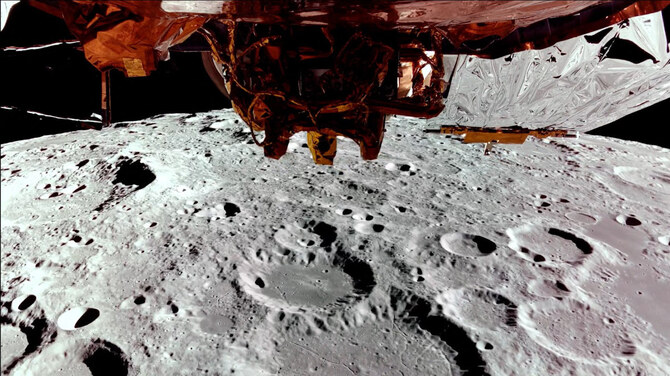
This still image taken from a February 24, 2025 video released by Firefly Aerospace shows Firefly's Blue Ghost lander on its third lunar orbit, showing the far side of the Moon and a top-down view of Blue Ghost. (Handout / Firefly Aerospace / AFP)
Short Url
Updated 02 March 2025
Follow

Private lunar lander Blue Ghost aces moon touchdown with a special delivery for NASA

  • Firefly Aerospace’s Blue Ghost Mission 1 is targeting landing no sooner than 3:34 a.m. US Eastern time (0834 GMT) on Sunday
  • Landing site target is near Mons Latreille, a volcanic feature in Mare Crisium on the Moon’s northeastern near side

CAPE CANAVERAL: A private lunar lander carrying a drill, vacuum and other experiments for NASA touched down on the moon Sunday, the latest in a string of companies looking to kickstart business on Earth’s celestial neighbor ahead of astronaut missions.
Firefly Aerospace’s Blue Ghost lander descended from lunar orbit on autopilot, aiming for the slopes of an ancient volcanic dome in an impact basin on the moon’s northeastern edge of the near side.
Confirmation of successful touchdown came from the company’s Mission Control outside Austin, Texas, following the action some 225,000 miles (360,000 kilometers) away.
“You all stuck the landing. We’re on the moon,” Firefly’s Will Coogan, chief engineer for the lander, reported.
An upright and stable landing makes Firefly — a startup founded a decade ago — the first private outfit to put a spacecraft on the moon without crashing or falling over. Even countries have faltered, with only five claiming success: Russia, the US, China, India and Japan.
A half hour after landing, Blue Ghost started to send back pictures from the surface, the first one a selfie somewhat obscured by the sun’s glare. The second shot included the home planet, a blue dot glimmering in the blackness of space.
Two other companies’ landers are hot on Blue Ghost’s heels, with the next one expected to join it on the moon later this week.



This undated image released by Firefly Aerospace Moon shot from Blue Ghost's top deck while in lunar orbit, shows imagery of the Moon’s south pole on the far left. (Handout / Firefly Aerospace / AFP)

Blue Ghost — named after a rare US species of fireflies — had its size and shape going for it. The squat four-legged lander stands 6-foot-6 (2 meters) tall and 11 feet (3.5 meters) wide, providing extra stability, according to the company.
Launched in mid-January from Florida, the lander carried 10 experiments to the moon for NASA. The space agency paid $101 million for the delivery, plus $44 million for the science and tech on board. It’s the third mission under NASA’s commercial lunar delivery program, intended to ignite a lunar economy of competing private businesses while scouting around before astronauts show up later this decade.
Firefly’s Ray Allensworth said the lander skipped over hazards including boulders to land safely. Allensworth said the team continued to analyze the data to figure out the lander’s exact position, but all indications suggest it landed within the 328-foot (100-meter) target zone in Mare Crisium.
The demos should get two weeks of run time, before lunar daytime ends and the lander shuts down.
It carried a vacuum to suck up moon dirt for analysis and a drill to measure temperature as deep as 10 feet (3 meters) below the surface. Also on board: a device for eliminating abrasive lunar dust — a scourge for NASA’s long-ago Apollo moonwalkers, who got it caked all over their spacesuits and equipment.
On its way to the moon, Blue Ghost beamed back exquisite pictures of the home planet. The lander continued to stun once in orbit around the moon, with detailed shots of the moon’s gray pockmarked surface. At the same time, an on-board receiver tracked and acquired signals from the US GPS and European Galileo constellations, an encouraging step forward in navigation for future explorers.
The landing set the stage for a fresh crush of visitors angling for a piece of lunar business.
Another lander — a tall and skinny 15-footer (4 meters tall) built and operated by Houston-based Intuitive Machines — is due to land on the moon Thursday. It’s aiming for the bottom of the moon, just 100 miles (160 kilometers) from the south pole. That’s closer to the pole than the company got last year with its first lander, which broke a leg and tipped over.
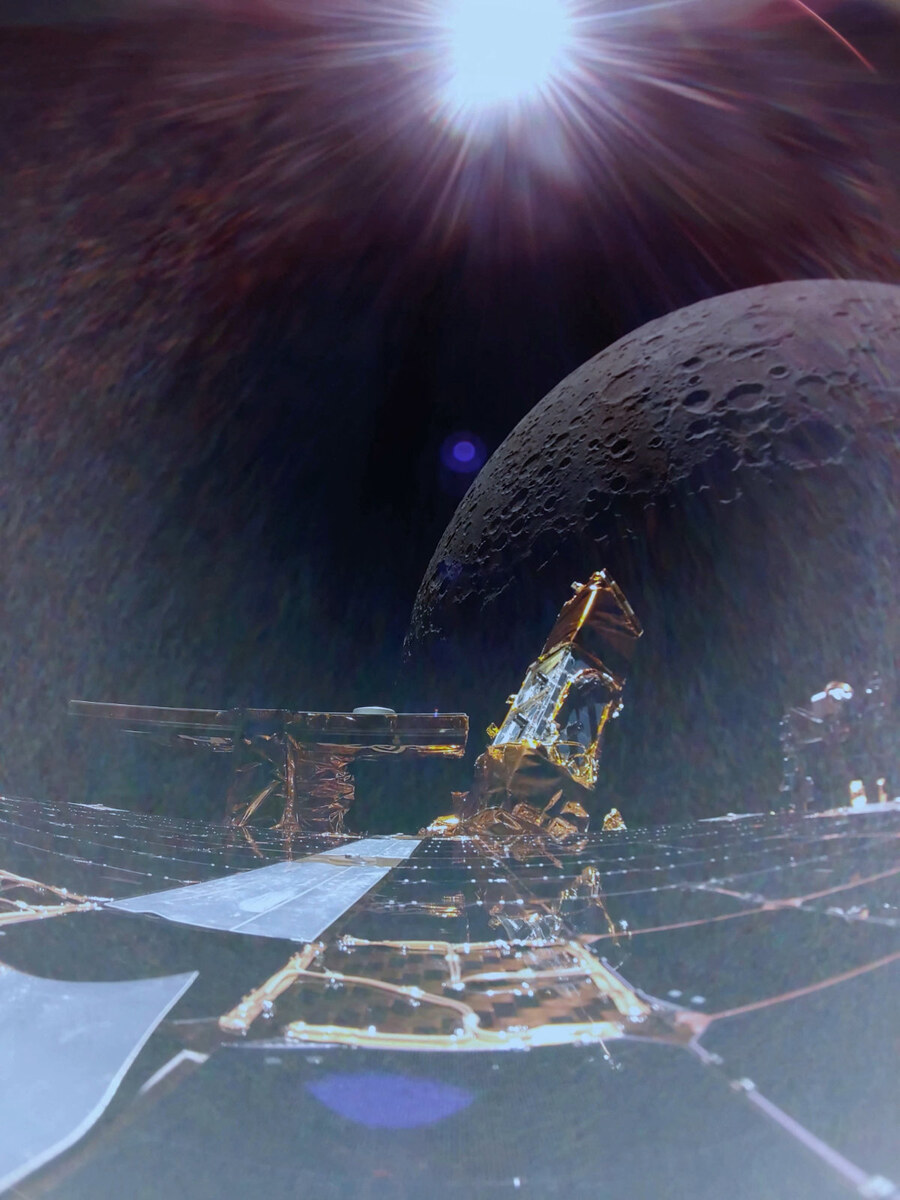


This undated image released by Firefly Aerospace Moon shot from Blue Ghost's top deck while in lunar orbit, shows imagery of the Moon’s south pole on the far left. (Handout / Firefly Aerospace / AFP)

Despite the tumble, Intuitive Machines’ lander put the US back on the moon for the first time since NASA astronauts closed out the Apollo program in 1972.
A third lander from the Japanese company ispace is still three months from landing. It shared a rocket ride with Blue Ghost from Cape Canaveral on Jan. 15, taking a longer, windier route. Like Intuitive Machines, ispace is also attempting to land on the moon for the second time. Its first lander crashed in 2023.
The moon is littered with wreckage not only from ispace, but dozens of other failed attempts over the decades.
NASA wants to keep up a pace of two private lunar landers a year, realizing some missions will fail, said the space agency’s top science officer Nicky Fox.
“It really does open up a whole new way for us to get more science to space and to the moon,” Fox said.
Unlike NASA’s successful Apollo moon landings that had billions of dollars behind them and ace astronauts at the helm, private companies operate on a limited budget with robotic craft that must land on their own, said Firefly CEO Jason Kim.
Kim said everything went like clockwork.
“We got some moon dust on our boots,” Kim said.


Trump says Iran ‘want to negotiate’ after reports of hundreds killed in protests

Updated 4 sec ago
Follow

Trump says Iran ‘want to negotiate’ after reports of hundreds killed in protests

  • US President Donald Trump said Sunday that Iran’s leadership had called him seeking “to negotiate” after he repeatedly threatened to intervene militarily if Tehran killed protesters
WASHINGTON: US President Donald Trump said Sunday that Iran’s leadership had called him seeking “to negotiate” after he repeatedly threatened to intervene militarily if Tehran killed protesters.
For two weeks, Iran has been rocked by a protest movement that has swelled in spite of a crackdown rights groups warn has become a “massacre.”
Initially sparked by anger over the rising cost of living, the demonstrations have evolved into a serious challenge of the theocratic system in place since the 1979 revolution.
Information has continued to trickle out of Iran despite a days-long Internet shutdown, with videos filtering out of capital Tehran and other cities over the past three nights showing large demonstrations.
As reports emerge of a growing protest death toll, and images show bodies piled outside a morgue, Trump said Tehran indicated its willingness to talk.
“The leaders of Iran called” yesterday, Trump told reporters aboard Air Force One, adding that “a meeting is being set up... They want to negotiate.”
He added, however, that “we may have to act before a meeting.”
The US-based Center for Human Rights in Iran (CHRI) said it had received “eyewitness accounts and credible reports indicating that hundreds of protesters have been killed across Iran during the current Internet shutdown.”
“A massacre is unfolding,” it said.
The Norway-based NGO Iran Human Rights (IHR) said it confirmed the killing of at least 192 protesters but that the actual toll could be much higher.
“Unverified reports indicate that at least several hundreds, and according to some sources, more than 2,000 people may have been killed,” said IHR.
More than 2,600 protesters have been arrested, IHR estimates.
A video circulating on Sunday showed dozens of bodies accumulating outside a morgue south of Tehran.
The footage, geolocated by AFP to Kahrizak, showed bodies wrapped in black bags, with what appeared to be grieving relatives searching for loved ones.
- Near paralysis -
In Tehran, an AFP journalist described a city in a state of near paralysis.
The price of meat has nearly doubled since the start of the protests, and many shops are closed. Those that do open must close at around 4:00 or 5:00 pm, when security forces deploy en masse.
There were fewer videos showing protests on social media Sunday, but it was not clear to what extent that was due to the Internet shutdown.
One widely shared video showed protesters again gathering in the Pounak district of Tehran shouting slogans in favor of the ousted monarchy.
The protests have become one of the biggest challenges to the rule of supreme leader Ayatollah Ali Khamenei, 86, coming in the wake of Israel’s 12-day war against the Islamic republic in June, which was backed by the United States.
State TV has aired images of burning buildings, including a mosque, as well as funeral processions for security personnel.
But after three days of mass actions, state outlets were at pains to present a picture of calm returning, broadcasting images of smooth-flowing traffic on Sunday. Tehran Governor Mohammad-Sadegh Motamedian insisted in televised comments that “the number of protests is decreasing.”
The Iranian government on Sunday declared three days of national mourning for “martyrs” including members of the security forces killed.
President Masoud Pezeshkian also urged Iranians to join a “national resistance march” Monday to denounce the violence.
In response to Trump’s repeated threats to intervene, Iran’s parliament speaker Mohammad Bagher Ghalibaf said Iran would hit back, calling US military and shipping “legitimate targets” in comments broadcast by state TV.
- ‘Stand with the people’ -
Reza Pahlavi, the US-based son of Iran’s ousted shah, who has emerged as an anti-government figurehead, said he was prepared to return to the country and lead a democratic transition.
“I’m already planning on that,” he told Fox News on Sunday.
He later urged Iran’s security forces and government workers to join the demonstrators.
“Employees of state institutions, as well as members of the armed and security forces, have a choice: stand with the people and become allies of the nation, or choose complicity with the murderers of the people,” he said in a social media post.
He also urged protesters to replace the flags outside of Iranian embassies.
“The time has come for them to be adorned with Iran’s national flag,” he said.
The ceremonial, pre-revolution flag has become an emblem of the global rallies that have mushroomed in support of Iran’s demonstrators.
In London, protesters managed over the weekend to swap out the Iranian embassy flag, hoisting in its place the tri-colored banner used under the last shah.