Pakistan reports sixth case of polio virus this year

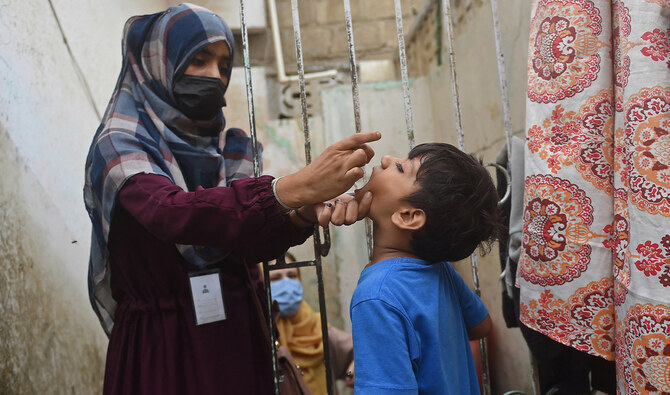
A health worker administers polio drops to a child during a door-to-door vaccination campaign in Karachi, Pakistan, on August 7, 2023. (AFP/File)
Short Url
Updated 01 March 2025
Follow

Pakistan reports sixth case of polio virus this year

  • The latest polio case was reported in the Thatta district, which is the fourth case in Sindh this year
  • Pakistan and Afghanistan are the only two countries in the world where polio remains an endemic

KARACHI: Health authorities have confirmed another case of polio virus in Pakistan, the country’s polio program said on Saturday, taking this year’s nationwide tally to six.
Polio is a paralyzing disease that has no cure. Multiple doses of the oral polio vaccine and completion of the routine vaccination schedule for all children under the age of 5 is essential to provide children high immunity against the disease.
The Regional Reference Laboratory for Polio Eradication at the National Institute of Health in Islamabad confirmed the polio virus in a child in Thatta district of the southern Sindh province, according to the Pakistan polio program.
“This is the fourth polio case from Sindh and the sixth case from Pakistan at large this year,” it said in a statement.
“The polio program urges all parents to get their children vaccinated against polio at every opportunity to keep them protected from this devastating disease.”
Pakistan witnessed an intense resurgence of polio virus last year, with a total of 74 cases reported nationwide. Of these, 27 were from Balochistan, 22 from Khyber Pakhtunkhwa, 23 from Sindh, and one each from Punjab and Islamabad.
The South Asian country last month concluded its first nationwide anti-polio campaign of 2025, with 99 percent of the targets achieved, according to the polio program. The campaign, conducted on Feb. 3-9, vaccinated more than 45 million children.
Pakistan and Afghanistan are the last two countries in the world where polio remains an endemic.
Immunization campaigns have succeeded in most countries and have come close in Pakistan, but persistent problems remain. In the early 1990s, Pakistan reported around 20,000 cases annually but in 2018 the number dropped to eight cases. Six cases were reported in 2023 and only one in 2021.
Pakistan’s polio program began in 1994 but efforts to eradicate the virus have since been undermined by vaccine misinformation and opposition from some religious hard-liners who say immunization is a foreign ploy to sterilize Muslim children or a cover for Western spies. Militant groups also frequently attack and kill members of polio vaccine teams.


Islamic military coalition, Pakistan to deepen cooperation to combat ‘terrorism’ — Pakistani military

Updated 02 February 2026
Follow

Islamic military coalition, Pakistan to deepen cooperation to combat ‘terrorism’ — Pakistani military

  • Islamic Military Counter Terrorism Coalition is a 43-member alliance that includes Pakistan, Saudi Arabia, Egypt, Jordan, UAE and other nations
  • The Pakistani military statement comes after a meeting between IMCTC secretary-general and the chief of Pakistani defense forces in Rawalpindi

ISLAMABAD: Pakistan and the Islamic Military Counter Terrorism Coalition (IMCTC) have reaffirmed their commitment to deepening cooperation, including intelligence sharing and capacity building, to jointly combat “terrorism” and “extremism,” the Pakistani military said on Monday.

The IMCTC is a 43-member military alliance that was formed on Saudi Arabia’s initiative in Dec. 2015 to consolidate Muslim countries’ efforts in countering “terrorism.”

A 17-member IMCTC delegation is visiting Pakistan from Feb. 2-6 to conduct a training at National University of Sciences and Technology on “Re-integration and Rehabilitation of Extremist Elements,” according to the Pakistani military.

On Monday, IMCTC Secretary-General Maj. Gen. Mohammed bin Saeed Al-Moghedi held a meeting with Chief of Pakistani Defense Forces Field Marshal Asim Munir to discuss cooperation among IMCTC member states.

“During the meeting, matters of mutual interest were discussed, with particular emphasis on regional security dynamics and enhanced cooperation in counter-terrorism efforts,” the Inter-Services Public Relations (ISPR), the Pakistani military’s media wing, said in a statement.

“Both sides reaffirmed their shared commitment to combating terrorism and extremism through collaborative strategies, intelligence sharing, and capacity building among member states.”

The IMCTC features Pakistan, Saudi Arabia, Türkiye, Afghanistan, Egypt, Jordan, Qatar, Palestine, UAE, Bangladesh and other nations. In 2017, Pakistan’s former army chief Gen. (retd) Raheel Sharif was appointed as the IMCTC commander-in-chief.

During discussions with Major General Al-Moghedi, Field Marshal Munir appreciated the role of IMCTC in fostering stability and promoting coordinated counterterrorism initiatives across the Islamic world, according to the ISPR.

The IMCTC secretary-general acknowledged Pakistan’s significant contributions and sacrifices in the fight against militancy and lauded the professionalism of Pakistan’s armed forces.

“The meeting underscored the resolve of both sides to further strengthen institutional collaboration for peace, stability, and security in the region,” the ISPR added.

Pakistan enjoys cordial ties with most Muslim countries around the world, particularly Gulf Cooperation Council countries. In Sept. 2025, Pakistan signed a landmark defense pact with Saudi Arabia according to which an act of aggression against one country will be treated as an act of aggression against both.