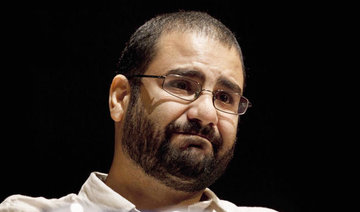
LONDON: An Egyptian-British mother on hunger strike in protest against the detention of her activist son in Cairo has been given a glucose drip after being hospitalized in London, a campaign group said on Friday.
Laila Soueif, 68, has been on hunger strike for 152 days and was admitted to London’s St. Thomas’s Hospital late on Monday due to “dangerously new lows” in her blood sugar and sodium levels, as well as her blood pressure.
She had previously turned down artificial glucose, despite being warned there was an “immediate risk to life,” but agreed at the request of her daughters Sanaa and Mona to take one dose “in an effort to extend her life,” campaign group Free Alaa said in a press release.
Soueif has lived on only coffee, tea and rehydration sachets since September 29, 2024, the date that marked five years in detention for her son Alaa Abdel Fattah.
Fattah, 43, a pro-democracy and rights campaigner, was arrested by Egyptian authorities in September 2019 and later given a five-year sentence for “spreading false news.”
His family criticized his trial as a “farce” and has demanded he be released having completed his sentence.
Soueif started the drip on Thursday and the dose was given to her over the course of 12 hours “due to the dangers of the intervention at this stage in her hunger strike,” said the campaign group.
“Doctors at the hospital have stressed that this is a temporary intervention, that they cannot guarantee it will extend Laila’s life, and that if it does it will be for a limited time, possibly only a few hours, and if lucky a few days,” they added.
Soueif has lost almost 30 kilograms (66 pounds) since starting her hunger strike, which she has vowed to continue until her son is released.
For weeks, Soueif braved London’s bitter cold to demonstrate outside Prime Minister Keir Starmer’s Downing Street office each working day since the date she says her son should have been released.
Sanaa Seif called on Starmer to take urgent action.
“When we met Keir Starmer he asked us for more time and promised that he would do all he could to free my brother,” she said.
“I don’t think we’ll be able to convince mum to do this again. So we desperately urge the prime minister to use this time well,” she added.

Hunger-striking mother of jailed UK-Egyptian activist on glucose drip
https://arab.news/yznym
Hunger-striking mother of jailed UK-Egyptian activist on glucose drip
- Laila Soueif, 68, has been on hunger strike for 152 days and was admitted to London’s St. Thomas’s Hospital late on Monday
- She had previously turned down artificial glucose, despite being warned there was an “immediate risk to life“
Pakistan says economy stabilizing as it looks to 2026 growth
- Inflation averages 5 percent, remittances hit $16.1 billion as government cites signs of recovery
- IT exports, industry and development spending highlighted as focus shifts to next year’s targets
ISLAMABAD: Pakistan’s economy has shown signs of stabilization in the first half of the current fiscal year, Planning Minister Ahsan Iqbal said on Thursday, as the government looks ahead to sustaining growth momentum into 2026 after several years of economic volatility.
Briefing the media on economic performance through November, Iqbal said key indicators including inflation, industrial output, exports, remittances and fiscal revenues had improved, creating what he described as a more stable base for forward planning.
Pakistan has spent much of the past two years navigating high inflation, external financing pressures and fiscal tightening under an IMF-backed reform program. While growth remains modest, officials say recent data suggests the economy has moved out of crisis mode and into a consolidation phase.
“During July to November of fiscal year 2025–26, stability has returned to Pakistan’s economy,” Iqbal said, adding that average inflation during the period stood at around 5 percent, compared with 7.9% last year, easing pressure on households and businesses.
Large-scale manufacturing posted growth of 4.1 percent, which Iqbal described as “clear evidence of recovery in industrial activity.”
The planning minister said government revenues also improved, with Federal Board of Revenue collections reaching Rs4,733 billion ($16.9 billion) during July–November, reflecting a 10.2% increase.
External inflows remained resilient, with workers’ remittances rising 9.3% to $16.1 billion, while IT services exports increased 19% to $1.8 billion over the same period, he said.
On the public investment side, Iqbal said Rs196 billion ($700 million) were released under the development budget during the quarter, of which Rs92 billion ($329 million) had already been spent. He added that cost rationalization in development projects between July and October saved Rs3.3 billion ($11.8 million) billion in public funds.
In November, the planning minister said, the Central Development Working Party approved 10 development projects, while six major schemes were referred to the Executive Committee of the National Economic Council.
Iqbal said the approved projects were expected to create 994 immediate jobs, with nearly 24,859 direct and 40,873 indirect employment opportunities projected overall.
Looking ahead, he said all future development schemes would be required to comply with green building codes to ensure environmental protection and sustainable growth.
He also highlighted skills and innovation initiatives, saying that under the “Uraan Pakistan” program, partnerships with Oxford and Cambridge universities were being pursued to promote research, technology and innovation.
Under an IT industry revival plan, he said more than 20,000 young people were being trained in advanced technologies, with over 14,000 new jobs expected to be created.
The government has said maintaining macroeconomic stability while gradually lifting growth remains its central challenge as Pakistan moves into 2026, with officials emphasising disciplined spending, export growth and job creation as key priorities.