

World bank says economic stabilization ‘taking hold’ in Pakistan

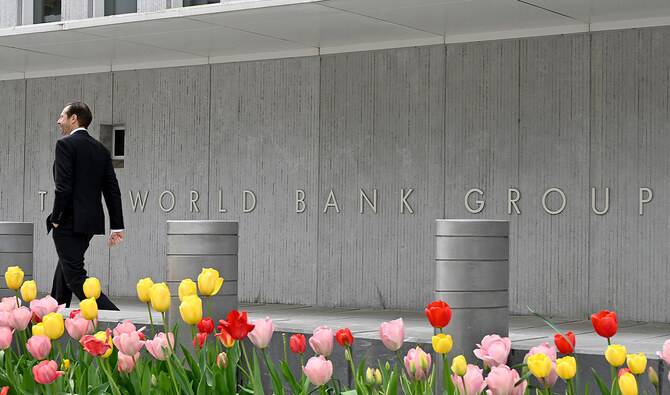
A man walks past the World Bank building in Washington, DC on April 21, 2022. (AFP/File)
Short Url
Updated 28 February 2025
Follow

World bank says economic stabilization ‘taking hold’ in Pakistan

  • Pakistan and World Bank last month signed an agreement for a ten-year plan for $20 billion in development loans
  • Pakistan currently under IMF bailout that requires it to boost government revenues, external sources of financing

ISLAMABAD: The World Bank said on Friday economic stabilization was “taking hold” in Pakistan, making this an opportune moment for the group to sign an agreement for a ten-year plan to focus $20 billion in development lending in the cash-strapped country.

The new plan, known as the Country Partnership Framework, was announced by the World Bank last month and will focus the global institution’s pledge of $20 billion in areas including clean energy and climate resilience in the ten years from 2026.

The country has teetered on the brink of economic crisis for several years and economists and international financial institutions have called for major economic reforms. Pakistan is currently under a $7 billion International Monetary Fund bailout program, which requires the country to boost government revenues and shore up external sources of financing, much of which comes from loans from China and Gulf nations.

“This is an important moment for the partnership between the World Bank Group and Pakistan as we engage on this journey at a particular moment for Pakistan where stabilization is taking hold and there are new ambitions and new plans for development on the long term that are very aligned with the prioritizes of the World Bank Group in the country,” WB Country Director for Pakistan, Najy Benhassine, said in a video message on X.

“This is a groundbreaking joint commitment with the government of Pakistan both at the federal and provincial level to commit to focus on six of the most acute development challenges that the country is facing.”

The World Bank’s lending for Pakistan will start in 2026 and focus on six outcomes: improving education quality, tackling child stunting, boosting climate resilience, enhancing energy efficiency, fostering inclusive development and increasing private investment.

The finance ministry’s monthly outlook report said this week Pakistan’s consumer inflation was expected to remain stable in February and maintain a downward trajectory compared to the previous year. Inflation has eased since last year with CPI coming in at 2.4 percent in January compared to 24 percent in the same period last year. Authorities have credited the downward trend to economic stabilization under the IMF program secured last summer.

An IMF mission is due to arrive in Islamabad next week for the first review of the global lender’s facility.

“The primary surplus is expected to improve further in the coming months,” the finance ministry said, pointing to one of the benchmarks identified by the IMF.

The report also said that foreign remittances, a crucial lifeline for Pakistan’s economy, were expected to rise.

“Workers’ remittances recorded robust inflows of $20.8 billion during July-Jan FY2025, marking a 31.7 percent increase over $15.8 billion last year,” the ministry said.


Pakistan arrests four TTP suspects in connection with Islamabad suicide bombing

Updated 48 min 3 sec ago
Follow

Pakistan arrests four TTP suspects in connection with Islamabad suicide bombing

  • Twelve people were killed and 36 injured in the suicide blast outside a district court complex in Islamabad on Tuesday afternoon
  • Pakistan’s Interior Minister Mohsin Naqvi claimed an Afghan national carried out the blast, Kabul did not respond to the allegation

ISLAMABAD: Pakistani intelligence and counter-terrorism authorities have arrested four Tehreek-e-Taliban Pakistan (TTP) members in connection with this week’s suicide blast in the Pakistani capital of Islamabad, the government said on Friday.

Twelve people were killed and 36 injured in a suicide blast outside a district court’s complex in Islamabad’s G-11 sector on Tuesday afternoon. Pakistan’s Interior Minister Mohsin Naqvi claimed an Afghan national had carried out the blast. Kabul did not respond to the allegation.

Pakistan’s Intelligence Bureau Division and the Counter-Terrorism Department have busted a “terrorist cell” involved in the attack and arrested four suspects, including the alleged handler of the attack on the court complex, according to a Pakistani government statement on X.

“During interrogation, Sajidullah alias Sheena, the handler of the suicide bomber, confessed that TTP/FAK (Fitna Al-Khawarij) Commander Saeed-ur-Rehman alias Daadullah (resident of Charmang, Bajaur, currently in Afghanistan, and serving as TTP’s Intelligence Chief for Nawagai, Bajaur) contacted him through the Telegram application to carry out a suicide attack in Islamabad to cause maximum casualties of LEAs (law enforcement agencies),” the statement read.

“Daadullah sent pictures of the suicide bomber (SB) Usman alias Qari to Sajidullah alias Sheena for receiving him. SB Usman Qari belonged to the Shinwari tribe and was a resident of Achin, Nangarhar, Afghanistan. When he reached Pakistan from Afghanistan, Sajidullah alias Sheena arranged his stay in a residence near Islamabad.”

Sajidullah collected a suicide jacket from Akhun Baba graveyard in the northwestern city of Peshawar and brought it to Islamabad, according to the statement. On the day of the blast, he set the suicide jacket on the bomber.

“The network was handled and guided at every step by the Fitna Al-Khawarij/TTP high command based in Afghanistan,” the Pakistani government said.

“The entire cell involved in the incident, including its commander and three other members, has been arrested. Investigations are continuing, and more revelations and arrests are expected.”

There was no immediate response from Kabul to the statement.

The TTP has been behind some of the deadliest attacks in Pakistan since late 2000s. The group has stepped up its attacks against Pakistani security forces and law enforcement agencies since the Taliban’s return to power in Afghanistan.

Islamabad frequently accuses the Afghan Taliban of sheltering the TTP, or the Pakistani Taliban, and India of backing the group in launching cross-border attacks against Pakistan. Kabul and New Delhi deny this.

Clashes erupted between the neighbors on Oct. 11 after Pakistan conducted airstrikes in Afghanistan against what it said were TTP-linked targets. The two sides reached a ceasefire in Doha on Oct. 19, but tensions remain high between the neighbors despite two rounds of talks in Istanbul, with Pakistan seeking “verifiable” action against militant groups operating on Afghan soil.