

Review: ‘Zero Day’ — Robert De Niro brings his star power to the small screen

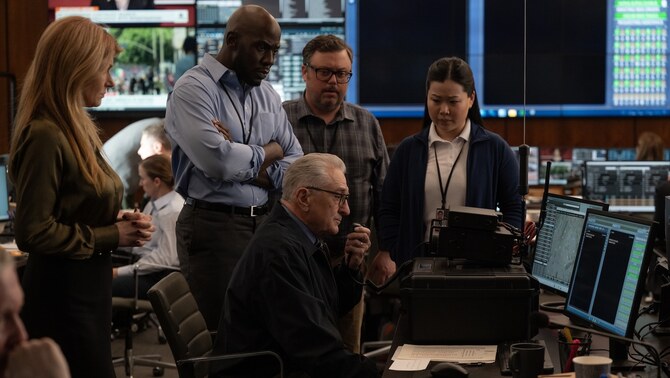
(L to R) Connie Britton as Valerie Whitesell, McKinley Belcher III as Carl Otieno, Robert De Niro as George Mullen, Jay Klaitz as Tim Pennington, and Eden Lee as Agent Angela Kim in 'Zero Day.' (Supplied)
Short Url
Updated 28 February 2025
Follow

Review: ‘Zero Day’ — Robert De Niro brings his star power to the small screen

  • Iconic actor is as good as he’s ever been in taut political thriller

LONDON: Despite his lauded career, Robert De Niro, arguably our greatest living actor, has, for the most part, steered clear of TV roles. So the news that he was to not only appear in, but also executive produce, new Netflix thriller “Zero Day” was noteworthy. And what’s even better? This taut, tense, six-part political thriller is every bit as captivating as you’d hope — a relief, given that De Niro’s more recent output has featured more than a few… let’s call them duds.

De Niro is perfectly cast as George Mullen, a universally respected former US President who confounded the political world by not seeking a second term, choosing instead to focus on his family after a personal tragedy. When the US is targeted by a nationwide cyberattack, which freezes all electronic devices and kills thousands of people, sitting President Mitchell (Angela Bassett) asks him to head up a new division tasked with finding and punishing the people behind the attack.

On paper, Mullen is the obvious choice — he’s a former prosecutor and hails from a time when politicians could still command bipartisan respect. But he’s also a man out of step — caught out by the speed of the modern media landscape, still struggling with his own grief, and suffering from a range of hallucinations.

That De Niro manages to convince with all of the above within the first episode is testament not only to the strength of his performance, but also to the skill of creators Eric Newman, Noah Oppenheim, and journalist Michael Schmidt. Though costars Jesse Plemons, Lizzy Caplan, Matthew Modine and others are all superb, none comes close to De Niro. George is simultaneously frighteningly fierce and alarmingly frail, possessed with a sense of naïve optimism that makes him either a fool or the smartest person in the room.

“Zero Day” is not perfect – there’s a lull around episode three, and some budget-chewing grandstanding before the finale. But the last two episodes are as tense and thrilling as any show from the last couple of years.


Riyadh exhibition to trace the origins of Saudi modern art

Updated 07 January 2026
Follow

Riyadh exhibition to trace the origins of Saudi modern art

  • Features painting, sculpture and archival documents
  • Open from Jan. 27-April 11 at Saudi national museum

DUBAI: A new exhibition in Riyadh is focusing on the origins of Saudi Arabia’s modern art scene, examining how a generation of artists helped shape the Kingdom’s visual culture during a period of rapid change.

The “Bedayat: Beginnings of Saudi Art Movement” show reportedly traces the emergence of creative practices in Saudi Arabia from the 1960s to the 1980s, an era that laid the groundwork for today’s art ecosystem.

On view from Jan. 27 until April 11 at the National Museum of Saudi Arabia, it includes works and archival material that document the early years of modern and abstract art in the Kingdom, according to the organizers.

It will examine how artists responded to shifting social, cultural and economic realities, often working with limited infrastructure but a strong sense of purpose and experimentation.

The exhibition is the result of extensive research led by the Visual Arts Commission, which included dozens of site visits and interviews with artists and figures active during the period.

These firsthand accounts have helped to reconstruct a time when formal exhibition spaces were scarce, art education was still developing, and artists relied heavily on personal initiative to build communities and platforms for their work.

Curated by Qaswra Hafez, “Bedayat” will feature painting, sculpture, works on paper and archival documents, many of which will be shown publicly for the first time.

The works will reveal how Saudi artists engaged with international modernist movements while grounding their practice in local heritage, developing visual languages that spoke to both global influences and lived experience.

The exhibition will have three sections, beginning with the foundations of the modern art movement, and followed by a broader look at the artistic concerns of the time.

It will conclude with a focus on four key figures: Mohammed Al-Saleem, Safeya Binzagr, Mounirah Mosly and Abdulhalim Radwi.

A publication, documentary film and public program of talks and workshops will accompany the exhibition, offering further insight into a pivotal chapter of Saudi art history and the artists who helped define it.