ROME: Nations cheered a last-gasp deal to map out funding to protect nature Thursday, breaking a deadlock at UN talks seen as a test for international cooperation in the face of geopolitical tensions.
Rich and developing countries hammered out a delicate compromise on raising and delivering the billions of dollars needed to protect species, overcoming stark divisions that had scuttled their previous meeting in Cali, Colombia, last year.
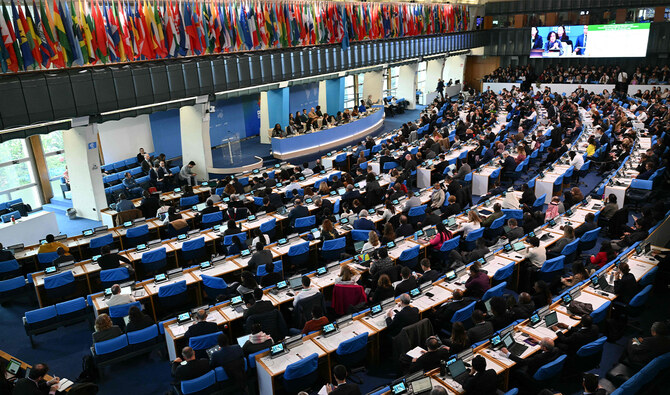
Delegates stood and clapped in an emotionally charged final meeting that saw key decisions adopted in the final minutes of the last day of rebooted negotiations at the UN’s Food and Agriculture Organization headquarters in Rome.
COP16 President Susana Muhamad of Colombia hailed the fact that countries worked together for a breakthrough, enabling progress “in this very fragmented and conflicted world.”
“This is something very beautiful because it’s around protecting life that we have come together, and there cannot be anything higher than that,” she added.
The decision comes more than two years after a landmark deal to halt the rampant destruction of nature this decade and protect the ecosystems and wildlife that humans rely on for food, climate regulation, and economic prosperity.
Scientists have warned that action is urgent.
A million species are threatened with extinction, while unsustainable farming and consumption destroys forests, depletes soils and spreads plastic pollution to even the most remote areas of the planet.
The agreement on Thursday is seen as crucial to giving impetus to the 2022 deal, which saw countries agree to protect 30 percent of the world’s land and seas.
Talks were also seen as a bellwether for international cooperation.
The meeting comes as countries face a range of challenges, from trade disputes and debt worries to the slashing of overseas aid — particularly by new US President Donald Trump.
Washington, which has not signed up to the UN’s Convention on Biological Diversity, sent no representatives to the meeting.
“Our efforts show that multilateralism can present hope at a time of geopolitical uncertainty,” said Steven Guilbeault, Canada’s Minister of Environment and Climate Change.
Ousseynou Kasse of Senegal, speaking on behalf of the Africa Group, also threw support behind global cooperation.
“We believe that this is the way that can save the world, and we must continue down this path,” he said.
Countries must be “accountable to our children, to the generations to come,” he added, saying he was thinking of what he would tell his own son when he returns home.
“I will give him good news that we have a compromise, we have a deal.”
The failure to finalize an agreement in Cali was the first in a string of disappointing outcomes at environmental summits last year.
A climate finance deal at COP29 in Azerbaijan in November was slammed by developing countries, while separate negotiations about desertification and plastic pollution stalled in December.
Muhamad, who has resigned as Colombia’s environment minister but stayed on to serve until after the Rome conference, was given a standing ovation as the talks drew to a close in the early hours of Friday.
Countries have already agreed a goal to deliver $200 billion a year in finance for nature by 2030, including $30 billion a year from wealthier countries to poorer ones.
The total for 2022 was about $15 billion, according to the OECD.
The main debate in Cali and later Rome was over developing countries’ calls for the creation of a specific biodiversity fund, which has seen pushback from the EU and other wealthy nations, who have argued against multiple funds.
Thursday saw intense closed-door talks based on a “compromise attempt” text that Brazil put forward on behalf of the BRICS country bloc that includes Russia, China and India.
The agreement reached in Rome leaves it to the 2028 COP to decide whether to set up a specific new fund under the UN biodiversity process, or to name a potentially reformed existing fund to play that role.
Georgina Chandler, Head of Policy and Campaigns at the Zoological Society of London, said the finance roadmap was a “key milestone,” but stressed that money is needed urgently.
Other decisions sought to bolster monitoring to ensure countries are held accountable for their progress toward meeting biodiversity targets.
One achievement in Cali was the creation of a new fund to share profits from digitally sequenced genetic data from plants and animals with the communities they come from.
The fund, officially launched on Tuesday, is designed for large firms to contribute a portion of their income from developing things like medicine and cosmetics using this data.
Delegates in Cali also approved the creation of a permanent body to represent the interests of Indigenous people.


World agrees hard-fought nature funding plan at UN talks
https://arab.news/rv2x4
World agrees hard-fought nature funding plan at UN talks

- The agreement on Thursday is seen as crucial to giving impetus to the 2022 deal, which saw countries agree to protect 30 percent of the world’s land and seas
- Countries have already agreed to deliver $200 billion a year in finance for nature by 2030, including $30 billion a year from wealthier countries to poorer ones


Trump administration labels 3 Muslim Brotherhood branches as terrorist organizations
- The State Department designated the Lebanese branch a foreign terrorist organization
- “These designations reflect the opening actions of an ongoing, sustained effort to thwart Muslim Brotherhood chapters’ violence,” Rubio said
WASHINGTON: President Donald Trump’s administration has made good on its pledge to label three Middle Eastern branches of the Muslim Brotherhood as terrorist organizations, imposing sanctions on them and their members in a decision that could have implications for US relationships with allies Qatar and Turkiye.
The Treasury and State departments announced the actions Tuesday against the Lebanese, Jordanian and Egyptian chapters of the Muslim Brotherhood, which they said pose a risk to the United States and American interests.
The State Department designated the Lebanese branch a foreign terrorist organization, the most severe of the labels, which makes it a criminal offense to provide material support to the group. The Jordanian and Egyptian branches were listed by Treasury as specially designated global terrorists for providing support to Hamas.
“These designations reflect the opening actions of an ongoing, sustained effort to thwart Muslim Brotherhood chapters’ violence and destabilization wherever it occurs,” Secretary of State Marco Rubio said in a statement. “The United States will use all available tools to deprive these Muslim Brotherhood chapters of the resources to engage in or support terrorism.”
Rubio and Treasury Secretary Scott Bessent were mandated last year under an executive order signed by Trump to determine the most appropriate way to impose sanctions on the groups, which US officials say engage in or support violence and destabilization campaigns that harm the United States and other regions.
Muslim Brotherhood leaders have said they renounce violence.
Trump’s executive order had singled out the chapters in Lebanon, Jordan and Egypt, noting that a wing of the Lebanese chapter had launched rockets on Israel after Hamas’ Oct. 7, 2023, attack in Israel that set off the war in Gaza. Leaders of the group in Jordan have provided support to Hamas, the order said.
The Muslim Brotherhood was founded in Egypt in 1928 but was banned in that country in 2013. Jordan announced a sweeping ban on the Muslim Brotherhood in April.
Nathan Brown, a professor of political science and international affairs at George Washington University, said some allies of the US, including the United Arab Emirates and Egypt, would likely be pleased with the designation.
“For other governments where the brotherhood is tolerated, it would be a thorn in bilateral relations,” including in Qatar and Turkiye, he said.
Brown also said a designation on the chapters may have effects on visa and asylum claims for people entering not just the US but also Western European countries and Canada.
“I think this would give immigration officials a stronger basis for suspicion, and it might make courts less likely to question any kind of official action against Brotherhood members who are seeking to stay in this country, seeking political asylum,” he said.
Trump, a Republican, weighed whether to designate the Muslim Brotherhood a terrorist organization in 2019 during his first term in office. Some prominent Trump supporters, including right-wing influencer Laura Loomer, have pushed his administration to take aggressive action against the group.
Two Republican-led state governments — Florida and Texas — designated the group as a terrorist organization this year.


