

More than 1,000 Syrians died in airport prison under Assad, report says

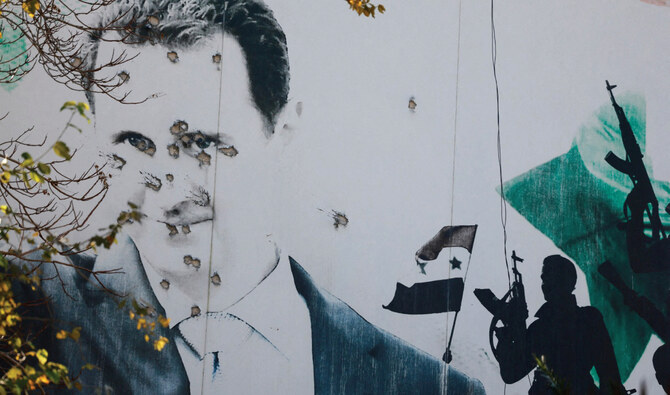
A damaged billboard in Damascus after Assad’s ouster in December. (Reuters)
Short Url
Updated 27 February 2025
Follow

More than 1,000 Syrians died in airport prison under Assad, report says

  • Grave sites identified using a combination of witness testimony, satellite imagery and documents

DAMASCUS: More than 1,000 Syrians died in detention at a military airport on the outskirts of Damascus, killed by execution, torture or maltreatment at a site that was widely feared, according to a report to be published Thursday tracing the deaths to seven suspected grave sites.

In the report, the Syria Justice and Accountability Center said it identified the grave sites by using a combination of witness testimony, satellite imagery and documents photographed at the military airport in the Damascus suburb of Mezzeh after the ouster of President Bashar Assad in December.

Some sites were on the airport grounds. Others were across Damascus.

Two of the sites, one on the Mezzeh airport property and another at a cemetery in Najha, show clear signs of long trenches dug during periods consistent with witness testimony from SJAC.

Shadi Haroun, one of the report’s authors, said he was among the captives. Held over several months in 2011-2012 for organizing protests, he described daily interrogations with physical and psychological torture intended to force him into baseless confessions.

Death came in many forms, he said.

Although detainees saw nothing except their cell walls or the interrogation room, they could hear “occasional shootings, shot by shot, every couple of days.”

Then there were the injuries inflicted by their tormentors.

“A small wound on the foot of one of the detainees, caused by a whipping he received during torture, was left unsterilized or untreated for days, which gradually turned into gangrene and his condition worsened until it reached the point of amputation of the entire foot,” Haroun said, describing a cellmate’s plight.

In addition to obtaining the documents, SJAC and the Association for the Detained and Missing Persons in Sednaya Prison interviewed 156 survivors and eight former members of air force intelligence, Syria’s security service that was tasked with the surveillance, imprisonment and killing of regime critics.

The new government has issued a decree forbidding former regime officials from speaking publicly and none were available to comment.

“Although some of the graves mentioned in the report had not been discovered before, the discovery itself does not surprise us, as we know that there are more than 100,000 missing persons in Assad’s prisons who did not come out during the days of liberation in early December,” said a colonel in the new government’s Interior Ministry who identified himself by his military alias, Abu Baker.

“Discovering the fates of those missing persons and searching for more graves is one of the greatest legacies left by the Assad regime,” he said.

Hundreds of thousands of Syrians are estimated to have been killed since 2011, when Assad’s crackdown on protests spiraled into a full-scale war. Both Assad and his father Hafez, who preceded him as president and died in 2000, have long been accused by rights groups, foreign governments and war-crimes prosecutors of widespread extrajudicial killings, including mass executions within the country’s prison system and using chemical weapons against the Syrian people.



UN rights chief Shocked by ‘unbearable’ Darfur atrocities

Updated 18 January 2026
Follow

UN rights chief Shocked by ‘unbearable’ Darfur atrocities

  • Mediation efforts have failed to produce a ceasefire, even after international outrage intensified last year with reports of mass killings, rape, and abductions during the RSF’s takeover of El-Fasher in Darfur

PORT SUDAN: Nearly three years of war have put the Sudanese people through “hell,” the UN’s rights chief said on Sunday, blasting the vast sums spent on advanced weaponry at the expense of humanitarian aid and the recruitment of child soldiers.
Since April 2023, Sudan has been gripped by a conflict between the army and the paramilitary Rapid Support Forces that has left tens of thousands of people dead and around 11 million displaced.
Speaking in Port Sudan during his first wartime visit, UN Human Rights commissioner Volker Turk said the population had endured “horror and hell,” calling it “despicable” that funds that “should be used to alleviate the suffering of the population” are instead spent on advanced weapons, particularly drones.
More than 21 million people are facing acute food insecurity, and two-thirds of Sudan’s population is in urgent need of humanitarian aid, according to the UN.
In addition to the world’s largest hunger and displacement crisis, Sudan is also facing “the increasing militarization of society by all parties to the conflict, including through the arming of civilians and recruitment and use of children,” Turk added.
He said he had heard testimony of “unbearable” atrocities from survivors of attacks in Darfur, and warned of similar crimes unfolding in the Kordofan region — the current epicenter of the fighting.
Testimony of these atrocities must be heard by “the commanders of this conflict and those who are arming, funding and profiting from this war,” he said.
Mediation efforts have failed to produce a ceasefire, even after international outrage intensified last year with reports of mass killings, rape, and abductions during the RSF’s takeover of El-Fasher in Darfur.
“We must ensure that the perpetrators of these horrific violations face justice regardless of the affiliation,” Turk said on Sunday, adding that repeated attacks on civilian infrastructure could constitute “war crimes.”
He called on both sides to “cease intolerable attacks against civilian objects that are indispensable to the civilian population, including markets, health facilities, schools and shelters.”
Turk again warned on Sunday that crimes similar to those seen in El-Fasher could recur in volatile Kordofan, where the RSF has advanced, besieging and attacking several key cities.
Hundreds of thousands face starvation across the region, where more than 65,000 people have been displaced since October, according to the latest UN figures.