EU urges ‘respect’ for court sentence against Bosnian Serb leader

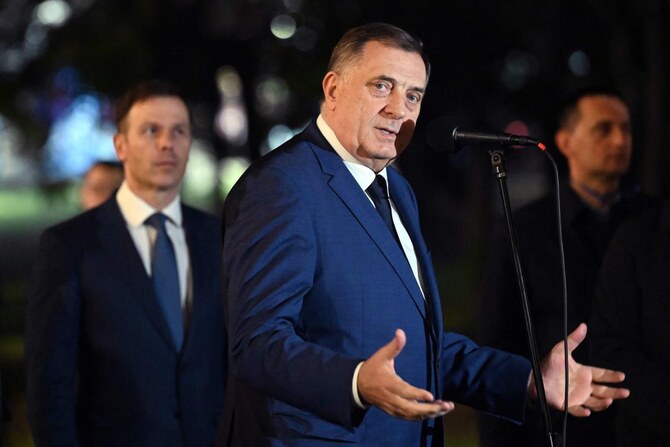
Bosnian Serb leader Milorad Dodik (C) delivers a speech flanked by Serbia’s President, in Banja Luka, northern Bosnia and Herzegovina, on Feb. 26, 2025, following Milorad Dodik’s one year prison sentence. (AFP)
Short Url
Updated 27 February 2025
Follow

EU urges ‘respect’ for court sentence against Bosnian Serb leader

  • “The EU expects all political actors in Bosnia and Herzegovina to respect the decisions of the courts,” a European Commission spokesman said
  • Russia has slammed the verdict as “political“

BRUSSELS: The European Union Thursday urged all sides in Bosnia to respect court rulings and avoid “divisive” actions after the head of the country’s Serb region was sentenced to jail for defying an international envoy.
“The EU expects all political actors in Bosnia and Herzegovina to respect the decisions of the courts and acknowledge their independence and impartiality without applying any pressure or interference,” a European Commission spokesman said.
Brussels urges all actors to “refrain from and renounce provocative, divisive rhetoric and actions, including questioning the sovereignty, unity and territorial integrity of the country,” spokesman Anouar El Anouni told reporters.
Under a 1995 peace agreement, Bosnia is split into two autonomous bodies — a Bosniak-Croat federation and a Serb entity, connected by a weak central government under supervision by an international high representative.
Milorad Dodik, the pro-Russian leader of the Serb-dominated Republika Srpska (RS), was sentenced to a year in jail Wednesday for failing to comply with decisions made by the high representative, Christian Schmidt.
Russia has slammed the verdict as “political,” and Bosnian Serb lawmakers were weighing potential measures in response.
The EU has previously warned that challenging the terms of the 1995 Dayton peace accords that ended Bosnia’s intercommunal war would threaten the country’s ambitions to join the bloc.
“The European Union is unequivocally committed to Bosnia and Herzegovina’s EU perspective as a single, united and sovereign country,” El Anouni said.
“We encourage all political actors to focus on the EU path, and this for the benefit of citizens, a large majority of whom do support EU integration,” he added.


Venezuelan activist Javier Tarazona released from prison as US diplomat assumes post

Updated 02 February 2026
Follow

Venezuelan activist Javier Tarazona released from prison as US diplomat assumes post

  • Human rights activist Javier Tarazona was arrested in July 2021
  • He was released shortly after the arrival in Caracas of US charge d’affaires

CARACAS: Venezuelan human rights activist Javier Tarazona, an ally of opposition leader María Corina Machado, was released from prison after the government promised to free political prisoners in an amnesty bill, rights organizations and family members said Sunday.
Tarazona, the director of the Venezuelan nonprofit human rights group FundaRedes, was arrested in July 2021, after reporting to authorities that he had been harassed by national intelligence officials. Two other activists of the group were also detained at the time.
Venezuela’s Foro Penal, a rights group that monitors the situations of political prisoners in the country, said Sunday that 317 people jailed for political reasons had been released as of noon local time Sunday, and 700 others were still waiting to be freed.
“After 1675 days, four years and seven months, this wishful day has arrived. My brother Javier Tarazona is free,” José Rafael Tarazona Sánchez wrote on X. “Freedom for one is hope for all.”
Tarazona was released shortly after the arrival in Caracas of US Charge d’Affaires Laura Dogu, who will reopen the American diplomatic mission after seven years of severed ties. It comes after US President Donald Trump ordered a military action that removed the South American country’s former President Nicolás Maduro from office and brought him to trial in the US
Dogu, who was previously ambassador in Nicaragua and Honduras, arrived in Venezuela one day after the country’s interim president, Delcy Rodríguez, announced an amnesty bill to release political prisoners. That move was one of the key demands of the Venezuelan opposition.
Venezuela’s government had accused Tarazona of terrorism, betraying the nation and hate speech, all frequent accusations it makes against real or potential opposition members. Tarazona was vocal against illegal armed groups on the country’s border with Colombia and their alleged connection to high-ranked members of the Maduro administration.
Amnesty International reported that Tarazona’s health has deteriorated due to lack of medical attention during his time in prison.
“All of Venezuela admires you and respects your bravery and your commitment,” Machado said on X. “You, better than anyone, know that there will be justice in Venezuela. Freedom for all political prisoners.”
Venezuela’s government denies it jails members of the opposition and accuses them of conspiring to bring it down.