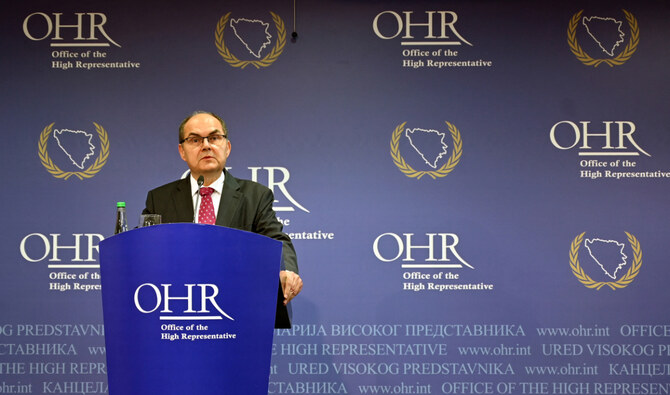
SARAJEVO: Bosnia’s international peace envoy on Thursday sought to keep the country’s European Union integration on track by rejecting the Serb Republic parliament’s orders last week that would have blocked progress.
The lawmakers in Bosnia’s Serb-dominated regional parliament last week ordered Serb delegates in the central government to block legal reforms needed for Bosnia’s integration into the EU.
High Representative Christian Schmidt, whose authority Serbs do not recognize, on Thursday prohibited “any attempt to implement the dangerous elements” of those orders.
The Dayton Accords that ended 3-1/2 years of ethnic war in the Balkan country in 1995 gave the high representative final authority over whether such decisions are allowed under the peace deal.
The peace accords split Bosnia into two autonomous regions, the Orthodox Serb-dominated Serb Republic and a federation dominated by Catholic Croats and Muslim Bosniaks, linked in a weak central government. That secured peace but left Bosnia dysfunctional as a state.
Schmidt’s move on Thursday was part of his efforts to stop Bosnia from sliding into a new political crisis and keep EU integration advancing.
Serb Republic President Milorad Dodik has tried for years to withdraw the region from Bosnia and has sought to stop state institutions from functioning. He is on trial in a Bosnian court on charges of defying Schmidt’s decisions.

Bosnia peace envoy declares Serb parliament’s orders illegal
https://arab.news/4b2er
Bosnia peace envoy declares Serb parliament’s orders illegal
- Lawmakers in Bosnia’s Serb-dominated regional parliament last week ordered Serb delegates in the central government to block legal reforms needed for Bosnia’s integration into the EU
Three Afghan migrants die of cold while trying to cross into Iran
- More than 1.8 million Afghans were forced to return to Afghanistan by the Iranian authorities between January and the end of November 2025
AFGHANISTAN: Three Afghans died from exposure in freezing temperatures in the western province of Herat while trying to illegally enter Iran, a local army official said on Saturday.
“Three people who wanted to illegally cross the Iran-Afghanistan border have died because of the cold weather,” the Afghan army official told AFP on condition of anonymity.
He added that a shepherd was also found dead in the mountainous area of Kohsan from the cold.
The migrants were part of a group that attempted to cross into Iran on Wednesday and was stopped by Afghan border forces.
“Searches took place on Wednesday night, but the bodies were only found on Thursday,” the army official said.
More than 1.8 million Afghans were forced to return to Afghanistan by the Iranian authorities between January and the end of November 2025, according to the latest figures from the United Nations refugee agency (UNHCR), which said that the majority were “forced and coerced returns.”
“These mass returns in adverse circumstances have strained Afghanistan’s already overstretched resources and services” which leads to “risks of onward and new displacement, including return movements back into Pakistan and Iran and onward,” UNHCR posted on its site dedicated to Afghanistan’s situation.
This week, Amnesty International called on countries to stop forcibly returning people to Afghanistan, citing a “real risk of serious harm for returnees.”
Hit by two major earthquakes in recent months and highly vulnerable to climate change, Afghanistan faces multiple challenges.
It is subject to international sanctions particularly due to the exclusion of women from many jobs and public places, described by the UN as “gender apartheid.”
More than 17 million people in the country are facing acute food insecurity, the UN World Food Programme said Tuesday.


