UAE, Pakistan sign agreements in mining, railways, banking during Abu Dhabi crown prince’s visit

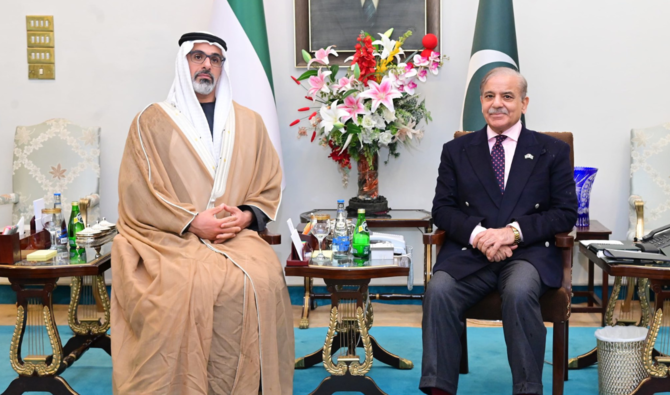
Abu Dhabi Crown Prince Sheikh Khaled bin Mohamed bin Zayed Al Nahyan meeting with Pakistan Prime Minister Shehbaz Sharif in Islamabad, Pakistan, on February 27, 2025. (Photo courtesy: @CMShehbaz/X)
Short Url
Updated 28 February 2025
Follow

UAE, Pakistan sign agreements in mining, railways, banking during Abu Dhabi crown prince’s visit

  • Sheikh Khaled bin Mohamed bin Zayed Al Nahyan arrived on first official visit to Islamabad
  • Analyst advises seeking joint ventures in agriculture, pursuing mining, tourism investments

KARACHI: Pakistan and the United Arab Emirates signed key agreements to boost cooperation in mining, railways, banking and infrastructure sectors, the Prime Minister’s Office (PMO) said, as Abu Dhabi Crown Prince Sheikh Khaled bin Mohamed bin Zayed Al Nahyan arrived on his first official visit to Islamabad on Thursday. 
The UAE is Pakistan’s third-largest trading partner after China and the United States and a major source of foreign investment, valued at over $10 billion in the last 20 years, according to the Gulf country’s foreign ministry. 
The crown prince’s visit came as Pakistan pursues economic diplomacy with several Gulf and Central Asian nations and treads a tricky path to economic recovery while being bolstered by a $7 billion IMF bailout loan.
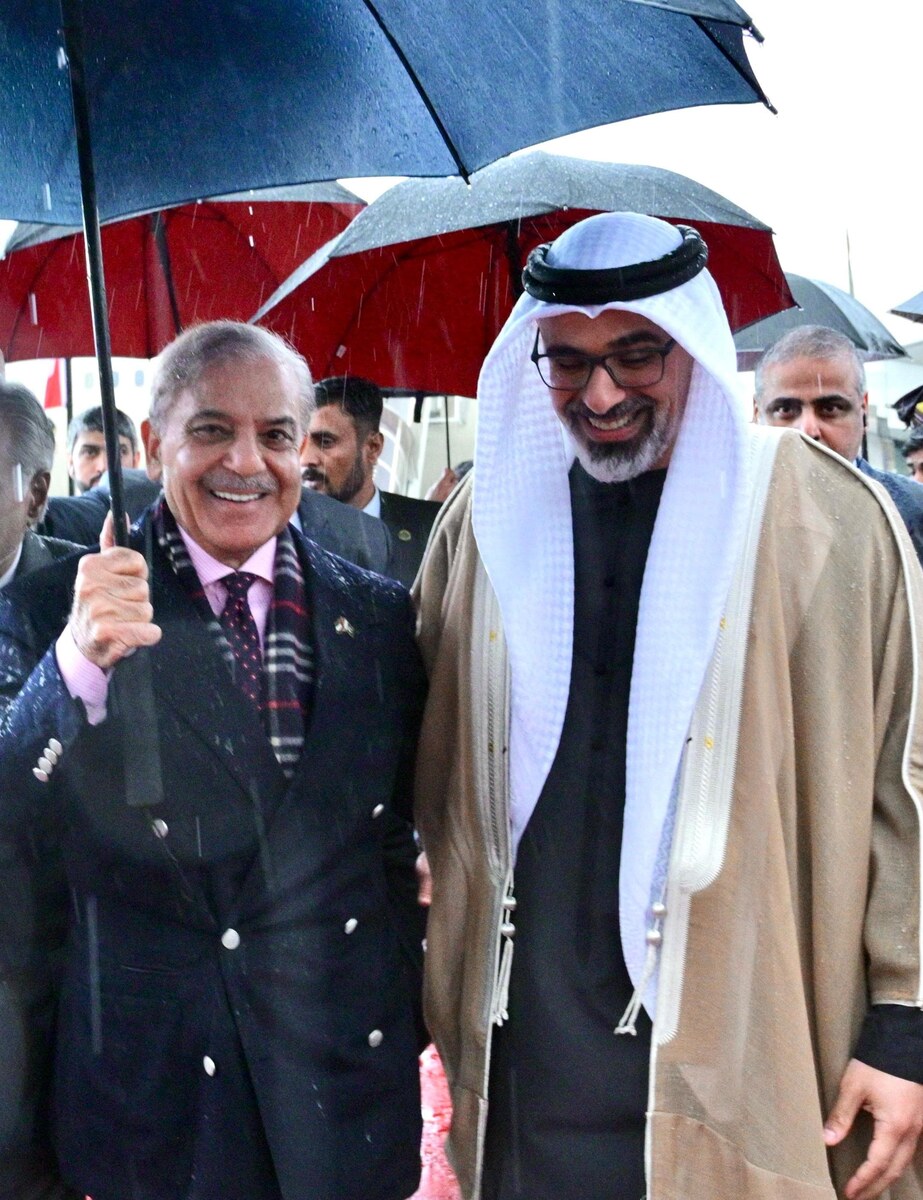


Pakistan Prime Minister Shebaz Sharif receives Abu Dhabi Crown Prince and Chairman Abu Dhabi Executive Council Sheikh Khaled bin Zayed Al Nahyan at the Nur Khan Airbase in Rawalpindi on February 27, 2025. (PMO)

Sheikh Al Nahyan was accompanied by a high-level delegation of ministers, senior officials and business leaders during his day-long trip to Pakistan. He witnessed the signing of agreements between the two sides with Sharif.
“The MoUs/agreements were signed in the fields of Banking, Mining, Infrastructure development and Railways,” Sharif’s office said in a statement. 
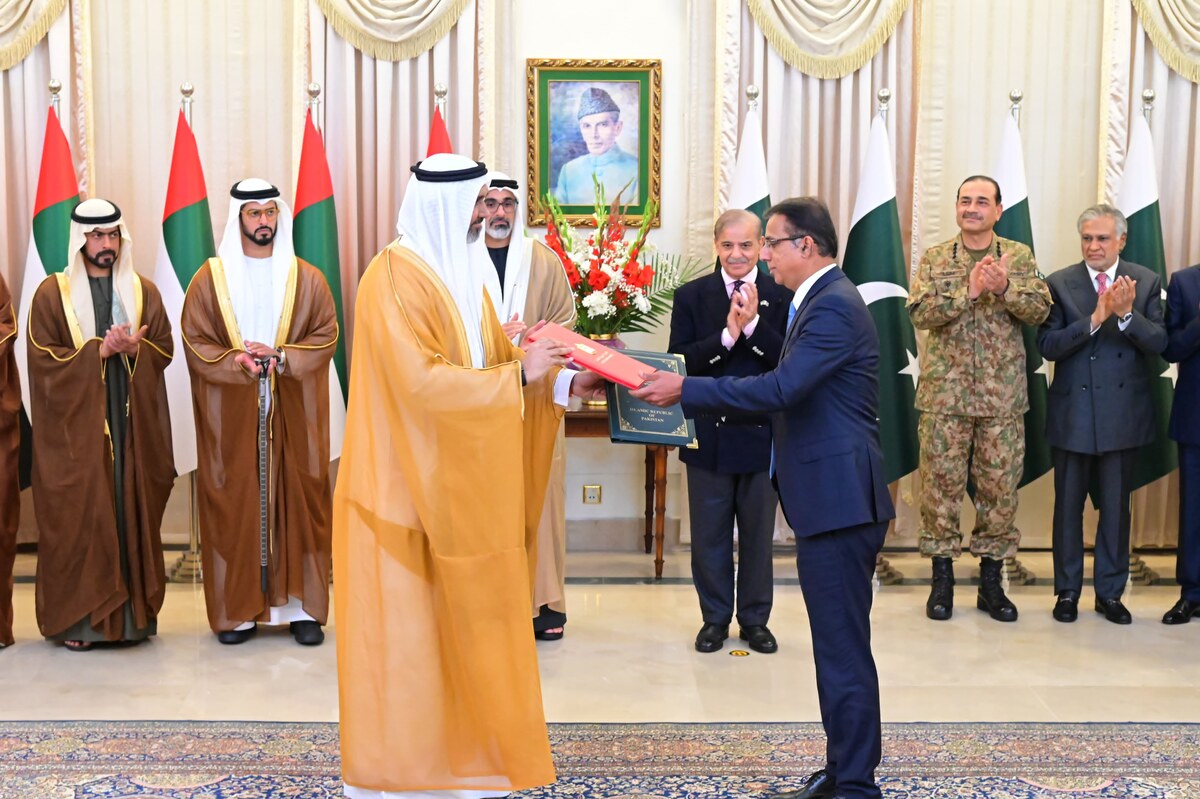


Officials from UAE (left) and Pakistan (right) exchange MOUs as Prime Minister Shebaz Sharif and Abu Dhabi Crown Prince and Chairman Abu Dhabi Executive Council Sheikh Khaled bin Zayed Al Nahyan attend the ceremony at the Prime Minister Office in Islamabad on February 27, 2025. (PMO)

Sharif’s office said that the Pakistani prime minister informed the crown prince of his discussions on the Uzbekistan-Afghanistan-Pakistan Railway Line in Tashkent this week. 
“He further said that the project will benefit the ports of Gwadar and Abu Dhabi and would prove to be a game changer for the whole region,” the PMO said. 
Sharif praised the UAE’s support for Pakistan in various fields, the PMO said, adding that he appreciated UAE’s “keen interest” in expanding its investment portfolio in Pakistan.  
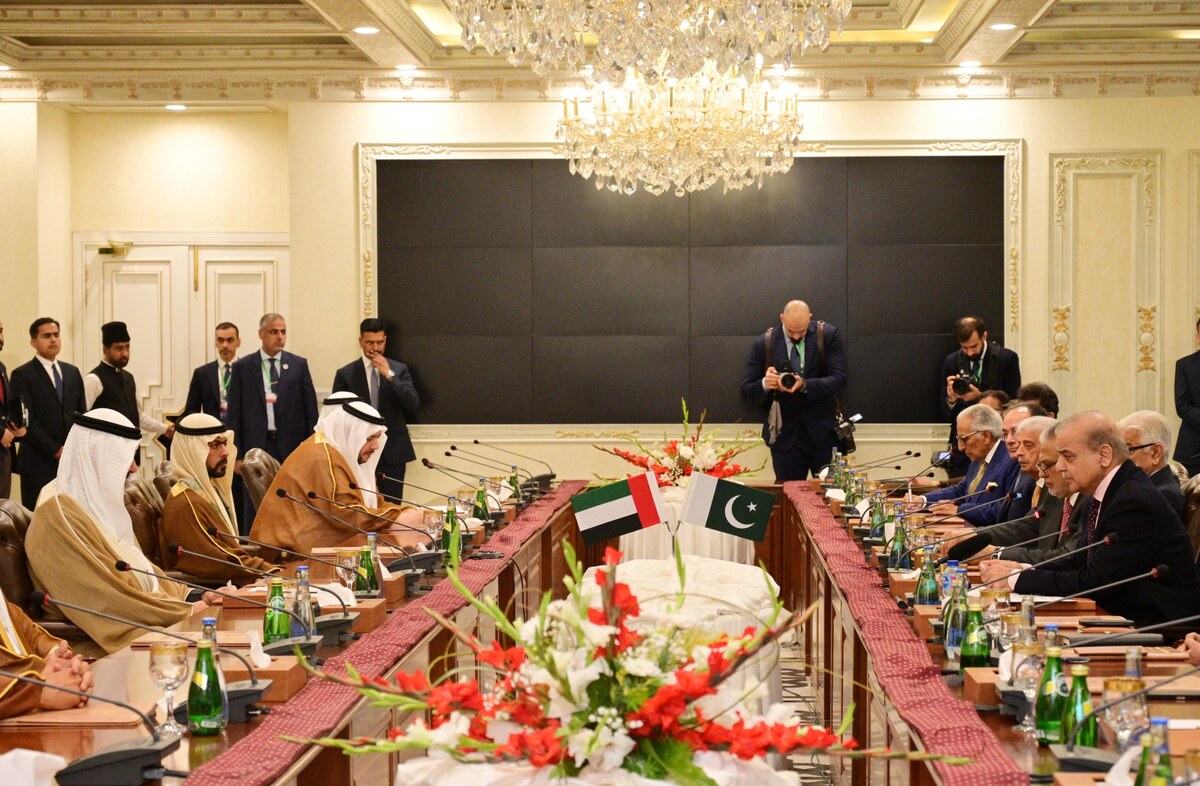


Abu Dhabi Crown Prince and Chairman Abu Dhabi Executive Council Sheikh Khaled bin Zayed Al Nahyan (first, left) and Pakistan Prime Minister Shehbaz Sharif (first, right) lead Pakistan and UAE delegation during a meeting at the Prime Minister Office in Islamabad on February 27, 2025. (PMO)

The crown prince had arrived in Islamabad on Thursday afternoon where he was received by the premier and President Asif Ali Zardari.
President Zardari later conferred Pakistan’s highest civilian award, the Nishan-e-Pakistan, on the Abu Dhabi crown prince in a ceremony attended by Sharif and top government officials. 
Sheikh Al Nahyan left after witnessing the signing of the agreements with Sharif. He was seen off by the Pakistani prime minister. 
Speaking to Arab News, an analyst and former government official described the visit as a “positive” development.
“If a high level official like the crown prince is visiting Pakistan that means they must be bringing something important in hand for our country,” Ashfaq Tola, Pakistan’s former state minister for resource mobilization, said.
He advised that Pakistan seek joint ventures with the UAE in its agro-based economy and encourage investment in Pakistan’s export-related sectors to improve the South Asian country’s forex earnings. He also said investors from the Gulf state could benefit from mining sector projects like the Reko Diq gold and copper reserves, along with the oil exploration and tourism sectors.


Pakistan and the UAE have stepped up efforts in recent years to strengthen economic relations. Last year the two countries signed multiple agreements exceeding $3 billion for cooperation in railways, economic zones, and infrastructure development.
Policymakers in Pakistan consider the UAE an optimal export destination due to its geographical proximity, which minimizes transportation and freight costs while facilitating commercial transactions.
The UAE is also home to more than a million Pakistani expatriates, making it the second-largest Pakistani expatriate community worldwide and a major source of foreign workers’ remittances.


Pakistan likely to import around 7 million cotton bales this year as local production nearly halves

Updated 5 sec ago
Follow

Pakistan likely to import around 7 million cotton bales this year as local production nearly halves

  • Pakistan produced 5.3 million cotton bales by mid-December against 10 million targeted, government data shows
  • While the imports may ensure smooth supply of raw material, they may put pressure on foreign exchange reserves

KARACHI: Pakistan is likely to import around 7 million cotton bales this year owing to a decline of nearly half the annual target set by the Federal Committee on Agriculture (FCA), industry stakeholders said on Tuesday.

Pakistan’s cotton production stood at 5.3 million bales each weighing 170 kilograms as of Dec. 15, according to state-run Pakistan Central Cotton Committee (PCCC) data. The FCA had set a target of 10.2 million bales in April.

Karachi Cotton Brokers Forum (KCBF) Chairman Naseem Usman Osawala sees the country’s cotton production declining by 46 percent this season, compared to the FCA target.

“The country is expected to produce about 5.5 million bales this year,” he told Arab News, adding Pakistan would have to import around 7 million bales to meet requirement of its textile industry which consumes about 12 million bales a year.

The country had sown cotton over 2.002 million hectares, which was down by 11 percent from the targeted 2.26 million hectares.

Muhammad Waqas Ghani, head of research at Karachi-based JS Global Capital brokerage firm, said the South Asian country is likely to miss its cotton output target of 10 million bales.

“At the current rate of arrival, the output can reach 7 million bales at its best,” he added.

Cotton is a raw material for Pakistan’s largest textile industry and was the worst hit crop by climate-induced floods earlier this year.

Osawala said Pakistan’s cotton production has been falling because of an increasing number of sugar mills being established in the country’s cotton-producing regions.

Courts in Pakistan have been issuing significant rulings to bar the establishment of sugar mills in the designated cotton belt areas of the Punjab province. In 2018, the Supreme Court ordered relocation of three sugar mills from cotton-producing districts in southern Punjab to protect the crop.

Since cotton prices are low in the international market, textile millers would go for more imports, according to the KCBF chairman.

On Dec. 22, the price of cotton in the New York market stood at as much as 65.85 cents per pound, 1.64 cents lower than last year, according to the PCCC data.

Osawala said Pakistan’s increasing textile imports are also “hurting local cotton production.”

According to the Pakistan Bureau of Statistics’ (PBS) July-November data, the country had imported raw cotton, synthetic fiber, synthetic and artificial silk yarn and worn clothing worth $2.82 billion, 5 percent more than the imports during the same period last year.

Speaking of the impact of Pakistan’s falling cotton production, Kamran Arshad, chairman of All Pakistan Textile Mills Association (APTMA), said the millers would have to import “a lot of cotton” this year.

“I think approximately 7-7.5 million bales will have to be imported this year,” he said.

The textile and apparel sector is Pakistan’s largest exporter, accounting for more than half of the country’s overall exports and contributing around 8.5 percent of the gross domestic product (GDP) by employing nearly 40 percent of the industrial labor force. But high energy costs and outdated infrastructure among other factors continue to slow growth and leave the country trailing regional peers.

In the last fiscal year, Pakistan imported as much as 6.2 million cotton bales each weighing 220 kilograms, mostly from Brazil and the United States, according to KCBF Chairman Arshad.

Shankar Talreja, head of research at Karachi-based Topline Securities, said Pakistan is likely to import cotton worth $1.2 billion this year “considering the requirement.”

“The full-year import of cotton is likely to remain over $1 billion,” Talreja said.

Economic experts say while importing more cotton would ensure smooth supply of raw material to Pakistan’s textile sector, it may put pressure on the country’s foreign exchange reserves that rose to $15.9 billion last week after the International Monetary Fund (IMF) released a $1.2 billion tranche under Pakistan’s $7 billion loan program.