

UAE launches higher education scholarship program for students from Balochistan

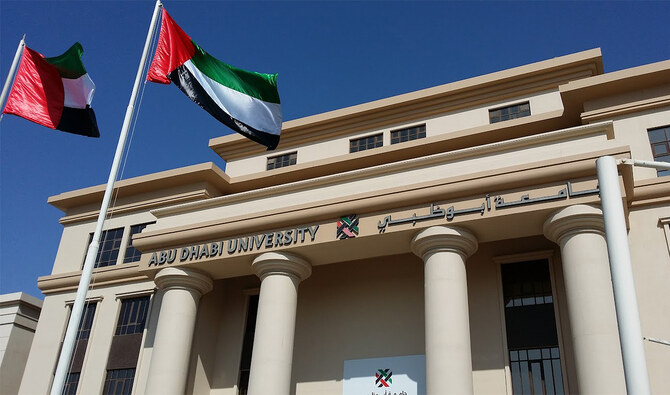
The picture posted on March 15, 2015, shows exterior view of Abu Dhabi University in Abu Dhabi, UAE. (Muhammad Hilal/Google Maps)
Short Url
Updated 26 February 2025
Follow

UAE launches higher education scholarship program for students from Balochistan

  • 20 boys and five girls have been selected from different districts of Balochistan after written tests
  • Balochistan has low literacy rate compared to rest of Pakistan, gender gap in education also significant

ISLAMABAD: The United Arab Emirates (UAE) has announced a higher education scholarship program for students from Pakistan’s southwestern Balochistan province, state broadcaster Radio Pakistan reported on Wednesday.

Balochistan has a low literacy rate compared to the rest of Pakistan. The gender gap in education is also significant. 

In 2022–2023, Balochistan’s literacy rate was 54.5 percent, the lowest in Pakistan. The literacy rate for women in Balochistan is lower than the national average. In some districts, like Washuk and Kharan, female literacy is less than 10 percent, according to official data. Across the province, only 34 percent of girls attend school, compared to 52 percent of boys. More than 60 percent of government schools in Balochistan lack electricity and 45 percent operate without clean water. Classrooms are overcrowded, with a pupil-teacher ratio of 50:1.

“The UAE has announced a scholarship program for students of Balochistan to promote higher education in the province,” Radio Pakistan reported. “Under the scholarship, 25 candidates including five girls have been selected from different districts of the province after conducting written tests.”

Students selected for the scholarship thanked the Pakistan and UAE governments for the “educational journey milestone.”

One of the girls selected for the scholarship, Husun Bano, a resident of Turbat district, said in a video message the scholarship offered her a way to fulfill her childhood dreams.

Another student identified as Malik Lehri, a resident of the provincial capital of Quetta, said he would be completing his civil engineering bachelor’s degree from Abu Dhabi University. 

Earlier this month, the Balochistan government had announced fully funded scholarships for talented students from the province.

In 2018, Saudi Arabian Ambassador to Pakistan Nawaf Al-Maliki announced 50 scholarships for Balochistan students to allow them to study in Saudi universities.


Pakistan army chief assumes role as first Chief of Defense Forces, signaling unified command

Updated 5 sec ago
Follow

Pakistan army chief assumes role as first Chief of Defense Forces, signaling unified command

  • New role is held simultaneously with Gen Asim Munir’s existing position as Chief of Army Staff
  • It is designed to centralize operational planning, war-fighting doctrine, modernization across services

ISLAMABAD: Pakistan’s most senior military officer, Field Marshal Syed Asim Munir, formally took charge as the country’s first Chief of Defense Forces (CDF) on Monday, marking a structural change in Pakistan’s defense command and placing the army, navy and air force under a single integrated leadership for the first time.

The new role, held simultaneously with Munir’s existing position as Chief of Army Staff, is designed to centralize operational planning, war-fighting doctrine and modernization across the services. It reflects a trend seen in several advanced militaries where a unified command oversees land, air, maritime, cyber and space domains, rather than service-level silos.

Pakistan has also established a Chief of Defense Forces Headquarters, which Munir described as a “historic” step toward joint command integration.

In remarks to officers from all three forces after receiving a tri-services Guard of Honor at the General Headquarters (GHQ) in Rawalpindi, Munir said the military must adapt to new theaters of conflict that extend far beyond traditional ground warfare.

He stressed the need for “a formalized arrangement for tri-services integration and synergy,” adding that future war will involve emerging technologies including cyber operations, the electromagnetic spectrum, outer-space platforms, information warfare, artificial intelligence and quantum computing.

“He termed the newly instituted CDF Headquarters as historic, which will afford requisite integration, coherence and coordination to meet the dynamics of future threat spectrum under a tri-services umbrella,” the military quoted Munir as saying in a statement. 

The ceremony also included gallantry awards for Pakistan Navy and Air Force personnel who fought in Marka-e-Haq, the brief May 2025 conflict between Pakistan and India, which Pakistan’s military calls a model for integrated land, air, maritime, cyber and electronic combat. During his speech, Munir paid tribute to the personnel who served in the conflict, calling their sacrifice central to Pakistan’s defense narrative.

The restructuring places Pakistan closer to command models used by the United States, United Kingdom and other nuclear-armed states where a unified chief directs inter-service readiness and long-range war planning. It also comes at a time when militaries worldwide are re-engineering doctrine to counter threats spanning satellites, data networks, information space and unmanned strike capabilities.