


ABIDJAN: For well over a decade, terrorist violence has plagued the Sahel, a semi-arid belt stretching along the Sahara desert’s southern rim from the Atlantic to the Red Sea.
Tens of thousands of people have been killed in violence that began in Mali in 2012, spread to Burkina Faso and Niger, and now threatens coastal west African states.
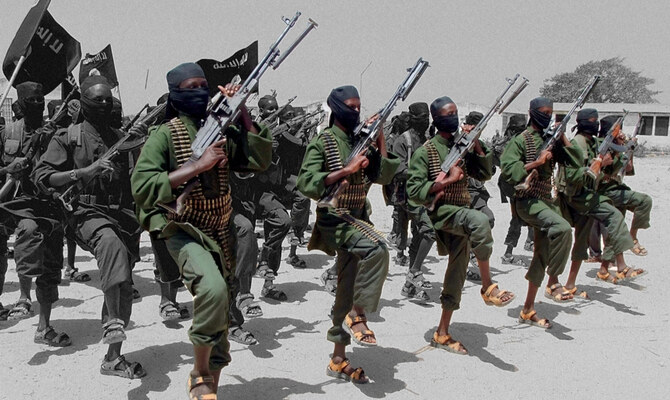
Two militant organizations dominate the central Sahelian region that includes Mali, Niger and Burkina: the Group for the Support of Islam and Muslims and the Islamic State — Sahel Province or ISSP.
Affiliated to Al-Qaeda, the JNIM was founded in 2017 after militant groups merged under the leadership of Iyad Ag Ghali, a Tuareg chief from the northern Malian town of Kidal.
The rival ISSP is linked to the Daesh group and was created two years earlier by Moroccan terrorist Adnan Abou Walid Al-Sahraoui, who was killed in Mali in 2021 by a French military force.
Nigeria, Niger, Cameroon and Chad — in the Lake Chad Basin — are battling two other jihadist groups: Boko Haram and its offshoot, the Islamic State in West Africa or ISWAP.
The groups mainly roam rural areas. “Controlling the towns is very difficult for them,” International Crisis Group researcher Ibrahim Yahaya said.
From their camps in the bush, they use intimidation tactics such as abduction and killings to menace villagers and organize attacks on towns, Yahaya said.
The JNIM has a wide presence in Mali, Niger and Burkina and is increasingly extending its influence toward the northern parts of the Gulf of Guinea countries.
“The group plans to make new areas of instability on the borders of Burkina Faso with Benin and Togo,” Seidik Abba, head of the International Center of Reflection and Studies on the Sahel, said.
The ISSP is concentrated in the border area encompassing Mali, Burkina and Niger. The group “struggles to expand” because of the JNIM which is “militarily stronger” and has more local support, Liam Karr, analyst at the American Enterprise Institute, said.
Their ambitions differ. The ISSP follows the hard line of the Daesh group, using indiscriminate violence against civilians and soldiers with the aim of establishing an Islamic caliphate in the Sahel under Shariah law.
The JNIM also carries out deadly attacks but seeks local footholds by presenting itself as the defender of marginalized communities.
“In the JNIM narrative, there is the reference to the Islamic ideology, but linked to forms of local demands,” said Bakary Sambe, director of the Timbuktu Institute in Dakar. “While Daesh has remained in a form of global jihad that is failing to take root in local communities,” he added.
Daesh frequently broadcasts videos showing violence committed by security forces and their allies in order to legitimize its discourse, a UN Security Council report said this month.
There is often violent rivalry between the groups.
The militant groups exploit social and ethnic tensions to enlist fighters.
The JNIM, initially composed of Fulani, a community of mainly semi-nomadic herders, and of ethnic Tuaregs, has widened its base to include other communities, in particular ethnic Bambaras.
Exact figures are difficult to estimate, but according to a UN report in July last year, the JNIM has 5,000-6,000 fighters and the ISSP 2,000-3,000.
Their weaponry comes largely from the armies of the region and was pillaged during attacks, or from arms trafficking from Libya.
Financing ranges from kidnappings, especially of Westerners, to the theft and resale of cattle and forcing locals to pay the “zakat,” an annual tax in charity.
The militant groups use ambush, abduction, long-range shelling, improvised explosive devices and recently started using drones to drop explosives.
Civilians suspected of collaboration with the army are kidnapped or killed.
Militants also impose embargoes, burn harvests and abduct community leaders to force villagers into submission.
The response of the region’s armies has proven limited as the groups are constantly on the move and feed on local grievances.
Mali, Burkina and Niger have formed the Alliance of Sahel States confederation and said they will soon set up a 5,000-strong anti-militant force.
“At a time when the Sahelian armies are killing 3,000 militants, 12,000 others are being recruited,” Abba, head of the International Center of Reflection and Studies on the Sahel, said.
“So, if we do not solve the problem of youth unemployment in these countries, they will remain at the mercy of militant groups,” he added.


