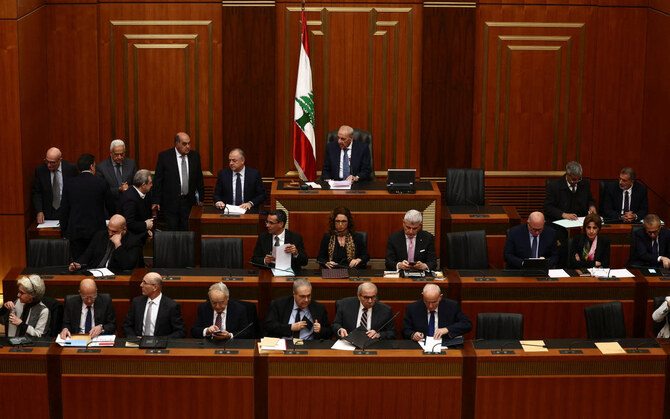
BEIRUT: Lebanon’s new government on Wednesday won a confidence vote in Parliament, with the support of Hezbollah’s bloc, even though the government statement adopted took a swipe at the group’s weapons.
Ninety-five out of 128 lawmakers supported the government of Prime Minister Nawaf Salam, a prominent jurist who previously headed the International Court of Justice. He was appointed last month to form a new government after a devastating war between Israel and Hezbollah, which killed over 4,000 people and caused widespread destruction.
The government statement adopted said that only Lebanon’s armed forces should defend the country in case of war. Unlike previous statements, it did not include the phrase “armed resistance,” which had been seen as legitimizing Hezbollah’s possession of weapons outside of state control.
Hezbollah has kept its weapons over the past decades saying they are necessary to defend the country against Israel. Calls for the group’s disarmament, however, intensified during the latest war, which ended with a US-brokered ceasefire on Nov. 27, 2024.
Hezbollah did not support Salam’s bid to be prime minister. But Hezbollah’s parliamentary leader, Mohammad Raad, on Tuesday announced his bloc’s confidence in his Cabinet on Tuesday.
Salam said the government asserts that Lebanon has the right to defend itself in case of any “aggression” and only the state has the right to have weapons. He also said the government takes measures to liberate land occupied by Israel “through its forces only.”
Legislators from the Amal movement, led by parliamentary speaker Nabih Berri — who brokered the ceasefire and is allied with Hezbollah — also voted for the new government. Hezbollah and the Amal Movement collectively hold about 27 seats designated for the Shi’ite community.
The Marada Movement, a Christian political party aligned with Hezbollah, and the Syrian Social Nationalist Party, a secular nationalist party aligned with Hezbollah, also offered the government their confidence.
The Lebanese Forces and the Kataeb, Christian parties that oppose Hezbollah and call for its disarmament and reduced Iranian influence, also backed Salam’s government.
Meanwhile, 12 legislators withheld support while four others abstained from voting, criticizing the ministerial statement as vague and lacking a clear plan. The “Strong Lebanon” bloc led by Gebran Bassil of the Free Patriotic Movement, previously aligned with Hezbollah, voted against the new government.
Among the key issues raised by parliamentarians for the government to address are Israel’s ceasefire violations and demands for its full withdrawal from Lebanese territory. While Israeli troops pulled out under the ceasefire terms, they remain in five strategic outposts along the border and continue to conduct airstrikes, saying they are targeting Hezbollah fighters and weapons caches.
Legislators also urged the government to tackle reconstruction following the war, Lebanon’s severe economic and banking crisis and implement long-overdue judicial and banking reforms.


![]()

Lebanon’s government wins confidence vote, says only armed forces should defend country in war
Short Url
https://arab.news/8cmng
Lebanon’s government wins confidence vote, says only armed forces should defend country in war
- Salam said the government asserts that Lebanon has the right to defend itself in case of any “aggression” and only the state has the right to have weapons
- He also said the government takes measures to liberate land occupied by Israel “through its forces only”


Latest updates





© 2026 SAUDI RESEARCH & PUBLISHING COMPANY, All Rights Reserved And subject to Terms of Use Agreement.