Graffiti left by Israeli soldiers turn south Lebanon homes into a canvas of war

1 / 3
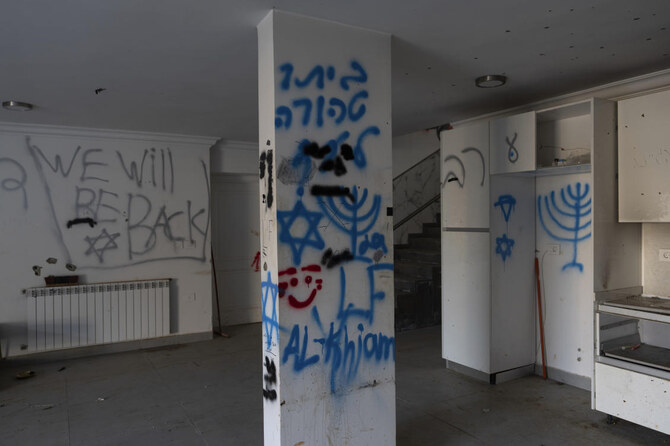
Hebrew and English graffiti written by Israeli soldiers during the ground offensive against Hezbollah, is seen in a house in the southern town of Khiam, Lebanon, Feb. 18, 2025. (AP)
2 / 3
Graffiti of a Bible verse and a Star of David is seen inside a house, written by Israeli soldiers during the ground offensive against Hezbollah, in the southern town of Khiam, Lebanon, Feb. 18, 2025. (AP)
3 / 3
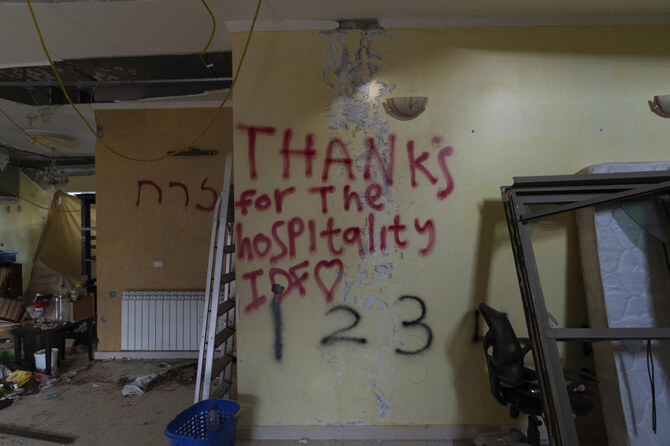
Graffiti written by Israeli soldiers during the ground offensive against Hezbollah, is seen in a house in the southern town of Khiam, Lebanon, Feb. 18, 2025. (AP)
Short Url
Updated 26 February 2025
Follow

Graffiti left by Israeli soldiers turn south Lebanon homes into a canvas of war

  • One yellow wall had written on it signs of preparedness: the cardinal directions in red
  • On another is what appears to be a battle plan: a hand-drawn map, a list of soldiers slated for a task and supplies — a drone, a stretcher

KHIAM, Lebanon: Residents of southern Lebanon have been gradually returning to their villages to find their homes heavily damaged by the fighting between Israel and the Lebanese militant group Hezbollah.
As they scour what remains, they are discovering that the battle-scarred walls of their houses served as a canvas for Israeli soldiers and Hezbollah supporters that tell the story of the war.
The scrawled messages give insight into the battles that erupted after Israel launched a ground invasion into southern Lebanon in October 2024, months after Hezbollah began firing rockets and drones at Israel in solidarity with the Palestinian militant group Hamas in the Gaza Strip.
A ceasefire in November allowed Lebanese residents to begin returning to their homes, which had been occupied by Israeli troops.
One yellow wall had written on it signs of preparedness: the cardinal directions in red. On another is what appears to be a battle plan: a hand-drawn map, a list of soldiers slated for a task and supplies — a drone, a stretcher.
“Wake up Kochuk every hour on the hour from 20:00,” reads one instruction, apparently referring to a soldier.
Elsewhere, a warning to the returnees: “We will be back,” scribbled in English, in gray spray paint, with a Star of David; the word Lebanon in red, with a large X crossing it out. One message reads cynically, “Thanks for the hospitality,” with a heart.
Others reveal moments of boredom — the rules of a card game spelled out in meticulous detail in Hebrew, along with sketches of most of the suit of hearts; a drawing of SpongeBob SquarePants, a dog, a ninja.
And still other messages appear intended to leave a personal mark: “Congratulations, mom,” scrawled in dark red on a bright pink bedroom wall, above a bed piled with belongings and near a photo of a local couple.
In another room, with windows blacked out by tarps and littered with garbage, a Bible verse. In a kitchen, inside an empty refrigerator alcove, a drawing of a blue menorah.
But not just messages from Israeli soldiers were left behind. Peppered throughout homes in the village of Khiam are notes in Arabic written by Hezbollah fighters or their supporters after Israeli forces withdrew earlier this month.
They underscore the continued allegiance to Hezbollah despite the hard blows it endured during the war. “Wish we lost everything and you stayed, Sayyed,” referring to Hezbollah’s longtime leader Hassan Nasrallah, who was killed in Israeli strikes in southern Beirut in September.
“Khiam is Golani’s graveyard,” reads a warning on one wall, referring to an Israeli military unit. On another, a message of defiance: “Our flag will not fall. ... We will not drop our weapons.”


Syrian Kurdish enclave on alert amid shaky ceasefire

Armed Kurdish volunteers pose for a picture while standing guard at a checkpoint in Qamishli, Syria, January 26, 2026. (REUTERS)
Updated 5 sec ago
Follow

Syrian Kurdish enclave on alert amid shaky ceasefire

  • The SDF is clinging on in its northeastern enclave — one of several where Kurds — an oppressed group under the ‌ousted Assad dynasty — established ‌de facto autonomy during the civil war

QAMISHLI, Syria: With Syria’s Islamist-led government bearing down on Kurdish forces, residents of their last major enclave are on alert, mindful of last year’s violence against other minority groups and determined to preserve their self-rule.
In the Kurdish-majority city of Qamishli in the northeast, a mechanic, a storekeeper, and ​a student were among those taking part in a nighttime volunteer patrol this week, vowing to defend their area and putting little faith in a shaky ceasefire.
“We’re going out to guard our neighborhoods, to stand with our people and protect our land,” said Yazan Ghanem, 23. “This is our land. We won’t accept any outside interference in our areas.”

’FEARS AND DOUBTS’ WEIGH ON KURDS, SAYS RESIDENT
It reflects simmering tensions despite the US-backed ceasefire, which was extended on Saturday for 15 days. Some clashes have taken place since then.
Having taken swathes of the north and east from the Kurdish-led Syrian Democratic Forces (SDF), President Ahmed Al-Sharaa’s government is pressing its demand for the integration of the remaining Kurdish-run enclaves with the state.
The SDF is clinging on in its northeastern enclave — one of several where Kurds — an oppressed group under the ‌ousted Assad dynasty — established ‌de facto autonomy during the civil war.
While Sharaa has repeatedly vowed to uphold Kurdish ‌rights — he ⁠recognized ​Kurdish as ‌a national language earlier this month — the residents patrolling Qamishli on Monday had little confidence in the former Al-Qaeda commander.
“We have fears and doubts about the government because, quite simply, wherever it has entered, there have been massacres and killing,” said Radwan Eissa, brandishing a gun.
Fears among Syrian minorities grew last year during several bouts of violence in which the Sunni Muslim-led government clashed with members of the Alawite community in Syria’s coastal region, and Druze communities in Sweida province, with government-aligned fighters killing hundreds of people.
Sharaa has promised accountability.
A senior Syrian government official said Kurdish fears were “understandable” based on abuses committed by army personnel in Sweida and some violations carried out by troops as they pressed into Kurdish-held ⁠areas in recent weeks.
The official said two people had been arrested for the recent abuses and a third was on the run, but being pursued. “We are keen to learn from ‌past experiences, and we did,” he added.
The prosecutor general last year pressed charges ‍against some 300 people linked to armed factions affiliated with the Syrian ‍army over the violence in the coastal region, and around 265 who belonged to Assad-era paramilitary groups.
Human Rights Watch said ‍on January 25 that both parties appeared to have committed abuses that violated international law during the current escalation in the northeast.

SDF READY ‘FOR WAR AND POLITICAL SOLUTIONS’
Government forces have advanced to the outskirts of SDF-held Hasakah, an ethnically mixed city some 70 km (45 miles) south of Qamishli. They have also encircled Kobani, or Ain Al-Arab, a Kurdish-held town at the Turkish border.
The SDF has vowed to protect Kurdish regions.
In an interview with Kurdish broadcaster Ronahi ​on Sunday, SDF commander Mazloum Abdi said dialogue continued with Damascus, and that after the 15-day period “serious steps” would be taken toward integration.
“Our forces are ready for war and political solutions,” he said. “The Kurds must get their rights ⁠in this region, and join the Syrian state,” he said.
The Syrian official said the January 18 integration deal aimed to reassure Kurds by stipulating that Syrian troops would not enter Kurdish areas and by spelling out how local communities would be able to delegate their own representatives.
The SDF’s territory grew as it partnered with the United States against Islamic State in Syria.
But its position weakened as Washington deepened ties to Sharaa over the last year. President Donald Trump said on January 20 Washington was trying to protect the Kurds.
Syria’s dominant Kurdish group, the PYD, follows a political doctrine emphasising leftism and feminism.
Giwana Hussein, a 23-year-old Qamishli student, said she hoped the ceasefire showed that both sides wanted a political solution. She urged Damascus to let Kurds run their own affairs, and said she was afraid that if the government took control, women’s rights would be marginalized.
The Syrian official said the government wanted to ensure a new constitution addressed Kurdish concerns, but said that it could only come after an integration deal was agreed and implemented. “Once we merge, we can discuss everything,” the official said.
Ivan Hassib, a Kurdish activist critical of the PYD, said Sharaa’s ‌decree recognizing Kurdish rights was positive but only a first step, saying they must be enshrined in the constitution and not limited to cultural rights: “The lasting solution ... is for the Kurds and other groups to obtain some form of autonomy.”