GENEVA: The UN rights chief on Wednesday rejected as “unlawful” proposals for the annexation of or forced transfer from Palestinian territories, warning they posed a threat to the entire region.
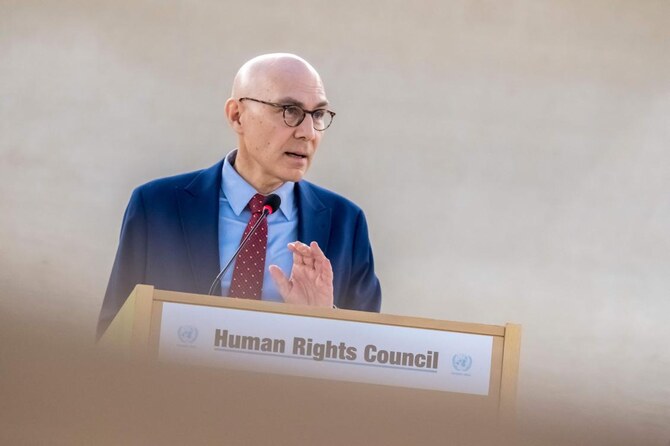
“We must resist any normalization of unlawful conduct, including proposals for annexation or forced transfer,” Volker Turk told the United Nations Human Rights Council.
Such proposals “could threaten the peace and security of Palestinians and Israelis, and of the wider region,” he warned, insisting that “this is the moment for voices of reason to prevail.”
Turk did not give details, but there have been rising levels of violence by Israeli settlers in the West Bank and calls for annexation after Israel announced expanded military operations in the occupied Palestinian territory.
US President Donald Trump has repeatedly proposed emptying war-ravaged Gaza of Palestinians.
He has floated the idea of a US takeover of Gaza under which its Palestinian population would be relocated — a proposal met with widespread condemnation, but welcomed by Israeli Prime Minister Benjamin Netanyahu.
Trump later appeared to soften his plan, saying he was only recommending the idea, and conceding that the leaders of Jordan and Egypt — the proposed destinations for relocated Gazans — had rejected any effort to move Palestinians against their will.
But the US president’s official social media accounts on Wednesday posted an apparently AI-generated video depicting war-ravaged Gaza rebuilt into a seaside resort, replete with a towering golden statue of Trump himself.
Presenting a fresh report on the rights situation in the Palestinian territories, Turk said Wednesday: “We urgently need to end the conflict.”
To do so, he said it was vital to hold accountable perpetrators of a vast array of abuses committed since the war in Gaza erupted after Hamas’s deadly October 7, 2023 attacks inside Israel.
“Israel’s means and methods of warfare have caused staggering levels of casualties and destruction, raising concerns over the commission of war crimes and other possible atrocity crimes,” he said.
But he raised “serious doubts” about the Israeli justice system’s ability to deliver justice “notably in relation to the unlawful killing of Palestinians in Gaza or in the West Bank.”
He also noted that “Hamas and other Palestinian armed groups have taken, held, and tortured hostages in Gaza, and have indiscriminately fired projectiles into Israeli territory, amounting to war crimes.”
To his knowledge, none of these groups had taken measures to punish those responsible, he said, adding that such “impunity begets more violence.”
So to did “delegitimising and threatening international institutions that are there to serve people and uphold international law also harms us all,” he warned.
All violations and abuses need to be investigated independently, he said.
While Turk mentioned no names, earlier this month Washington sanctioned the chief prosecutor at the International Criminal Court Karim Khan over the ICC’s investigations targeting US personnel as well as alleged Israeli war crimes in Gaza.
Khan was responsible for the request that led the ICC to issue arrest warrants late last year for Netanyahu and his former defense minister Yoav Gallant.


![]()


UN rejects ‘annexation’ proposals for Palestinian territories
Short Url
https://arab.news/whyjy
UN rejects ‘annexation’ proposals for Palestinian territories
- “We must resist any normalization of unlawful conduct, including proposals for annexation or forced transfer,” Volker Turk told the UN Human Rights Council
- Such proposals “could threaten the peace and security of Palestinians and Israelis, and of the wider region“


Thirty four Australians released from Syrian camp holding Daesh affiliated families
ROJ CAMP: Syrian Kurdish forces on Monday released 34 Australians from a camp holding families of suspected Daesh militants in northern Syria, saying they would be flown to Australia from Damascus.
Hukmiya Mohamed, a co-director of Roj camp, told Reuters that the 34 Australians had been released to members of their families who had come to Syria for the release. They were put on small buses for Damascus.
Roj camp holds more than 2,000 people from 40 different nationalities, the majority of them women and children.
Thousands of people believed to be linked to Daesh militants have been held at Roj and a second camp, Al-Hol, since the militant group was driven from its final territorial foothold in Syria in 2019.
Syrian government forces seized swathes of northern Syria from the Kurdish-led Syrian Democratic Forces in January, before agreeing a ceasefire on January 29.
The US military last week completed a mission to transfer 5,700 adult male Daesh detainees from Syria to Iraq.
Hukmiya Mohamed, a co-director of Roj camp, told Reuters that the 34 Australians had been released to members of their families who had come to Syria for the release. They were put on small buses for Damascus.
Roj camp holds more than 2,000 people from 40 different nationalities, the majority of them women and children.
Thousands of people believed to be linked to Daesh militants have been held at Roj and a second camp, Al-Hol, since the militant group was driven from its final territorial foothold in Syria in 2019.
Syrian government forces seized swathes of northern Syria from the Kurdish-led Syrian Democratic Forces in January, before agreeing a ceasefire on January 29.
The US military last week completed a mission to transfer 5,700 adult male Daesh detainees from Syria to Iraq.
Latest updates


Recommended



© 2026 SAUDI RESEARCH & PUBLISHING COMPANY, All Rights Reserved And subject to Terms of Use Agreement.