

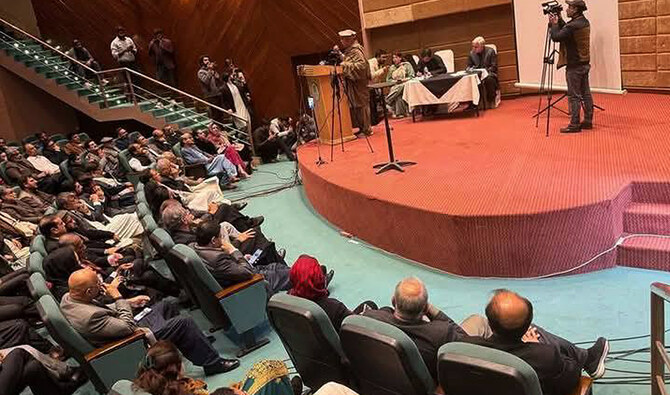
Pakistan opposition alliance holds conference in Islamabad to demand ‘supremacy of constitution’

Mahmood Khan Achakzai, Pakistan’s Pashtunkhwa Milli Awami Party chairman, speaks during the two-day “National Conference on Constitution Supremacy” in Islamabad on February 26, 2025. (Photo courtesy: Facebook/PkMAP)
Short Url
Updated 26 February 2025
Follow

Pakistan opposition alliance holds conference in Islamabad to demand ‘supremacy of constitution’

  • Opposition’s PTI, SIC, PkMAP, members of civil society and journalists attend Islamabad conference
  • Pakistan’s opposition accuses coalition government of stifling dissent, interfering in judicial matters

ISLAMABAD: An alliance of Pakistan’s leading opposition parties kicked off a two-day conference in the capital city on Wednesday to demand rule of law and “supremacy of the constitution” in the country, calling on the government to refrain from committing alleged rights abuses. 
The meeting has been organized by the six-party Tehreek Tahafuz Ayeen-e-Pakistan (or the Movement to Protect the Constitution of Pakistan) at Islamabad’s Legend Hotel. Leaders from the Pakistan Tehreek-e-Insaf (PTI), Sunni Ittehad Council (SIC), Awam Pakistan, Majlis Wahdat-e-Muslimeen (MWM) and Pashtunkhwa Milli Awami Party (PkMAP) parties and others are attending the conference. 
Pakistan’s leading opposition parties have accused the ruling coalition government of cracking down on opposition supporters, resorting to rights abuses, interfering in judicial matters and passing legislation to stifle dissent. The government rejects these allegations and accuses the opposition of creating hurdles in its mission to reform Pakistan’s economy. 
Led by former prime minister Imran Khan’s PTI, the multi-party opposition alliance has also demanded the government investigate alleged irregularities in the February 2024 general election. 
“We demand supremacy of the constitution and rule of law in Pakistan,” former prime minister Shahid Khaqan Abbasi, leader of the Awaam Pakistan party, told participants at the conference. 
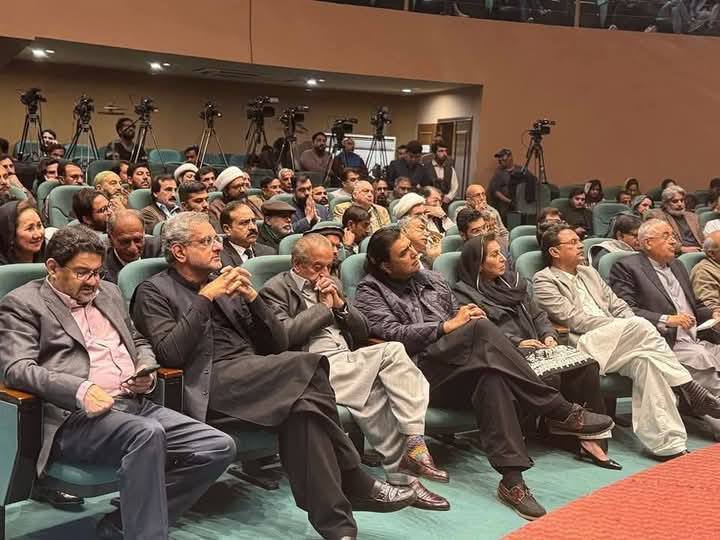


Awaam Pakistan party leaders Miftah Ismail (left), former finance minister, and ex-PM Shahid Khaqan Abbasi (2L) attend the two-day “National Conference on Constitution Supremacy” in Islamabad on February 26, 2025. (Photo courtesy: Facebook/PkMAP)

He said lawyers, journalists, intellectuals and members of the civil society had been invited on the first day of the conference to present their point of view on the state of affairs regarding the rule of law and constitution in Pakistan. 
“Till we do not have supremacy of the constitution, there will be political turmoil in the country,” Abbasi said. “And if there is political turmoil, the economy cannot move forward, the country cannot move forward.”
In a post on social media platform X, the PTI said it was being represented at the conference by the party chairman Gohar Ali Khan and opposition leader Omar Ayub.
SIC Chairman Sahibzada Hamid Raza and PkMAP chief Mahmood Khan Achakzai are also attending the event. 
Pakistan has been plagued with political turmoil since Khan was ousted as prime minister via a parliamentary vote in April 2022. He was later convicted in a slew of charges and sent to jail in August 2023. 
Khan denies the charges and says they are politically motivated to keep him and his party away from power. He accuses the country’s powerful military of orchestrating his removal from office and backing his political rivals in the government. The military denies Khan’s allegations and insists it does not interfere in political matters. 
Protests led by Khan’s party in May 2023 and November 2024 led to violence and clashes with law enforcers.


Pakistan Air Force conducts ‘Exercise Golden Eagle’ to test combat readiness, agility

Updated 10 February 2026
Follow

Pakistan Air Force conducts ‘Exercise Golden Eagle’ to test combat readiness, agility

  • The exercise follows an intense, four-day Pakistan-India military conflict in May 2025
  • It focused on AI-enabled operations integrating disruptive technologies, military says

ISLAMABAD: The Pakistan Air Force (PAF) has conducted “Exercise Golden Eagle” that successfully validated its combat readiness and operational agility through synchronized employment of the PAF’s complete combat potential, the Pakistani military said on Tuesday.

It comes months after Pakistan’s four-day military conflict with India in May, with Islamabad claiming victory in the standoff after the PAF claimed to have shot down at least six Indian fighter aircraft, including the French-made Rafale. New Delhi acknowledged some losses but did not specify a number.

The exercise was conducted on a Two-Force construct, focusing on AI-enabled, net-centric operations while integrating indigenous niche, disruptive and smart technologies in line with evolving regional security dynamics, according to the Inter-Services Public Relations (ISPR), the Pakistani military’s media wing.

Operating within a robust Integrated Air Defense System, friendly forces shaped the battlespace through seamless fusion of kinetic operations with cyber, space and electro-magnetic spectrum operations.

“The kinetic phase featured First-Shoot, First-Kill swing-role combat aircraft equipped with long-range BVR air-to-air missiles, extended-range stand-off weapons and precision strike capabilities, supported by Airborne Early Warning & Control platforms and Air-to-Air Refuelers,” the ISPR said in a statement.

“A key highlight of the exercise was Manned–Unmanned Teaming, with deep-reach killer drones and loitering munitions operating in a highly contested, congested and degraded environment, validating PAF’s capability to conduct high-tempo operations in modern warfare.”

In recent months, many countries have stepped up defense engagement with Pakistan, while delegations from multiple nations have proposed learning from the PAF’s multi-domain air warfare capabilities that officials say were successfully employed during the May conflict.

“The successful conduct of Exercise Golden Eagle reaffirms Pakistan Air Force’s unwavering commitment to maintaining a high state of operational preparedness, leveraging indigenous innovation and effectively countering emerging and future security challenges,” the ISPR added.