Russia, US diplomats to meet in Istanbul on Thursday

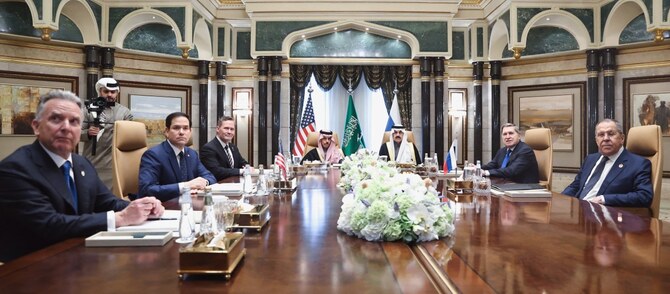
This handout picture taken and released by the Russian Foreign Ministry shows US Middle East envoy Steve Witkoff, Secretary of State Marco Rubio, Saudi Arabia's Foreign Minister Prince Faisal bin Farhan al-Saudand the Russian president's foreign policy advisor Yuri Ushakov, and Russia's Foreign Minister Sergei Lavrov attending a meeting together at Riyadh's Diriyah Palace on February 18, 2025 (AFP)
Short Url
Updated 26 February 2025
Follow

Russia, US diplomats to meet in Istanbul on Thursday

  • US President Donald Trump has upended US foreign policy since coming to office last month
  • Lavrov and US Secretary of State Marco Rubio met on February 18 in the Saudi capital Riyadh

DOHA: Russian and US diplomats will meet in Istanbul on Thursday to discuss resolving issues related to their embassies, Russia’s foreign minister said, amid easing relations between the two countries.
US President Donald Trump has upended US foreign policy since coming to office last month, reaching out to President Vladimir Putin and initiating high-level talks with Moscow for the first time in over three years.
The latest meeting will focus on resolving diplomatic issues, after both countries expelled embassy staff from the other during former US President Joe Biden’s administration.
“Such a meeting will take place tomorrow in Istanbul. I think that its results will show how quickly and effectively we can move forward,” Foreign Minister Sergei Lavrov said Wednesday on a visit to Qatar.
Lavrov and US Secretary of State Marco Rubio met on February 18 in the Saudi capital Riyadh, where they agreed to kickstart talks on the Ukraine war without Kyiv.
Both sides have since moved closer while sidelining Ukraine.
Last Wednesday, Trump branded his Ukrainian counterpart a “dictator” and called for him to “move fast” to end the war.
The United States sided with Russia twice Monday in votes at the United Nations, as it sought to avoid condemnation of Moscow’s invasion of its neighbor three years ago.


Vietnam’s ruling Communist Party re-elects To Lam as general secretary

Updated 3 sec ago
Follow

Vietnam’s ruling Communist Party re-elects To Lam as general secretary

HANOI: Vietnam’s leader To Lam was re-elected Friday as the general secretary of its ruling Communist Party, securing a new five-year term in the country’s most powerful position and pledging to rev up economic growth in the export powerhouse.
Lam, 68, was reappointed unanimously by the party’s 180-member Central Committee at the conclusion of the National Party Congress, the country’s most important political conclave.
In a speech, he said he wanted to build a system grounded in “integrity, talent, courage, and competence,” with officials to be judged on merit rather than seniority or rhetoric.
No announcement was made about whether Lam will also become president. If he were to get both positions, he would be the country’s most powerful leader in decades, similar to Chinese leader Xi Jinping.
The Congress was framed by Vietnam’s defining national question: whether the country can transform itself into a high-income economy by 2045. During the meeting, Vietnam set a target of average annual GDP growth of 10 percent or more from 2026 to 2030.
The gathering brought together nearly 1,600 delegates to outline Vietnam’s political and economic direction through 2031. It also confirmed a slate of senior appointments, electing 19 members to the Politburo, the country’s top leadership body.
Beyond settling the question of who will lead Vietnam for the coming years, the Congress will also determine how the country’s single-party system responds to world grown increasingly turbulent as China and the United States wrangle over trade and Washington under President Donald Trump challenges a longstanding global order.
Vietnam’s transformation into a global manufacturing hub for electronics, textiles, and footwear has been striking. Poverty has declined and the middle class is growing quickly.
But challenges loom as the country tries to balance rapid growth with reforms, an aging population, climate risks, weak institutions and US pressure over its trade surplus. At the same time it must balance relations with major powers. Vietnam has overlapping territorial claims with China, its largest trading partner, in the South China Sea.
Lam has overseen Vietnam’s most ambitious bureaucratic and economic reforms since the late 1980s, when it liberalized its economy. Under his leadership, the government has cut tens of thousands of public-sector jobs, redrawn administrative boundaries to speed decision-making, and initiated dozens of major infrastructure projects.
Lam spent decades in the Ministry of Public Security before becoming its minister in 2016. He led an anti-corruption campaign championed by his predecessor, Nguyen Phu Trong. During his rise, Vietnam’s Politburo lost six of its 18 members during an anti-graft campaign, including two former presidents and Vietnam’s parliamentary head.