HUB, PAKISTAN: Fourteen-year-old Zunaira Qayyum stepped out of an auto-rickshaw one weekday morning earlier this month, adjusting her white and green scarf as she entered the Global Islamic Public High School in the heart of Hub, a small town in Pakistan’s impoverished Balochistan province.
Qayyum is no regular ninth grader. She is a climate champion and an advocate for girls’ education from one of Pakistan’s most underdeveloped regions who was last week announced as a ‘Youth Advocate for Girls’ Empowerment and Climate Action’ by UNICEF, the UN’s humanitarian and developmental aid agency for children.
The eldest of four siblings, Qayyum’s journey to global recognition began after she conducted research in 2022 for a UNICEF Policy Research Challenge (PRC) that aimed to examine how climate-induced floods and heatwaves had disrupted girls’ education in her hometown of Hub. Her findings were among the winning entries in the challenge.
“Coming from a small area, a small village named Zehri, coming from there to the world stage was not an easy task for me but still I never gave up on my dreams and followed them,” Qayyum told Arab News in an interview.
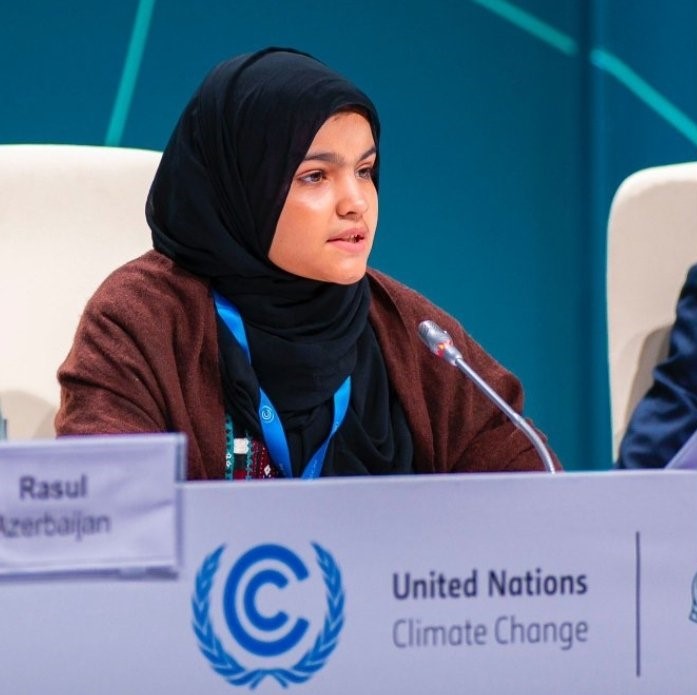
The undated file photo shows Zunaira Qayyum at the United Nations Climate Change confrence in Azerbaijan. (Photo courtesy: Zunaira Qayyum)
Women’s education figures are dismal for Balochistan, which has one of the lowest female literacy rates in the world. Many girls in the province drop out of school in grades four and five. Poverty, limited school numbers, and poor school infrastructure contribute to low literacy rates, as do long distances between homes and schools. Security challenges in the insurgency-wracked province and cultural barriers also limit access to education for girls.
These existing challenges were exacerbated in 2022 when catastrophic floods submerged a third of Pakistan, killing more than 1,700 people, affecting over 33 million people, and inflicting around $30 billion in damages and economic losses. Nearly 27,000 schools were damaged across Pakistan, leaving two million children without access to education, according to UNICEF. Balochistan was one of the worst hit areas.
In 2024 alone, climate-induced hazards disrupted schooling for more than 2.6 million children in Pakistan, one of the most vulnerable nations globally to climate change, with recurring floods, droughts and heatwaves.
Balochistan, which makes up 43 percent of Pakistan’s total landmass, lags behind other provinces in nearly all development indicators, including literacy and girls’ education, while the 2022 floods damaged more than 3,000 schools in the province.
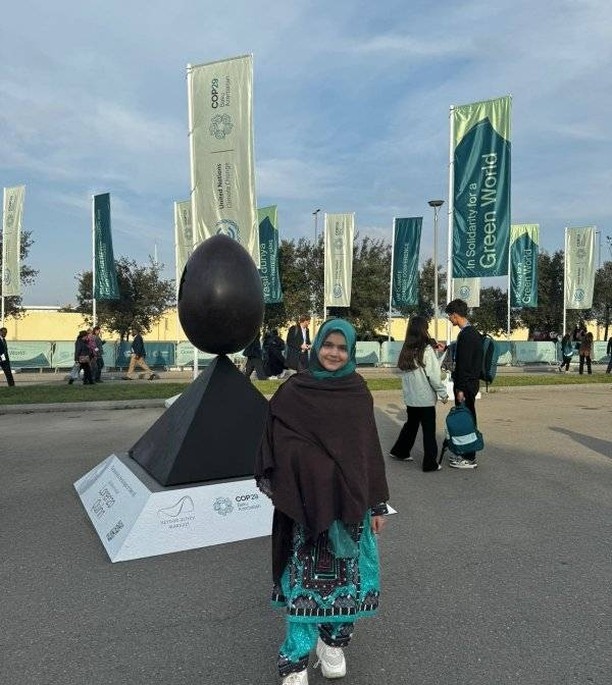
The undated file photo shows Zunaira Qayyum at the United Nations Climate Change confrence in Azerbaijan. (Photo courtesy: Zunaira Qayyum)
“Flood-induced damages in 2022 really disturbed the education sector in Hub, like the re-scheduling of students, schools were destroyed due to floods. Particularly in rural areas of Hub, schooling was resumed in huts and students got disturbed,” Qayyum said.
She has since been focusing her research and advocacy on the destruction of girls’ schools in Hub and their rehabilitation, work that has taken her to global platforms like the United Nations Climate Change Conference (COP29) held in Baku, Azerbaijan, in November 2024.
“COP29 experience was very interesting because I saw so many people who were passionate about climate change coming from different areas and countries,” she said. “I met many international and national leaders there, which was very motivating for me.”
Abdul Raziq, the principal of Qayyum’s school, was all praise for her “dedication and maturity.”
“When UNICEF named Zunaira as their Youth Advocate, it was a moment of pride for her parents, teachers and schoolmates,” he told Arab News. “I believe if we provide a platform to our girls, they can perform better in all fields.”
The UNICEF representative in Pakistan, Abdullah Fadil, stressed the importance of youth advocacy in tackling climate change and empowering marginalized segments in a country like Pakistan.
“The climate crisis poses one of the biggest challenges we have ever faced, but when I listen to Zunaira and the children of Pakistan, I find hope and inspiration for the future,” he said in a statement, following Qayyum’s appointment.
“We must do more to empower children and young people with opportunities to lead, act, and help this country prosper.”
Qayyum says working for organizations like UNICEF provided a “beacon of hope” to drive change in society, urging the people of Balochistan to better equip their daughters for a sustainable future.
“So, this is my message to the Baloch people, all of Balochistan,” Qayyum said. “They should educate their daughters.”