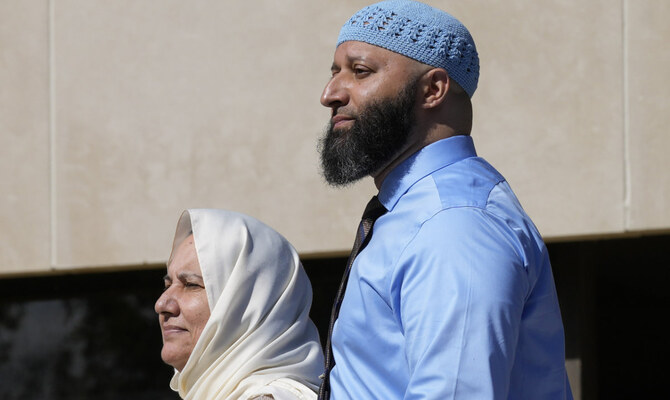
BALTIMORE: Despite documented problems with the evidence against him and an earlier request from prosecutors to clear his record, Adnan Syed will remain a convicted murderer, according to court papers filed Tuesday night.
The decision from Baltimore prosecutors comes ahead of a scheduled hearing Wednesday morning where a judge will consider whether to reduce Syed’s sentence, but this means the conviction itself is no longer in question.
It is the latest wrinkle in an ongoing legal odyssey that garnered a massive following after being featured in the “Serial” podcast over a decade ago.
Syed’s attorneys recently filed the request for a sentence reduction under Maryland’s Juvenile Restoration Act, a relatively new state law that provides a potential pathway to release for people serving long prison terms for crimes committed when they were minors. That request is supported by prosecutors.
Meanwhile, Baltimore State’s Attorney Ivan Bates announced Tuesday that his office is withdrawing a previously filed motion to vacate Syed’s conviction in the 1999 killing of his high school ex-girlfriend, Hae Min Lee, who was found strangled to death and buried in a makeshift grave.
“I did not make this decision lightly, but it is necessary to preserve the credibility of our office and maintain public trust in the justice system,” Bates said in a statement.
The original motion to vacate — which was filed by Bates’ predecessor Marilyn Mosby — won Syed his freedom in 2022. But his conviction was reinstated following a procedural challenge from Lee’s family. The Maryland Supreme Court ordered a redo of the conviction vacatur hearing after finding that the family didn’t receive adequate notice to attend in person.
Since the prosecutor’s office changed hands in the meantime, the decision of whether to withdraw the motion fell to Bates.
Instead of asking a judge to again consider Syed’s guilt or innocence, Bates chose a different path. He supported Syed’s motion for a reduced sentence — without addressing the underlying conviction.
Bates said that since his release in 2022, Syed has demonstrated he is a productive member of society whose continued freedom is “in the interest of justice.” He said the case “is precisely what legislators envisioned when they crafted the Juvenile Restoration Act.”
The legislation was passed amid growing consensus that such defendants are especially open to rehabilitation, partly because brain science shows cognitive development continues well beyond the teenage years. Syed was 17 when Lee was killed.
Now 43, he has been working at Georgetown University’s Prisons and Justice Initiative and caring for aging relatives since his release, according to court filings. His father died in October after a long illness.
Bates was facing a Friday deadline to decide on the motion to vacate.
After reviewing the motion filed by his predecessor, Bates concluded that it contained “false and misleading statements that undermine the integrity of the judicial process,” he said in a statement Tuesday.
Attorneys for the victim’s family had argued that prosecutors should address the integrity of Syed’s conviction before the court considered reducing his sentence. Prosecutors “should not be allowed to duck the issue by hiding behind” his motion for a reduced sentence, attorneys wrote in a recent filing.
Syed has maintained his innocence from the beginning, but many questions remain unanswered even after the “Serial” podcast combed through the evidence, reexamined legal arguments and interviewed witnesses. The series debuted in 2014 and drew millions of listeners who became armchair detectives.
Rife with legal twists and turns, the case has recently pitted criminal justice reform efforts against the rights of crime victims and their families, whose voices are often at odds with a growing movement to acknowledge and correct systemic racism, police misconduct and prosecutorial missteps.
When prosecutors sought to vacate Syed’s conviction in 2022, they cited numerous problems with the case, including alternative suspects and unreliable evidence presented at trial. A judge agreed to vacate the conviction and free Syed. Prosecutors in Mosby’s office later chose not to refile charges after they said DNA testing excluded Syed as a suspect.
Even though the appellate courts reinstated his conviction, they allowed Syed to remain free while the case continued.


![]()

Adnan Syed’s murder conviction still stands as he seeks sentence reduction in ‘Serial’ case
Short Url
https://arab.news/yytvm
Adnan Syed’s murder conviction still stands as he seeks sentence reduction in ‘Serial’ case
- Syed has maintained his innocence from the beginning, but many questions remain unanswered even after the “Serial” podcast combed through the evidence, reexamined legal arguments and interviewed witnesses


Latest updates


© 2026 SAUDI RESEARCH & PUBLISHING COMPANY, All Rights Reserved And subject to Terms of Use Agreement.