

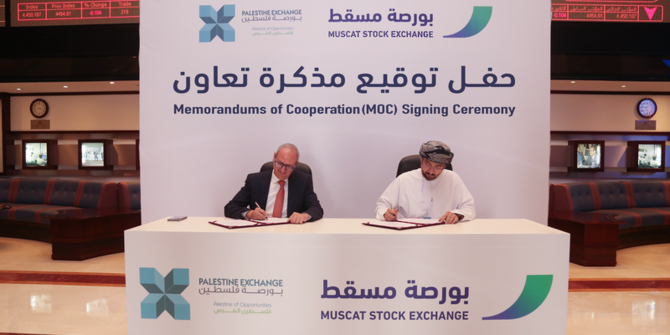

RIYADH: Muscat and Palestine’s stock exchanges have signed a cooperation agreement to enhance financial integration, facilitate cross-border investments, and bolster market access.
The memorandum of cooperation between the Muscat Stock Exchange and the Palestine Exchange outlines a framework for information sharing, dual listings, and broker participation, Oman News Agency reported.
The initiative is expected to strengthen both markets by improving operational efficiency and aligning financial disclosure practices with international standards.
While Oman-Palestine trade remains relatively small, the agreement reflects broader regional trends. As of 2023, Oman’s exports to Palestine totaled approximately $10.59 million, while imports stood at $145,770, according to the UN COMTRADE database.
The pact comes amid a record year for Arab stock markets, with Gulf Cooperation Council exchanges witnessing the highest initial public offering volumes on record in 2024 — 53 listings across the region, according to PwC’s latest market review.
The agreement was signed by Haitham bin Salem Al-Salmi, the CEO of Muscat Stock Exchange, and Nihad Kamal, the director general of Palestine Exchange.
The two sides emphasized the importance of the memorandum as a key milestone in enhancing financial integration between Arab stock exchanges and improving financial services in both markets.
They also highlighted the need to develop advisory services and offer specialized training programs for stock exchange employees and investors, thereby increasing knowledge of financial markets and trading mechanisms.
Additional collaboration will focus on governance and sustainability, as well as initiatives to improve financial literacy through educational and cultural programs.
Earlier this month, during a panel discussion at the Capital Markets Forum in Riyadh, Al-Salmi said Oman is working to elevate its market to Emerging Market status and is implementing various initiatives as part of Vision 2040.
He added that the exchange has begun aligning its market infrastructure with the required standards to enhance accessibility and attractiveness.
Al-Salmi also said that in 2024, Oman’s exchange was highly active in boosting liquidity and market capitalization, adding the exchange had two listings, one of which was the country’s largest IPO, adding $8 billion to the market.
Founded in 1995, PEX has been key to promoting investment in Palestine. It became a publicly traded company in 2010, making it the second Arab stock exchange fully privately owned. As of 2024, it lists 49 companies with a market cap of $4.3 billion but has been hit hard by the war in Gaza and West Bank restrictions.
PEX reported a 59 percent drop in net profit for 2024, down to $336,667 from $829,762 in 2023. Trading value fell 50 percent to $164 million, while the Al-Quds Index dropped 90 points or 15 percent.
In a press release earlier this month, Chairman Samir Hulileh attributed the losses to the ongoing conflict in Gaza and restrictions in the West Bank, citing a 28 percent economic contraction and a rise in unemployment to 51 percent.
Despite these setbacks, PEX remains listed in global financial indices, including FTSE Global, Morgan Stanley, and Standard & Poor’s Frontier Markets. The exchange aims to enhance financial disclosure, improve governance standards, and promote sustainability under the new partnership with MSX.


