
JEDDAH: Saudi Arabia has signed multiple deals to localize aerospace manufacturing, including aircraft maintenance, air taxis, vertical take-off and landing systems, and helicopter production.
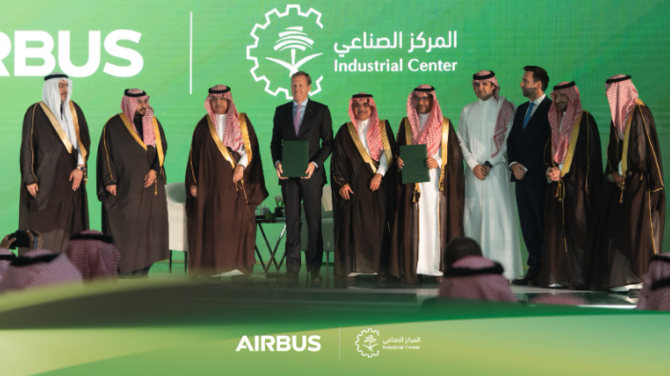
During the Aerospace Connect Forum, held in Jeddah from Feb. 24 to 25, the National Industrial Development Center signed a memorandum of understanding with European aerospace company Airbus to advance helicopter development and localization in the Kingdom.
This agreement, along with others, supports Saudi Vision 2030 by advancing aerospace localization and reinforcing its position as a global leader in the sector. It also aligns with the Kingdom’s broader aviation and industrial strategies, promoting local manufacturing, attracting investment, and reducing reliance on imports.
Additionally, these deals contribute to the General Authority for Military Industries’ goal of localizing 50 percent of military spending by 2030.
By partnering with global aerospace leaders, Saudi Arabia is fostering technological advancement, high-skilled jobs, and industrial growth.
The Industrial Center has also signed a MoU with Kingdom Aero Industries and Doroni, focusing on localizing and manufacturing light-sport aircraft with vertical takeoff and landing capabilities.
This partnership is a significant move for both parties as they aim to develop the H1-X flying car and strengthen Saudi Arabia’s position inthe aerospace sector.
US startup Doroni has secured a promising partnership with Innovation Wings Industries, operating as KAI in the Kingdom.
The deal involves a $30 million investment, with KAI contributing $5 million initially and up to $25 million over the next two years, in exchange for a 40 percent stake in Doroni.
This partnership is set to accelerate the development of the H1-X, with commercial-scale manufacturing planned in Saudi Arabia starting in 2027.
Both companies plan to establish a joint venture to manufacture and distribute the flying car globally.
For the startup, this represents a major step in realizing its vision, while for KAI, it offers the opportunity to create a world-class production hub in the Kingdom, supporting the nation’s aviation ambitions.
The NIDC also signed a deal with the Second Airport Cluster Co. to localize national industries in the aerospace sector by enabling and incentivizing investors by providing dedicated spaces within airports to establish specialized aircraft maintenance centers.
The strategic partnership represents a significant advancement in airport operations by uniting government efforts and fostering the localization of aircraft component manufacturing in the Kingdom, aligning with the National Aviation Strategy and the National Industry Strategy, according to Cluster2.
As part of the National Industrial Development and Logistics Program’s efforts to localize the manufacturing of titanium sponge metal-melting process pipes, the center signed an MoU with AIC STEEL and AMIC to strengthen local capabilities in advanced materials production and support industrial supply chains.
The NIDC also inked an agreement with Life Shield, a Saudi company with extensive experience in the defense, military, and security sectors.
Moreover, another deal was made with Auto Gyro, a firm which specializes in the innovation, production, and distribution of gyroplanes. These pacts focus on localization and technology transfer for manufacturing air taxis and helicopters.