SALFIT, West Bank: Order a Coke to wash down some hummus in the Israeli-occupied West Bank these days and chances are the waiter will shake his head disapprovingly – or worse, mutter “shame, shame” in Arabic – before suggesting the popular local alternative: a can of Chat Cola.
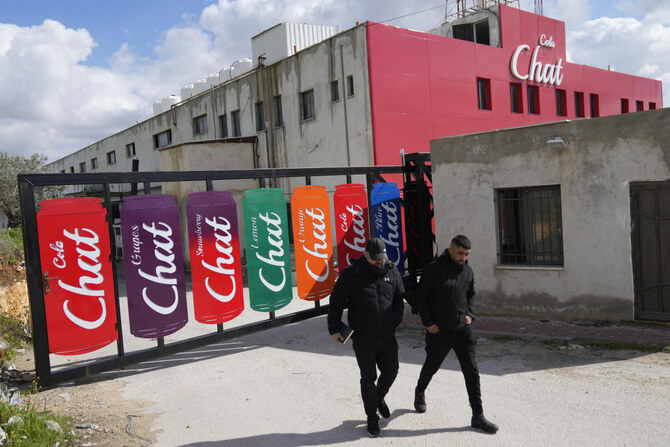
Chat Cola – its red tin and sweeping white script bearing remarkable resemblance to the iconic American soft drink’s logo – has seen its products explode in popularity across the occupied West Bank in the past year as Palestinian consumers, angry at America’s steadfast support for Israel in its war against Hamas in Gaza, protest with their pockets.
“No one wants to be caught drinking Coke,” said Mad Asaad, 21, a worker at the bakery-cafe chain Croissant House in the West Bank city of Ramallah, which stopped selling Coke after the war erupted. “Everyone drinks Chat now. It’s sending a message.”
Since Hamas’ Oct. 7, 2023, attack triggered Israel’s devastating military campaign in the Gaza Strip, the Palestinian-led boycott movement against companies perceived as supportive of Israel gained momentum across the Middle East, where the usual American corporate targets like McDonald’s, KFC and Starbucks saw sales slide last year.
Here in the West Bank, the boycott has shuttered two KFC branches in Ramallah. But the most noticeable expression of consumer outrage has been the sudden ubiquity of Chat Cola as shopkeepers relegate Coke cans to the bottom shelf – or pull them altogether.
“When people started to boycott, they became aware that Chat existed,” Fahed Arar, general manager of Chat Cola, said from the giant, red-painted factory, nestled in the hilly West Bank town of Salfit. “I’m proud to have created a product that matches that of a global company.”
With the “buy local” movement burgeoning during the war, Chat Cola said its sales in the West Bank surged more than 40 percent last year, compared to 2023.
While the companies said they had no available statistics on their command of the local market due to the difficulties of data collection in wartime, anecdotal evidence suggests Chat Cola is clawing at some of Coca-Cola’s market share.
“Chat used to be a specialty product, but from what we’ve seen, it dominates the market,” said Abdulqader Azeez Hassan, 25, the owner of a supermarket in Salfit that boasts fridges full of the fizzy drinks.
But workers at Coca-Cola’s franchise in the West Bank, the National Beverage Company, are all Palestinian, and a boycott affects them, too, said its general manager, Imad Hindi.
He declined to elaborate on the business impact of the boycott, suggesting it can’t be untangled from the effects of the West Bank’s economic free-fall and intensified Israeli security controls that have multiplied shipping times and costs for Palestinian companies during the war.
The Coca-Cola Company did not respond to a request for comment.
Whether or not the movement brings lasting consequences, it does reflect an upsurge of political consciousness, said Salah Hussein, head of the Ramallah Chamber of Commerce.
“It’s the first time we’ve ever seen a boycott to this extent,” Hussein said, noting how institutions like the prominent Birzeit University near Ramallah canceled their Coke orders. “After Oct. 7, everything changed. And after Trump, everything will continue to change.”
President Donald Trump’s call for the mass expulsion of Palestinians from Gaza, which he rephrased last week as a recommendation, has further inflamed anti-American sentiment around the region.
With orders pouring in not only from Lebanon and Yemen but also the United States and Europe, the company has its sights set on the international market, said PR manager Ahmad Hammad.
Hired to help Chat Cola cash in on combustible emotions created by the war, Hammad has rebranded what began in 2019 as a niche mom-and-pop operation.
“We had to take advantage of the opportunity,” he said of the company’s new “Palestinian taste” logo and national flag-hued merchandise.
In its scramble to satisfy demand, Chat Cola is opening a second production site in neighboring Jordan. It rolled out new candy-colored flavors, like blueberry, strawberry and green apple.
At the steamy plant in Salfit, recent college graduates in lab coats said that they took pains to produce a carbonated beverage that could sell on its taste, not just a customer’s sense of solidarity with the Palestinians.
“Quality has been a problem with local Palestinian products before,” said Hanna Al-Ahmad, 32, the head of quality control for Chat Cola, shouting to be heard over the whir of machines squirting caramel-colored elixir into scores of small cans that then whizzed down assembly lines. “If it’s not good quality, the boycott won’t stick.”
Chat Cola worked with chemists in France to produce the flavor, which is almost indistinguishable from Coke’s – just like its packaging. That’s the case for several flavors: Squint at Chat’s lemon-lime soda and you might mistake it for a can of Sprite.
In 2020, the Ramallah-based National Beverage Company sued Chat Cola for copyright infringement in Palestinian court, contending that Chat had imitated Coke’s designs for multiple drinks. The court ultimately sided with Chat Cola, determining there were enough subtle differences in the can designs that it didn’t violate copyright law.
In the Salfit warehouse, drivers loaded “family size” packages of soda into trucks bound not only for the West Bank but also for Tel Aviv, Haifa and other cities in Israel. Staffers said that Chat soda sales in Israel’s predominantly Arab cities jumped 25 percent last year. To broaden its appeal in Israel, Chat Cola secured kosher certification after a Jewish rabbi’s thorough inspection of the facility.
Still, critics of the Palestinians-led Boycott, Divestment and Sanctions movement, or BDS, say that its main objective – to isolate Israel economically for its occupation of Palestinian lands – only exacerbates the conflict.
“BDS and similar actions drive communities apart, they don’t help to bring people together,” said Vlad Khaykin, the executive vice president of social impact and partnerships in North America for the Simon Wiesenthal Center, a Jewish human rights organization. “The kind of rhetoric being embraced by the BDS movement to justify the boycott of Israel is really quite dangerous.”
While Chat Cola goes out of its way to avoid buying from Israel – sourcing ingredients and materials from France, Italy and Kuwait – it can’t avoid the circumstances of Israeli occupation, in which Israel dominates the Palestinian economy, controls borders, imports and more.
Deliveries of raw materials to Chat Cola’s West Bank factory get hit with a 35 percent import tax – half of which Israel collects on behalf of the Palestinians. The general manager, Arar, said his company’s success depends far more on Israeli bureaucratic goodwill than nationalist fervor.
For nearly a month last fall, Israeli authorities detained Chat’s aluminum shipments from Jordan at the Allenby Bridge Crossing, forcing part of the factory to shut down and costing the company tens of thousands of dollars.
Among the local buyers left in the lurch was Croissant House in Ramallah, where, on a recent afternoon, at least one thirsty customer, confronting a nearly empty refrigerator, slipped to the supermarket next-door for a can of Coke.
“It’s very frustrating,” said Asaad, the worker. “We want to be self-sufficient. But we’re not.”


![]()

Anti-US sentiment bubbling up in the West Bank bolsters demand for a local Coke-alternative
Short Url
https://arab.news/z3vgm
Anti-US sentiment bubbling up in the West Bank bolsters demand for a local Coke-alternative
- Chat Cola has seen its products explode in popularity across the occupied West Bank in the past year
- Palestinian consumers, angry at America’s steadfast support for Israel, protested with their pockets


Latest updates


Recommended


© 2026 SAUDI RESEARCH & PUBLISHING COMPANY, All Rights Reserved And subject to Terms of Use Agreement.