

Boycott campaigns over Gaza war hit Western brands

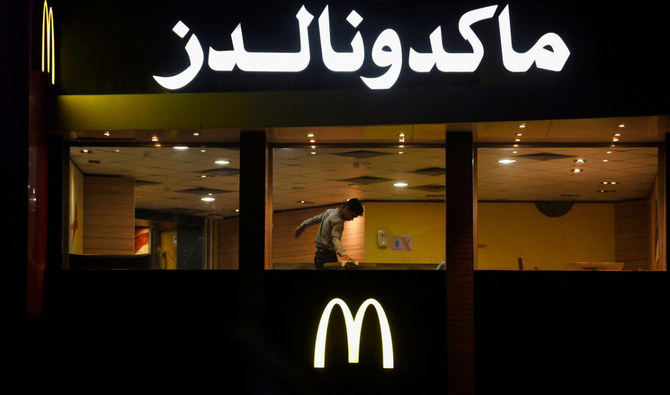
A worker cleans a table in an empty McDonald’s restaurant as a result of the boycott of Western brands in Egypt due to the Israeli bombardment in Gaza, in Cairo, Egypt, November 20, 2023. (Reuters)
Short Url
Updated 23 November 2023
Follow

Boycott campaigns over Gaza war hit Western brands

CAIRO: Midway through a recent evening in Cairo, a worker cleaned tables in an empty McDonald’s restaurant. Branches of other Western fast-food chains in the Egyptian capital also appeared deserted.

All have been hit by a boycott campaign over Israel’s military offensive in the Gaza Strip.

Western brands are feeling the impact in Egypt and Jordan, and there are signs the campaign is spreading in some other Arab countries including Kuwait and Morocco.

Some of companies the campaign is directed at are perceived to have taken pro-Israeli stances, and some are alleged to have financial ties to Israel or investments there.

As the campaign has started to spread, boycott calls circulated on social media have expanded to list dozens of companies and products, prompting shoppers to shift to local alternatives.

In Egypt, where there is little chance of people taking to the streets because of security restrictions, some see the boycott as the best or only way to make their voices heard.

“I feel that even if I know this will not have a massive impact on the war, then this is the least we can do as citizens of different nations so we don’t feel like our hands are covered in blood,” said 31-year-old Cairo resident Reham Hamed, who is boycotting US fast food chains and some cleaning products.

In Jordan, pro-boycott residents sometimes enter McDonald’s and Starbucks branches to encourage scarce customers to take their business elsewhere. 

Videos have circulated of what appear to be Israeli troops washing clothes with well-known detergent brands which viewers are urged to boycott.

“No one is buying these products,” said Ahmad Al-Zaro, a cashier at a large supermarket in the capital Amman where customers were choosing local brands instead.

In Kuwait City, a tour of seven branches of Starbucks, McDonald’s and KFC found them nearly empty. A worker at one Starbucks  said other US brands had also been affected.


Lebanon PM says IMF wants rescue plan changes as crisis deepens

Updated 4 sec ago
Follow

Lebanon PM says IMF wants rescue plan changes as crisis deepens

  • “We want to engage with the IMF. We want to improve. This is a draft law,” Salam said
  • “They wanted the hierarchy of claims to be clearer. The talks are all positive”

DAVOS, Switzerland: The International Monetary Fund has demanded amendments to a draft rescue law aimed at hauling Lebanon out of its worst financial crisis on record and giving depositors access to savings frozen for six years, Prime Minister Nawaf Salam said.
The “financial gap” law is part of a series of reform measures required by the IMF in order to access its funding and aims to allocate the losses from Lebanon’s 2019 crash between the state, the central bank, commercial banks and depositors.
Salam told Reuters the IMF wants clearer provisions in the hierarchy of claims, which is a core element of the draft legislation designed to determine how losses are allocated.
“We want to engage with the IMF. We want to improve. This is a draft law,” Salam said in an interview at the World Economic Forum annual meeting in ⁠the Swiss mountain resort of Davos.
“They wanted the hierarchy of claims to be clearer. The talks are all positive,” Salam added.
In 2022, the government put losses from the financial crisis at about $70 billion, a figure that analysts and economists forecast is now likely to be higher.
Salam stressed that Lebanon is still pushing for a long-delayed IMF program, but warned the clock is ticking as the country has already been placed on a financial ‘grey list’ and risks falling onto the ‘blacklist’ if reforms stall further.
“We want an IMF program and we want to continue our discussions until we get there,” he said, adding: “International pressure is real ... The longer we delay, the more people’s money will evaporate.”
The draft law, which was passed by Salam’s government in December, is under parliamentary review. It aims to give depositors a guaranteed path to recovering their funds, restart bank lending, and end a financial crisis that has left nearly a million accounts frozen and confidence in the system shattered.
The roadmap would repay depositors up to $100,000 over four years, starting with smaller accounts, while launching forensic audits to determine losses and responsibility.
Lebanon’s Finance Minister Yassine Jaber, who is driving the reform push with Salam, told Reuters it was ⁠essential to salvage a hollowed-out banking system, and to stop the country from sliding deeper into its cash-only, paralyzed economy.
The aim, Jaber said, is to give depositors clarity after years of uncertainty and to end a system that has crippled Lebanon’s international standing.
He framed the law as part of a broader reckoning: the first time a Lebanese government has confronted a combined collapse of the banking sector, the central bank and the state treasury.
Financial reforms have been repeatedly derailed by political and private vested interests over the last six years and Jaber said the responsibility now lies with lawmakers.
Failure to act, he said, would leave Lebanon trapped in “a deep, dark tunnel” with no way back to a functioning system.
“Lebanon has become a cash economy, and the real question is whether we want to stay on the grey list, or sleepwalk into a blacklist,” Jaber added.