

Syria economy minister discusses resuming cooperation with World Bank

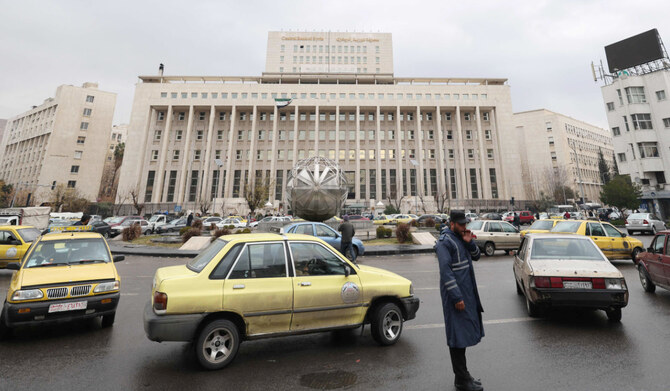
A Syrian officer directs traffic past the Central Bank building in Sabaa Bahrat Square in the capital Damascus on December 29, 2024. (AFP)
Short Url
Updated 25 February 2025
Follow

Syria economy minister discusses resuming cooperation with World Bank

  • The World Bank had previously supported Syria with technical assistance and development advice, but suspended all of its operations after the civil war broke out in 2011

DAMASCUS: Syria’s economy minister sat down with the Middle East director of the World Bank on Monday to discuss resuming cooperation with the lender, which was suspended under the toppled government of Bashar Assad, state media reported.
Since ousting Assad in December, Syria’s new rulers have been trying to restore ties to international institutions to support the country’s reconstruction and revive its sanctions-hit economy.
“The minister of economy, Mr. Bassel Abdel Hanan, discussed with World Bank’s director for the Middle East, Jean-Christophe Carret, the resumption of relations between the bank and Syria as well as the prospects for their development,” the official SANA news agency said.
Abdel Hanan proposed the establishment of a “joint committee between the ministry and the bank to evaluate a new start.”
He added that “the nature of the financing granted by the bank will determine the type of projects that will be financed,” pointing to the energy, agriculture, industry and infrastructure sectors in particular, SANA said.
Abdel Hanan also said there was a need for “loans to manufacturers whose facilities have been destroyed so they can resume their activities, and raised the possibility of creating an investment fund to support industry, provided the (bank) offers sanctions in this area.”
The World Bank had previously supported Syria with technical assistance and development advice, but suspended all of its operations after the civil war broke out in 2011.
Since the fall of Assad, Syria has been urging the international community to drop sanctions imposed on the former government.
The European Union on Monday eased sanctions on the energy, transport and banking sectors in a bid to help the country’s reconstruction.
Syrian Foreign Minister Asaad Al-Shaibani called the move “a step toward alleviating the suffering of our people.”
A UN report published last week found that 90 percent of Syrians live in poverty — three times as many as before the war — while 75 percent rely on humanitarian aid.
The country is expected to form a transitional cabinet on March 1.


Baghdad traders protest new customs tariffs

Iraqi traders protest against the imposition of customs duties on imported goods in Baghdad, Iraq, Sunday, Feb. 8, 2026. (AP)
Updated 4 sec ago
Follow

Baghdad traders protest new customs tariffs

  • The demonstrators gathered outside the General Customs Directorate on Sunday, chanting slogans against corruption and rejecting the new fees

BAGHDAD: Hundreds of traders and owners of customs clearance companies protested in central Baghdad on Sunday, demanding that Iraq’s government reverse recently imposed customs tariffs they say have sharply increased their costs and disrupted trade.
The new tariffs that took effect on Jan. 1 were imposed to reduce the country’s debt and reliance on oil revenues, as oil prices have fallen.
Iraq faces a debt of more than 90 trillion Iraqi dinars ($69 billion) — and a state budget that remains reliant on oil for about 90 percent of revenues, despite attempts to diversify.
But traders say the new tariffs — in some cases as high as 30 percent — have placed an unfair burden on them. Opponents have filed a lawsuit aiming to reduce the decision, which Iraq’s Federal Supreme Court is set to rule on Wednesday.
The demonstrators gathered outside the General Customs Directorate on Sunday, chanting slogans against corruption and rejecting the new fees.
“We used to pay about 3 million dinars per container, but now in some cases they ask for up to 14 million,” said Haider Al-Safi, a transport and customs clearance company owner. 
“Even infant milk fees rose from about 495,000 dinars to nearly 3 million.”
He said that the new tariffs have caused a backlog of goods at the Umm Qasr port in southern Iraq and added that electric vehicles, previously exempt from customs duties, are now subject to a 15 percent fee.
“The main victim is the citizen with limited income, and government employee whose salary barely covers his daily living, those who have to pay rent, and have children with school expenses — they all will be affected by the market,” said Mohammed Samir, a wholesale trader from Baghdad.
Protesters also accused influential groups of facilitating the release of goods in exchange for lower unofficial payments, calling it widespread corruption. 
Many traders, they said, are now considering routing their imports through the Kurdistan region, where fees are lower.
The protests coincided with a nationwide strike by shop owners, who closed markets and stores in several parts of Baghdad to oppose the tariff increase. 
In major commercial districts, shops remained shut and hung up banners reading “Customs fees are killing citizens.”